Why “Best AI Coaching” Is So Confusing Right Now
Managers have quietly become the most overloaded role in modern organizations. They’re expected to coach performance, navigate constant change, support well-being, align teams, and still deliver results, often with fewer resources and less support than ever before.
At the same time, the skills required to lead effectively are changing faster than traditional learning and development models can keep up with. What used to last years now becomes outdated in months.
As a result, the demand for coaching has surged. Organizations want scalable ways to help managers give better feedback, handle difficult conversations, adapt their leadership style, and support their teams through ongoing uncertainty.
Human coaching remains deeply valuable—but it doesn’t scale easily, it’s expensive, and it’s often episodic rather than continuous. This gap has created the conditions for AI coaching to grow rapidly.
Over the past few years, “AI coaching” has gone from a niche concept to a crowded market category almost overnight. New tools promise on-demand guidance, personalized insights, and measurable behavior change at scale. For HR, L&D, and People leaders, that sounds like exactly what’s needed. But it has also created a new problem: clarity.
Today, the term “AI coaching” is used to describe tools that do fundamentally different things. Some focus on conversation and reflection. Others emphasize skill practice or simulations. Others layer AI onto traditional coaching programs.
A small number aim to support managers and teams continuously, inside the flow of work. When all of these approaches are grouped together under a single label, comparison becomes difficult—and most “best of” lists become hard to interpret and easy to misapply.
This is why answers to the question “What is the best AI coaching platform?” vary so widely. The disagreement isn’t just about vendors or features; it’s about definitions. Before it’s possible to meaningfully evaluate platforms, the category itself needs to be clarified.
Before considering any tools, it defining what AI coaching can mean, explaining why different approaches exist, and establishing a clear framework for evaluating platforms, especially for organizations focused on supporting managers and teams at scale.
Get the free guide to close your leadership development gap and build the trust, collaboration, and skills your leaders need to thrive.
What Is an AI Coaching Platform?
Before comparing tools, it’s important to establish a shared baseline. Without one, “AI coaching” becomes a catch-all label applied to products with very different purposes, designs, and outcomes.
At its most neutral level:
An AI coaching platform uses artificial intelligence to support learning, reflection, or behavior change at work — often through conversation, guidance, or practice — at a scale that human-only coaching cannot reach.
This definition is intentionally broad. It captures what these tools have in common without assuming how coaching is delivered, what level it operates at, or what outcomes it prioritizes. Those differences matter—and they’re where most confusion begins.
Why AI Coaching Has Exploded in the Workplace
Several converging pressures have accelerated the adoption of AI coaching inside organizations.
Managers have become the primary multiplier of performance and culture.
Organizations increasingly rely on managers to drive engagement, retention, development, and execution. Yet most managers receive limited, inconsistent support themselves—especially once they move beyond formal training programs.
Work is distributed, fast-moving, and harder to coordinate.
Hybrid and remote work have reduced informal learning moments while increasing the complexity of communication and collaboration. Leaders need support that travels with them into meetings, messages, and real decisions—not something that lives in a separate system.
L&D and HR teams face tighter budgets and higher expectations.
Traditional coaching and training models are resource-intensive and difficult to scale. At the same time, organizations are under pressure to show measurable impact from development investments.
There is growing demand for learning during work, not outside of it.
Managers rarely need more courses or content libraries. They need timely guidance, perspective, and reinforcement in the moments where behavior actually matters.
AI coaching has emerged as a response to these realities. In theory, it offers personalized support, continuous availability, and scalability that human-only models struggle to provide.
Why “AI Coaching” Why “AI Coaching” Has Become a Catch-All Category
While the demand is real, the category itself has become blurred.
Today, platforms labeled “AI coaching” often prioritize very different things:
- Some emphasize conversation, offering chat-based reflection, prompts, or advice.
- Others emphasize practice, using simulations or role-play to rehearse specific skills.
- Others emphasize human coaching at scale, using AI to match, augment, or extend traditional coaching programs.
- A smaller number emphasize team-level, contextual behavior change, focusing on relationships, roles, timing, and reinforcement inside real work.
All of these approaches can be useful. But they are not interchangeable.
When tools built for different purposes are grouped together under a single label, comparisons become misleading. This is why one “best AI coaching” list may prioritize conversational depth, another may highlight simulation realism, and another may focus on access to human coaches.
Understanding these distinctions is the first step toward evaluating platforms meaningfully—especially for organizations looking to support managers and teams, not just individuals in isolation.
The 3 Types of AI Coaching Platforms
Before evaluating specific platforms, it’s essential to reset the mental model. Most confusion around “best AI coaching” doesn’t come from vendor claims—it comes from comparing tools that were never designed to solve the same problem.
Broadly, today’s AI coaching platforms fall into three distinct categories.
Conversational AI Coaches
Conversational AI coaches are chat-first experiences designed to support reflection, journaling, and exploratory thinking. Users interact with them much like they would with a digital thought partner—asking questions, describing challenges, or seeking perspective.
These tools are typically reactive: the user initiates the interaction, frames the situation, and controls the depth and direction of the conversation.
Where they’re strong
- Low friction and easy to adopt
- Available on demand, at any time
- Useful for personal reflection, self-awareness, and mindset work
For individuals who want a private space to think through challenges or build reflective habits, conversational AI can be genuinely helpful.
Where they could lack
- They understand only what the user explicitly shares
- Coaching is centered on the individual, not the team
- There is no inherent awareness of relationships, roles, power dynamics, or timing
Because these tools lack visibility into how work actually happens, they struggle to support real-time behavior change in complex, team-based environments.
Examples:
- AI well-being or leadership chatbots
- General-purpose AI adapted for coaching-style prompts
Skill & Scenario-Based AI Coaching
Skill and scenario-based AI coaching tools focus on practice. They simulate specific situations—such as giving feedback, handling conflict, or navigating a sales conversation—and allow users to rehearse responses through role-play or structured scenarios.
These platforms are often tied to clearly defined moments and skills, with a strong emphasis on repetition and performance.
Where they’re strong
- Excellent for rehearsal and confidence-building
- Clear, short-term outcomes tied to specific skills
- Particularly effective for conversation-heavy roles
For organizations trying to close the gap between “knowing” and “doing” in specific situations, these tools can deliver real value.
Scenario simulation and role-play are valuable tools — but they are not coaching systems on their own.
Coaching requires longitudinal context, relationship awareness, and reinforcement over time, not just practice in isolated moments.
This distinction matters. Practice is one component of coaching, but without continuity and context, its impact is often limited.
Where they could lack
- Narrow scope focused on individual skills
- Limited transfer to broader team behavior and dynamics
- Often disconnected from live workflow context and timing
Examples
- Exec
- Retorio
- Other simulation-first platforms
Context-Aware AI Coaching for Teams
This third category represents a fundamentally different approach—and the one most relevant for organizations focused on managers and teams.
Context-aware AI coaching platforms are designed to understand not just individuals, but teams. That includes relationships, roles, interaction patterns, timing, and the moments that actually shape behavior at work.
Rather than operating as separate applications, these systems integrate into calendars, collaboration tools, and communication workflows where managerial decisions and interactions actually occur.
Defining characteristics
- Grounded in behavioral science, not just language models
- Aware of team structure and relationships, not just users
- Embedded in collaboration tools, calendars, and daily workflows
- Proactive—surfacing guidance before critical moments
- Designed to support managers and teams continuously
This category exists because sustained behavior change does not happen in isolation.
Coaching that drives real impact at scale must account for context—who is involved, what’s happening, and when support is needed. Without that, even the most sophisticated AI risks becoming just another tool managers have to remember to use.
What Is Context-Aware AI Coaching?
Before any platform can be meaningfully evaluated, there needs to be a clear standard. Without one, comparisons default to surface-level features—chat quality, number of scenarios, or access to human coaches—rather than the underlying system that actually drives behavior change.
Context-aware AI coaching is best understood not as a feature set, but as a coaching model. The criteria below define that model and serve as the evaluation logic for the platforms discussed later in this article.
The Limits of Prompt-Driven and Individual-Only AI Coaching
Many early AI coaching tools represent an important step forward—but they also reveal consistent limitations when applied to real-world management and team environments.
Most rely on prompt-only understanding. They respond based on what a user chooses to share in the moment, without awareness of what’s happening around them or between people. This places the full burden of context on the user, who may not see their own blind spots.
They tend to operate from an individual-only perspective. Even when the challenge involves team dynamics, power differences, or cross-functional tension, the coaching logic treats the user as an isolated unit rather than part of a system.
Delivery is typically reactive. Help arrives after someone asks for it—often once a situation has already escalated or a key moment has passed.
Finally, many tools lack a true reinforcement loop. Insight may be generated, but there is little follow-up, repetition, or accountability to support sustained behavior change over time.
These gaps don’t make traditional AI coaching “wrong.” They simply reflect an earlier stage of evolution—one that works for reflection and practice, but struggles to support managers and teams continuously in real work.
The Five Criteria That Define Context-Aware AI Coaching
The following five criteria define context-aware AI coaching at a system level. Each is written to stand on its own, because effective coaching depends on how these elements work together—not on any single feature in isolation.
Criterion 1: Behavioral Science Foundation
A context-aware AI coaching platform is grounded in validated behavioral science, not just language patterns or sentiment analysis.
This means it draws on established models of personality, motivation, communication, and behavior to inform its guidance. Rather than inferring meaning solely from text, it anchors insights in how people actually behave, react, and interact over time.
The result is coaching that is more consistent, explainable, and relevant—especially in complex interpersonal situations where tone, intent, and impact often diverge.
Criterion 2: Team-Level Intelligence
Context-aware AI coaching operates at the team level, not just the individual level.
It understands relationships, roles, and interaction patterns—who works with whom, where friction or misalignment may exist, and how dynamics shift depending on context. Coaching is designed to happen between people, not only within individuals.
This team-level intelligence reduces blind spots and echo chambers by surfacing perspectives the user may not naturally see, helping managers navigate the realities of collaboration rather than idealized scenarios.
Criterion 3: Workflow Context Awareness
Effective coaching depends on timing. Context-aware AI coaching is aware of when guidance matters, not just what to say.
This requires visibility into meetings, roles, and moments that shape outcomes—such as upcoming conversations, feedback cycles, or decision points. Coaching is delivered in proximity to real work, supporting learning in the flow of work rather than as a separate activity.
By aligning guidance with actual moments of need, coaching becomes easier to apply and less cognitively demanding.
Criterion 4: Proactive Coaching Delivery
Context-aware AI coaching is proactive, not merely responsive.
Instead of waiting for users to ask for help, it surfaces insights, nudges, and reminders ahead of key moments. It reinforces behaviors over time through small, timely interventions that fit naturally into existing workflows.
This approach reduces cognitive load by removing the need to remember another tool or process, making coaching support feel like part of work rather than an additional task.
Criterion 5: Awareness + Accountability Loop
Sustained behavior change requires more than insight alone.
Context-aware AI coaching creates an awareness + accountability loop: it helps people see what they couldn’t see before, and then supports follow-through through reinforcement, repetition, and reflection over time.
This loop enables learning to stick. It supports measurable behavior change by connecting insight to action, and action to reinforcement—rather than treating coaching as a one-time interaction.
Together, these five criteria define what context-aware AI coaching is—and what it is not. They form the standard against which platforms can be evaluated, especially for organizations seeking to support managers and teams continuously, at scale, and inside the realities of daily work.
Best AI Coaching Platforms for Managers & Teams (2026)
The platforms below are among the most commonly evaluated AI coaching solutions for managers and teams. Each is assessed based on how closely it aligns with the principles of context-aware AI coaching.
This section applies the evaluation standard defined earlier. The goal is not to rank tools by features or popularity, but to clarify how different platforms approach coaching—and where they align (or don’t) with team-level, context-aware behavior change.
Cloverleaf: Context-Aware AI Coaching for Managers & Teams
Cloverleaf is designed specifically for team-level, context-aware coaching delivered in the flow of work. Its core model focuses on understanding people in relation to one another and delivering timely guidance where real work happens—before, during, and after moments that shape behavior.
While Cloverleaf is frequently used alongside executive coaches and leadership programs, its core value is a context-aware AI coaching tool that supports teams continuously, not a marketplace or scheduling layer for coaching sessions.
How Cloverleaf aligns with the five criteria
- Behavioral science foundation: Cloverleaf grounds coaching in validated assessments and established models of personality, communication, and strengths—providing explainable, durable insights rather than relying on language analysis alone.
- Team-level intelligence: The platform understands relationships and dynamics across teams, enabling coaching that happens between people, not just within individuals.
- Workflow context awareness: By integrating with calendars and collaboration tools, Cloverleaf delivers guidance in proximity to real meetings, conversations, and decisions.
- Proactive coaching delivery: Coaching is surfaced before key moments through nudges and insights, reducing the need for managers to remember to “go get coached.”
- Awareness + accountability loop: Insights are reinforced over time through feedback, repetition, and reflection, supporting sustained behavior change rather than one-off advice.
→ Compare AI coaching platforms for managers & teams
BetterUp Grow™: AI-Augmented Human Coaching Programs
BetterUp Grow™ extends a long-standing human coaching model with AI-enabled support. Its primary strength lies in access to a broad network of certified coaches and structured development programs.
- Coaching is primarily delivered through scheduled human-led sessions
- AI supports reflection, progress tracking, and program insights
- Team context and real-time workflow signals play a more limited role between sessions
This approach can be effective for organizations prioritizing individualized, session-based coaching at scale, particularly where human coach relationships are central to the experience.
CoachHub AIMY™: Goal-Oriented Conversational AI Coaching
CoachHub’s AIMY™ is a conversational AI coach designed to complement its global human coaching programs.
- Strong multilingual and global coverage
- Emphasis on goal-setting, reflection, and progress tracking
- Coaching interactions are largely conversation-driven
- Less emphasis on live team dynamics, relationships, or workflow timing
This model suits organizations looking to extend access to coaching conversations across regions, particularly as part of broader human-led initiatives.
Valence (Nadia): Persona AI Coaching
Valence’s conversational AI coach focuses on providing empathetic, manager-oriented guidance through dialogue.
- Support delivered primarily through conversational interaction
- Less depth in validated psychometrics and team-level context
This approach can be helpful for individual manager reflection, though it places less emphasis on relationship-aware, in-flow coaching across teams.
More AI Coaching Tools in the Market
Some platforms, including hybrid coaching marketplaces and simulation-first tools, combine human coaches, AI assistants, or practice environments. While valuable, these platforms typically rely on scheduled interactions, individual inputs, or isolated scenarios, rather than continuous, context-aware team coaching.
The tools below represent common alternative approaches within the broader AI coaching landscape:
Coachello
A hybrid coaching platform that combines certified human coaches with an AI assistant embedded in collaboration tools. Coachello emphasizes leadership development through scheduled coaching sessions, supported by AI-driven reflection, role-play, and analytics between sessions.
Hone
A leadership development platform that blends live, instructor-led training with AI-supported practice and reinforcement. Hone focuses on cohort-based learning experiences, simulations, and skill application following structured workshops.
Exec
A simulation-first AI coaching platform designed for conversation practice. Exec specializes in voice-based role-play and scenario rehearsal to help individuals build confidence and execution skills for high-stakes conversations.
Retorio
An AI-powered behavioral analysis platform that uses video-based simulations to assess communication effectiveness, emotional signals, and non-verbal behavior. Retorio is often used for practicing leadership, sales, or customer-facing interactions.
Rocky.ai
A conversational AI coaching app focused on individual reflection, habit-building, and personal development. Rocky.ai delivers daily prompts and structured self-coaching journeys through a chat-based experience.
These solutions can play meaningful roles within specific coaching or training strategies. However, they are generally designed around sessions, simulations, or individual practice, rather than sustained, team-level coaching delivered continuously in the flow of work.
See Cloverleaf’s AI Coaching in Action
How to Choose the Right AI Coaching Platform
Once the category distinctions are clear, the decision becomes less about feature checklists and more about intent. The most useful way to evaluate AI coaching platforms is to ask a small number of system-level questions that reveal how a platform is designed to create behavior change.
Is coaching strictly prompt-based or context-aware too?
Start by understanding what drives the coaching interaction.
Prompt-based tools rely on the user to initiate coaching, describe the situation, and frame the problem. The quality of guidance depends almost entirely on what the user chooses to share in the moment.
Context-aware systems, by contrast, use signals from roles, relationships, timing, and workflow to inform coaching automatically. Guidance is surfaced based on what’s happening, not just what’s asked.
This distinction determines whether coaching is occasional and reactive, or continuous and embedded.
Does it solely support individuals or understand team dynamics too?
Many AI coaching tools are designed for individual growth in isolation. That can be valuable, but it doesn’t reflect how work actually happens.
Teams are the unit of performance. Managers succeed or fail based on how well they navigate relationships, communication patterns, and shared accountability. Platforms that support intact teams can coach between people, helping managers see dynamics, not just self-improvement opportunities.
Ask whether the platform understands and supports teams as systems, or only individuals as users.
Is coaching delivered in the flow of work?
Where coaching shows up matters as much as what it says.
Platforms that live outside daily workflows require managers to stop, switch contexts, and remember to engage. In practice, this limits adoption and follow-through.
Flow-of-work coaching is embedded where work already happens; meetings, messages, planning, and collaboration. It meets managers in real moments, reducing friction and increasing relevance.
Does it only create awareness or accountability too?
Insight alone rarely changes behavior.
Effective coaching helps people see what they couldn’t see before and supports follow-through over time. That requires reinforcement, repetition, and reminders.
Look for systems that create an awareness + accountability loop, connecting insight to action and action to sustained behavior change.
How is behavior change measured over time?
Finally, ask how success is defined and measured.
Many tools report usage metrics: logins, sessions, or interactions. Fewer measure whether behavior actually changes, especially in ways that matter to teams and organizations.
Strong platforms track patterns over time, linking coaching insights to observable shifts in behavior, communication, or team effectiveness. Without this, it’s difficult to distinguish meaningful impact from activity.
Taken together, these questions cut through category confusion. They help clarify not just which platform looks most impressive, but which one aligns with how your organization defines coaching, and what kind of change you’re actually trying to create.
Which AI Coaching Platform Is “Best” Depends on Your Definition
If you’ve searched for “best AI coaching platform” and found wildly different answers, you’re not imagining it. Most disagreement comes from the fact that people are using the word coaching to mean different things.
Here’s the simplest way to interpret the market:
- If you define coaching as chat-based help (reflection, advice, journaling, on-demand Q&A), many tools qualify. The “best” option often comes down to usability, tone, and how well it supports individual reflection.
- If you define coaching as skill rehearsal (role-play, simulations, scenario practice, immediate feedback), fewer tools qualify—because the platform has to create structured practice experiences, not just conversation. These tools can be excellent for preparing for specific moments.
- If you define coaching as team-level behavior change (relationship-aware, context-aware, delivered in the flow of work, reinforced over time), very few tools qualify, because the platform must operate as a system: understanding dynamics, surfacing guidance at the right moments, and supporting follow-through beyond isolated interactions.
In other words, the “best” platform isn’t a universal winner. It’s the one that best matches what you mean by coaching, and what kind of change you’re actually trying to drive.
The Future of AI Coaching: Contextual, Embedded, and Continuous
The future of AI coaching is not defined by more prompts, more dashboards, or more simulated conversations.
It is defined by coaching that operates in context, is embedded where work happens, and supports behavior change continuously over time.
The most effective AI coaching will operate as infrastructure rather than a standalone tool: activating automatically based on context, integrating into existing workflows, and disengaging when guidance is not needed.
AI should reduce managerial cognitive load and friction, enabling leaders to spend more time on judgment, relationships, and decision-making rather than managing tools or processes.
Context matters more than content because effective coaching depends on timing, relationships, and situational awareness—not generic advice delivered without understanding who is involved or what is happening.
Teams, not individuals, are the true unit of performance.
Most leadership challenges are not personal skill gaps; they’re relational and systemic. Coaching that ignores team dynamics can only go so far.
The trajectory of AI coaching is increasingly clear: systems are moving away from standalone interactions and toward continuous, context-aware support that is embedded directly into daily work.
U.S. businesses lose an estimated $1.2 trillion every year due to poor communication, with ineffective workplace interactions costing companies an average of $12,506 per employee annually (Grammarly & Harris Poll, 2022).
Despite massive investments in soft skills training, teams forget 90% of what they learn without proper reinforcement (GP Strategies, 2024). Meanwhile, 46% of employees regularly receive confusing or unclear requests, spending around 40 minutes daily trying to decode directions (HR Magazine, 2024).
But the core issue isn’t that power skills are ineffective.
They work — communication, collaboration, adaptability, and emotional intelligence consistently predict performance.
The real issue is how organizations try to develop them.
Most training treats power skills as universal:
“Be clear.”
“Adapt to change.”
“Collaborate effectively.”
“Practice empathy.”
But in the real world, these skills only work when applied contextually — with the right approach, for the right person, in the right moment, based on team dynamics and stress levels.
Power Skills Don’t Break Down — Context Does
Power skills succeed when employees understand:
- who they’re communicating with,
- how each person receives information,
- what the relationship dynamic is,
- and when a situation requires a specific behavioral adjustment.
Traditional training cannot provide this level of moment-to-moment, relationship-aware guidance. It delivers content, not context. It teaches concepts, not situational application. It provides insights, but not timing.
This is the missing layer in power-skills development:
Contextual intelligence — the ability to read situations, relationships, and dynamics in real time.
And it’s the layer Cloverleaf’s AI coaching is specifically designed to unlock.
Get the free guide to close your leadership development gap and build the trust, collaboration, and skills your leaders need to thrive.
What Makes Power Skills “Powerful” in the First Place?
Power skills are often described as the evolution of traditional soft skills — the human capabilities that enable good judgment, flexibility, creativity, and effective communication. They help people navigate complexity, work with others, and solve problems more effectively (isEazy, 2023).
But defining power skills as a list of competencies misses their core value.
Power skills are not static abilities. They are contextual abilities — the capacity to apply communication, collaboration, adaptability, and emotional intelligence differently depending on the person, team dynamic, and situation.
In other words: Power skills only create performance when applied contextually.
How Do Power Skills Show Up in Real-World Work Moments?
Real power skills are not abstract behaviors. They are situational responses rooted in relational intelligence:
- Contextual Communication — adjusting your message based on someone’s personality, stress level, and preferred style.
- Adaptive Collaboration — working across different motivations, working styles, and pressures.
- Situational Adaptability — shifting your approach based on the energy, tone, or dynamics in the room.
- Applied Emotional Intelligence — reading emotional cues in real time and responding appropriately.
These aren’t “nice-to-have” abilities. They’re direct performance drivers.
Do Power Skills Really Improve Performance? Here’s What the Research Says
The data is overwhelming:
- Emotional intelligence remains one of the 10 most in-demand skills globally through at least 2025 (Niagara Institute, 2024).
- 57% of people managers say their highest performers have strong emotional intelligence.
- 64% of business leaders say effective communication has increased their team’s productivity (Pumble, 2025).
- Employees who feel included in communication are nearly 5x more likely to report higher productivity.
Yet the gap between what organizations need and what their people can actually apply remains massive:
- Only 22% of 155,000 leaders demonstrate strong emotional intelligence (Niagara Institute, 2024).
- EQ is most critical during change, personal issues, and feedback conversations — precisely the moments where situational, relational insight matters most.
Soft-skills training clearly helps — a rigorous MIT study found that soft-skills development significantly improves productivity with substantial ROI (MIT, 2024).
But here’s the critical insight Cloverleaf brings:
According to Cloverleaf platform engagement data, 67% of all learning moments reported by users are about teammates—not individual development.
This means power skills are not individual competencies at all.
They are relational competencies — skills that depend on the people, personalities, and interactions involved.
This further confirms Cloverleaf’s foundational POV:
- Growth happens in relationships.
- Power skills are contextual — not universal.
- Contextual intelligence determines whether these skills translate into performance.
See Cloverleaf’s AI Coaching in Action
Power Skill Trainings Must Be Situational, In The Moment
Most training strategies often treats power skills as if they can be taught the same way every time, to every person, in every context. But power skills don’t work this way. They are situational behaviors shaped by the people involved, the team dynamics, and the environment. When organizations teach power skills as universal, they unintentionally remove the very ingredient that makes them effective: context.
This is why traditional learning formats—workshops, webinars, bootcamps, and compliance modules—struggle to produce lasting behavior change. They deliver content, not context, and cognitive science confirms that’s not enough.
What Does the Science Say About Why One and Done Workshops Struggle To Build Powerskills
Ebbinghaus’s classical research and modern replications show that without reinforcement, people lose most of what they learn—often within hours. Newer studies confirm steep early forgetting regardless of initial mastery (LinkedIn, 2024). Even emotionally engaging sessions fade quickly without ongoing application.
But forgetting is only the surface problem.
The deeper issue is that traditional training assumes power skills are static knowledge rather than situational abilities. Workshops can teach principles, but they cannot replicate the real interpersonal dynamics where these skills matter.
This aligns with research showing that standalone training events fail to create behavior change, largely because they are not reinforced through real work (Diversity Resources, 2024). Learners may understand a concept in the classroom, but they struggle to transfer it into workplace situations that demand nuance, adjustment, and interpersonal sensitivity (ResearchGate, 2024).
How Do You Actually Apply Power Skills to Different People and Situations?
Power skills aren’t abstract behaviors—they’re relational and situational.
For example:
- Communication isn’t “be clear.” It’s recognizing that a High-D colleague needs bottom-line details while a High-S colleague needs reassurance and shared context.
- Collaboration isn’t “work together.” It’s knowing that Enneagram 8s and 9s handle conflict, pressure, and decision-making in fundamentally different ways.
- Adaptability isn’t “go with the flow.” It’s reading team stress levels and adjusting your style to stabilize the environment.
- Emotional Intelligence isn’t “be empathetic.” It’s understanding when a colleague’s reaction is tied to personality triggers—not intent.
These distinctions cannot be taught as universal truths.
They only make sense in relationship to other people, at the moment they are needed.
What Does Teamwork Research Reveal About the Role of Context?
Decades of organizational psychology research shows that effective teamwork isn’t the result of a single skill—it’s the outcome of interdependent, relational processes.
Teams function well when members can coordinate, communicate, manage conflict, coach one another, and build shared understanding. These capabilities are not static traits but contextual behaviors that shift based on team dynamics, personalities, and the work environment (Oxford Research Encyclopedia, 2024).
In simple terms: The skills aren’t the problem. The absence of context is.
Traditional training can define cooperation or communication, but it cannot replicate:
- Real personalities
- Real stress
- Real disagreement
- Real interpersonal dynamics
- Real timing
…and that’s where power skills actually live.
Training explains the “what.”
Teams need support in the “how, with whom, and when.”
Which is why universal training consistently breaks down in real-world interactions.
Why Are Power Skills Really About Relational Intelligence?
Power skills don’t operate in isolation. They are relational intelligence—the ability to read a situation, understand the people involved, and adapt behavior accordingly.
Why Real-World Team Dynamics Require Contextual Intelligence
Different personality combinations change everything:
- A High-D and a High-S in DISC require different communication pacing, structure, and emotional reassurance.
- Enneagram 8s lead with intensity; Type 9s avoid conflict; Type 3s prioritize outcomes—identical feedback lands differently on each.
- Thinking types and Feeling types in 16 Types process feedback, decisions, and tension using entirely different cognitive filters.
These patterns aren’t theoretical—they show up daily in meetings, Slack threads, presentations, one-on-ones, and cross-functional work.
Validated assessments provide a behavioral foundation for understanding how different people communicate, make decisions, respond under stress, and collaborate productively. But memorizing personality types is not realistic.The goal is contextual intelligence—adapting your approach in the moment, based on the people right in front of you.
Context Drives Thriving, Not Content Alone
Research in applied psychology shows that team dynamics, supervisory relationships, and contextual factors strongly influence whether employees thrive—meaning whether they experience vitality, learning, and positive momentum at work (Applied Psychology, 2025).
People thrive when their environment supports:
- Clear relationships
- Healthy interactions
- Psychological safety
- Shared expectations
- Useful feedback
These are contextual conditions—not traits and not workshop outputs.
Traditional training treats power skills as individual capabilities.
But power skills are contextual capabilities—shaped by teams, relationships, and situations.
And that’s precisely why they fail without ongoing, situationally relevant support.
How Can AI Coaching Build Contextual Intelligence in Real Time?
Organizations have long known coaching works. Research shows that organizational coaching supported by AI enhances learning, wellbeing, and performance outcomes (Journal of Applied Behavioral Science, 2024). Meta-analyses confirm that coaching produces meaningful improvements in performance, goal attainment, and behavioral change (Emerald, 2024).
But coaching’s biggest limitation has always been scale. Human coaches cannot be present in every meeting, every project handoff, or every interpersonal moment where power skills are tested.
AI changes that—but only if the AI is contextual.
Most AI coaching tools provide generic guidance based on limited inputs. They offer well-intentioned tips but lack the behavioral science foundation necessary to interpret relationships, personalities, and situations.
What Science-Based AI Coaching Must Do (And What Cloverleaf Actually Does)
1. Start With Behavioral Science, Not Generic Advice
Cloverleaf’s AI Coach is built on validated behavioral assessments to understand working styles, motivations, stress responses, and collaboration tendencies.
This isn’t about labeling people. It’s about understanding the context required for skill application.
2. Read Team Dynamics, Not Just Individual Traits
Power skills only work when applied relationally. Cloverleaf’s AI Coach synthesizes:
- personality combinations across an entire team,
- preferred communication patterns,
- working style friction points,
- and upcoming moments where dynamics matter.
This enables anticipatory coaching—guidance surfaced before the moment, not after the mistake.
3. Deliver Insights in the Flow of Work
Power skills show up in real situations:
- A tense Slack thread where tone matters
- A cross-functional standup requiring different collaboration styles
- A 1:1 where a teammate’s stress level affects how feedback lands
- A decision-making meeting with mixed personality types
Ai coaching tools should integrate with Slack, Microsoft Teams, email, and calendars to deliver insights exactly when they’re needed, based on who you’re meeting with and how they prefer to work.
4. Reinforce Through Behavioral Nudges and Micro-Interventions
Research shows personalized behavioral nudging and micro-interventions outperform traditional learning for real behavior change (LinkedIn, 2024).
Cloverleaf uses this approach to build contextual awareness over time—not by teaching more content, but by reinforcing the right behavior at the right moment.
Power Skill Development Is Most Effective With True Contextual Intelligence
Power skills aren’t diminishing in relevance. They’re becoming more critical as work becomes more distributed, more interdependent, and more AI-enabled.
Leaders must realize that power skills are inherently contextual. They are not standalone abilities; they are situational judgments shaped by people, relationships, and dynamics.
But to create competitive advantage, these skills must evolve from generic training topics into real-time relational capabilities.
Organizations that do this will:
- Communicate with more precision
- Move faster with fewer friction points
- Make better decisions together
- Navigate ambiguity with resilience
- Strengthen cultures of trust and psychological safety
Contextual intelligence is no longer an HR initiative—it is a performance strategy for developing power skills at scale.
Ready to build your team’s contextual intelligence?
Discover how Cloverleaf’s AI coaching strengthens communication, alignment, and performance by delivering the situational awareness power skills truly require.
Artificial intelligence has lowered the cost of producing learning content to nearly zero. But while AI has made content easy to create, it has also created a much bigger risk for organizations: the illusion of progress without actual learning or real behavior change.
This problem is accelerating. The LinkedIn Workplace Learning Report 2024 shows that 77% of L&D professionals expect AI to dramatically shape content development. Yet in a striking contrast, the McKinsey 2025 AI in the Workplace report finds that only 1% of C-suite leaders believe their AI rollouts are mature.
That gap represents billions spent on AI tools that look innovative but fail to deliver what matters: performance improvement.
The core issue? Most AI in learning is built to produce more content faster, not help people apply what they learn or behave differently in real work. And when organizations deploy generic AI tools that produce generic learning, the outcome is predictable:
- low adoption
- low trust
- low impact
- high frustration
The stakes are not theoretical. Research from the Center for Engaged Learning shows how AI hallucinations can result in “hazardous outcomes” in educational settings. Even outside corporate learning, researchers are raising the alarm. Boston University’s EVAL Collaborative found that fewer than 10% of AI learning tools—across the entire education sector—have undergone independent validation. The problem is systemic: AI is being adopted faster than it is being proven effective.
If organizations accept low-quality AI, they accept low-quality learning—and ultimately, low-quality performance.
This article outlines a clearer path: leaders must demand AI learning that is personalized, contextual, interactive, and grounded in behavioral science. And they must stop settling for AI that only scales content when what they need is AI that actually scales capability.
Get the free guide to close your leadership development gap and build the trust, collaboration, and skills your leaders need to thrive.
The Current AI Landscape: A Flood of Tools, A Drought of Impact
Why every learning vendor suddenly claims “AI-powered”
AI’s accessibility has led to an explosion of vendors offering automated learning solutions. The problem isn’t that these tools exist—it’s that leaders often struggle to distinguish between AI that looks impressive and AI that drives measurable change.
Most AI learning tools fall into five common categories:
1. Content Generators
They rapidly produce courses, scripts, or microlearning modules. Useful for speed—but often shallow.
- Generic “starter” content
- Often requires human rewriting
- Lacks learner- or team-specific context
No surprise: companies report up to 60% of AI-generated learning content still requires substantial revision.
2. Recommendation Engines
These tools suggest courses based on role, skill tags, or past activity. On the surface, this feels personalized. In reality, it rarely is.
Research on personalized and adaptive learning shows that effective personalization requires cognitive, behavioral, and contextual adaptation—not merely matching people to generic content.
3. Auto-Curation Systems
They pull content from libraries or the open web. This increases volume—not relevance. Without quality controls, curation leads to:
- bloated libraries
- inconsistent quality
- decision fatigue
4. AI Quiz Builders & Assessments
These generate questions or quick checks for understanding. The issue? They often fail to align with real work demands. The ETS Responsible AI Framework underscores how most AI assessments fall short of required validity standards.
5. Chat Tutors / On-Demand Assistants
These tools answer learner questions or summarize concepts. But as Faculty Focus research highlights, AI hallucinations and generic responses still undermine trust.
See Cloverleaf’s AI Coaching in Action
Why Most AI Learning Fails: Content ≠ Capability
A pivotal finding from the World Journal of Advanced Research and Reviews makes this clear:
Most AI in learning optimizes for content production—not behavior change.
The result is a widening “quality divide”:
Content-Focused AI
- Speeds up creation
- Produces learning assets
- Measures completions
- Encourages passive consumption
- Results: low retention, low adoption, low impact
Research shows learners retain only 20% of information from passive formats.
Behavior-Focused AI
- Helps people apply new skills
- Connects learning to real work
- Reinforces habits over time
- Measures behavioral outcomes
- Results: improved performance, stronger relationships, better teams
The difference is dramatic. PNAS research demonstrates that AI can directly shape behavior—but only when it engages with people meaningfully.
The Three Non-Negotiables of Effective AI Learning
Leaders who want more than check-the-box training must insist on AI that meets three criteria:
1. Personalization: Grounded in Behavioral Science, Not Job Titles
Most “personalized” AI learning is anything but. True personalization requires understanding how individual people think, communicate, and make decisions.
Validated behavioral assessment like DISC, Enneagram, or 16 Types—reveal cognitive patterns and work-style tendencies generic AI cannot infer.
A study in ScienceDirect (2025) shows AI personalization yields significant performance gains (effect size 0.924) when it adjusts for cognitive abilities and prior knowledge.
Effective personalization must:
- reflect real behavioral data
- explain why a recommendation matters
- adapt as a person grows
- support team-specific dynamics
Ineffective personalization:
- “Because you’re a manager…”
- “Because you viewed 3 videos on feedback…”
- Same content for everyone in a job family
When AI understands behavior—not just role—personalization becomes transformative.
2. Context: The Missing Ingredient in Almost All AI Learning
The number one reason learning doesn’t transfer?
It happens out of context.
The Learning Guild notes that learning fails when it’s separated from the moments where it’s applied. A 2025 systematic review reinforces that workplace e-learning rarely succeeds without contextual alignment.
Contextual AI considers:
- the meeting you’re heading into
- the personalities in the room
- your team’s communication patterns
- current priorities and tensions
- the timing of performance cycles
This is what makes learning usable—not theoretical.
Context examples:
- Before a 1:1: “This teammate values structure; clarify expectations early.”
- Ahead of a presentation: “Your audience prefers details; lead with data, not story.”
- During team conflict: “Your communication style may feel intense to high-S colleagues; slow your pace.”
This is what mediocre AI learning and development tools and coaches cannot do. It doesn’t know or understand the context.
3. Interactivity: What Actually Drives Behavior Change
A mountain of research—including active learning analysis and Transfr efficacy studies—shows that learning only sticks when people interact with it.
Passive AI = quick forgetting
Interactive AI = habit building
Reactive chatbots succeed only 15–25% of the time.
Proactive coaching systems succeed 75%+ of the time.
Because interaction drives:
- reflection
- intention
- timing
- reinforcement
And those four elements drive behavior change.
The Costly Sacrifice of Mediocre AI
Organizations assume mediocre AI is “good enough.” It isn’t. It’s expensive.
1. The Mediocrity Tax
- wasted licenses
- low adoption
- inconsistent quality
- rework and rewriting
- user skepticism
- stalled digital transformation
HBR’s Stop Tinkering with AI warns that small, tentative AI deployments “never reach the step that adds economic value.”
2. The Trust Erosion Problem
Once people encounter hallucinations or generic advice, they stop engaging. Research from ResearchGate shows trust recovery takes up to two years.
3. The Competitive Gap
Organizations using high-quality AI learning systems report:
- 30–50% faster skill acquisition
- 20–40% better team collaboration
- higher retention
Mediocre AI leads nowhere. Quality AI compounds results.
What Quality AI Learning Looks Like (And Why Cloverleaf Meets the Standard)
Most AI learning tools cannot meet the three standards above for a simple reason: they lack foundational data about how people behave and work together.
Cloverleaf takes a fundamentally different approach.
1. Assessment-Backed Personalization (the science foundation)
Cloverleaf’s AI Coach is built on validated assessments giving it behavioral insight generic AI cannot mimic.
This enables:
- tailored guidance for each personality
- team-specific coaching
- insights that explain why an approach works
- adaptive updates as behavior changes
2. Contextual Intelligence Across the Workday
Cloverleaf connects with:
- calendar systems
- HRIS data
- communication platforms (Slack, Teams, email)
- team structures
It delivers coaching:
- at the moment of real work
- for the specific people involved
- based on real team dynamics
- in normal workflows
3. Proactive, Not Reactive Engagement
Cloverleaf does not wait for users to ask questions.
Rather it can:
- anticipate coaching needs
- deliver micro-insights before meetings
- reinforce strengths over time
- adapt based on user response patterns
This is what drives sustained adoption (75%+) and measurable results:
- 86% improvement in team effectiveness
- 33% improvement in teamwork
- 31% better communication
The problem with mediocre AI is that it produces content—endlessly, cheaply, and often generically. Cloverleaf does something different: it builds capability by coaching people in the moments where their behavior, decisions, and relationships actually change.
How Leaders Can Evaluate Their AI Learning Investments
A simple, fast audit using the “Quality Standards Matrix” can reveal whether your current AI tools will create capability—or waste.
1. Personalization
Does the AI understand behavior, not just role?
2. Context
Does it integrate with real work and real teams?
3. Interactivity
Does it drive reflection, timing, reinforcement?
4. Proactivity
Does it anticipate needs instead of waiting for prompts?
5. Measurement
If the system can’t show measurable improvement in how people communicate, collaborate, and make decisions, then it’s not building capability. It’s simply generating content.
The Choice Ahead: Mediocrity or Meaningful Change
AI is shaping the next decade of workplace learning, but whether it accelerates performance or amplifies mediocrity depends entirely on the standards leaders demand.
Mediocre AI makes learning cheaper.
Quality AI makes teams better.
The difference is enormous.
Leaders have a rare opportunity to build implement tools that truly transform how people work, collaborate, and grow. But only if they refuse to settle for AI mediocrity and choose to invest in solutions that meet the science-backed standards of personalization, context, and interactivity.
When we first began imagining an AI coach more than a decade ago, we were told it was impossible. When we launched our first commercial product in 2018, “AI coach” was a frightening phrase in the market. We softened it to “Automated Coaching.”
We led the market with academic research. We showed that technology does not replace human coaching—it amplifies it, extending support into places human coaches cannot go. And we proved it works. Coaching from technology was not only effective, but trusted. Even beloved.
Still, the market was skeptical. And honestly, the technology could only deliver a fraction of our vision.
Today, everything has changed.
Three Disruptions Reshaping the Future of Work
We stand at the intersection of three seismic shifts:
1. Consolidation of the HR tech stack.
Organizations demand tools that work together seamlessly, not another silo.
2. The accelerating half-life of skills.
Technical skills expire in months. Human skills—collaboration, leadership, creativity—are now the enduring differentiator.
3. AI. Need we say more?
These disruptions are not threats. They are opportunities. And the question is not whether HR will evolve, but how boldly. Today, like never before, Talent and Learning leaders can finally equip every individual with the help they need, the moment they need it.
It is time to take a strategic seat at the table. Let us lead our people into their best futures.
What’s Possible in Talent Development with AI Today
We are thrilled to announce a new suite of Cloverleaf products, built to meet this moment.
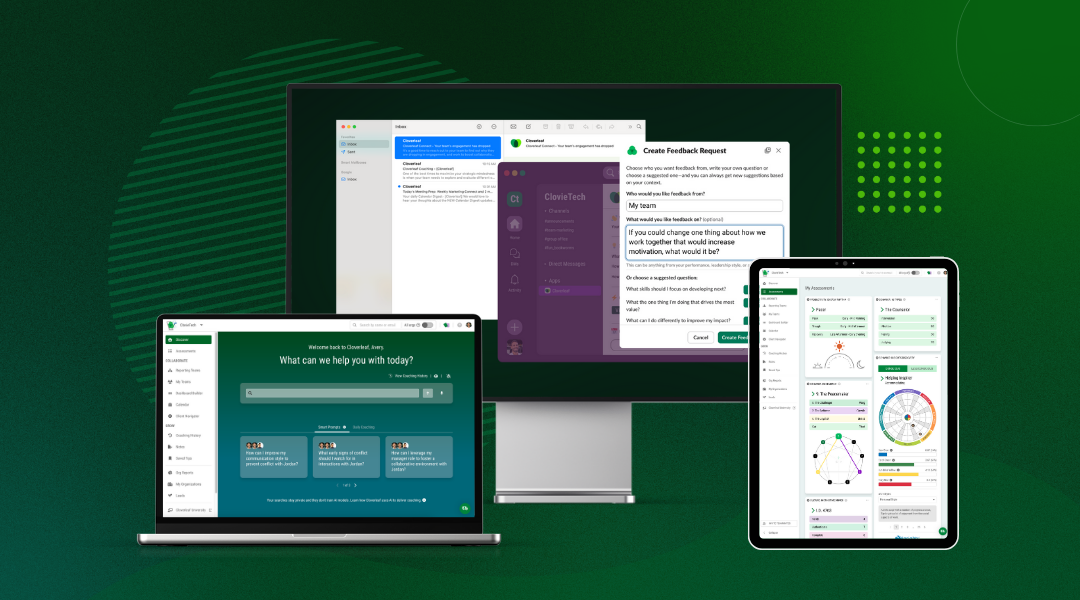
At the center is Cloverleaf Connect, the most progressive and comprehensive integration of learning and talent management ever imagined.
Why should managers navigate difficult conversations without a coach that understands their team’s engagement scores and each employee’s skills, performance, goals, and behavioral profile?
Organizations have so much data about their people scattered in disparate systems. It’s time this data not just be about the people, but united and put to use for the people.
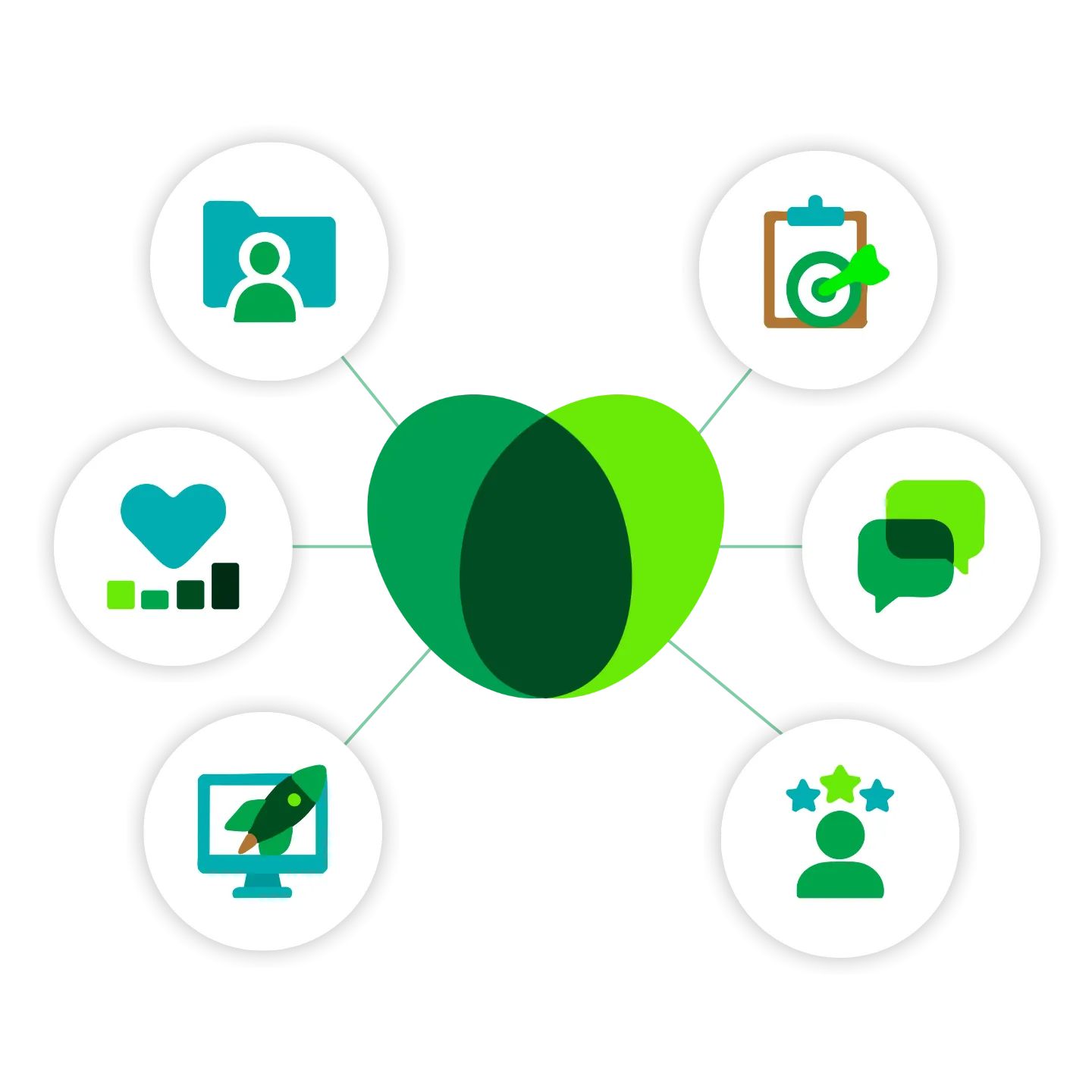
Gone are the days when “personalization” meant role-generalized content. No more one-size-fits-many.
With Cloverleaf Connect, every person receives coaching tailored to them individually, to be deeply empowered and developed continuously. And talent leaders, for the first time, can measure their impact with clarity and confidence.
This is not just what’s possible—it is what is best. HR should accept nothing less from all of their vendors today.
Cloverleaf Solutions for Every Organization: Assess, Coach & Connect
We recognize the world is changing rapidly in different directions. That’s why we’re also launching:
Cloverleaf Assess: a smarter, more affordable way to manage all behavioral assessments.
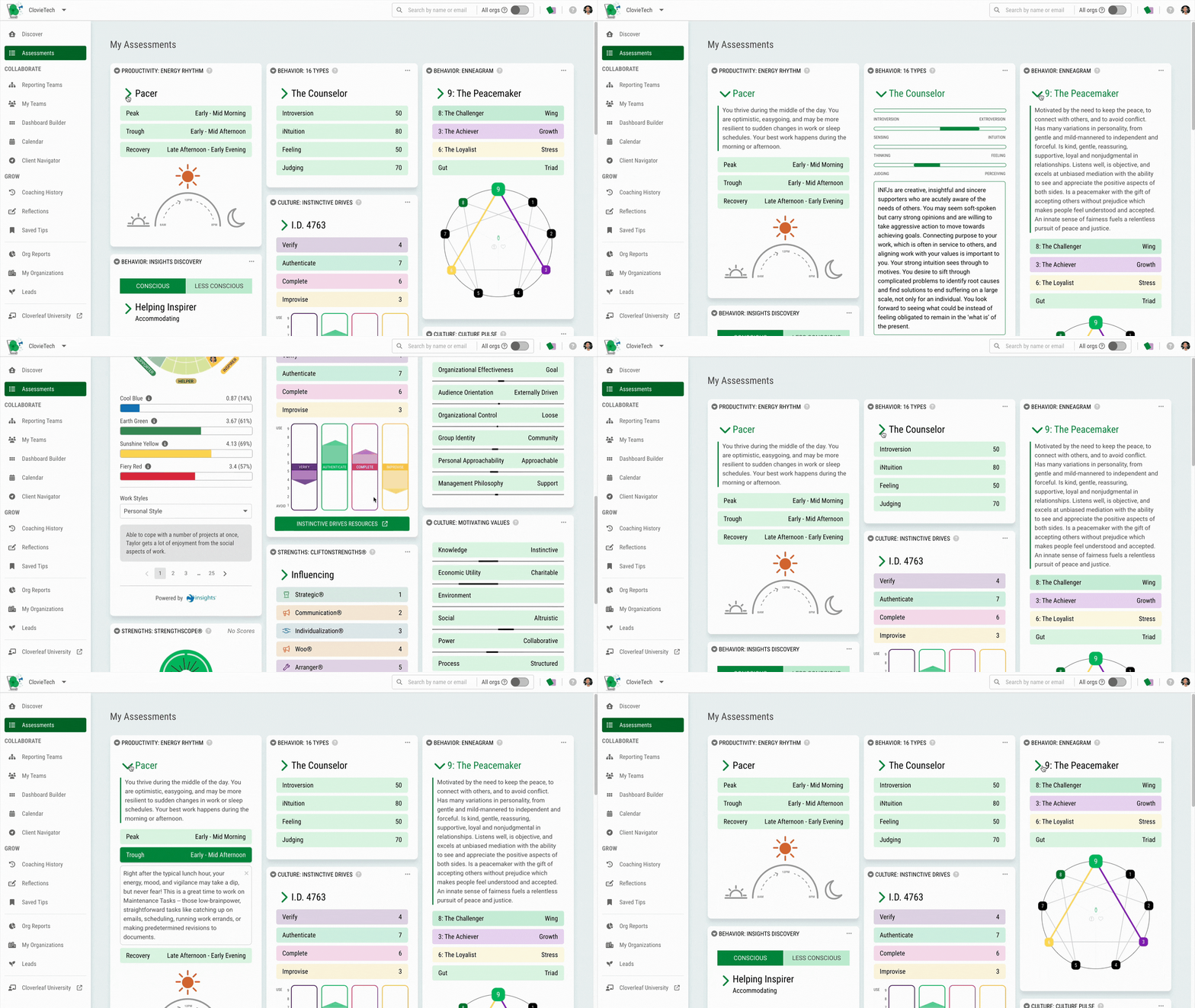
Cloverleaf Coach: the industry’s first ever AI coach grounded in personality science.
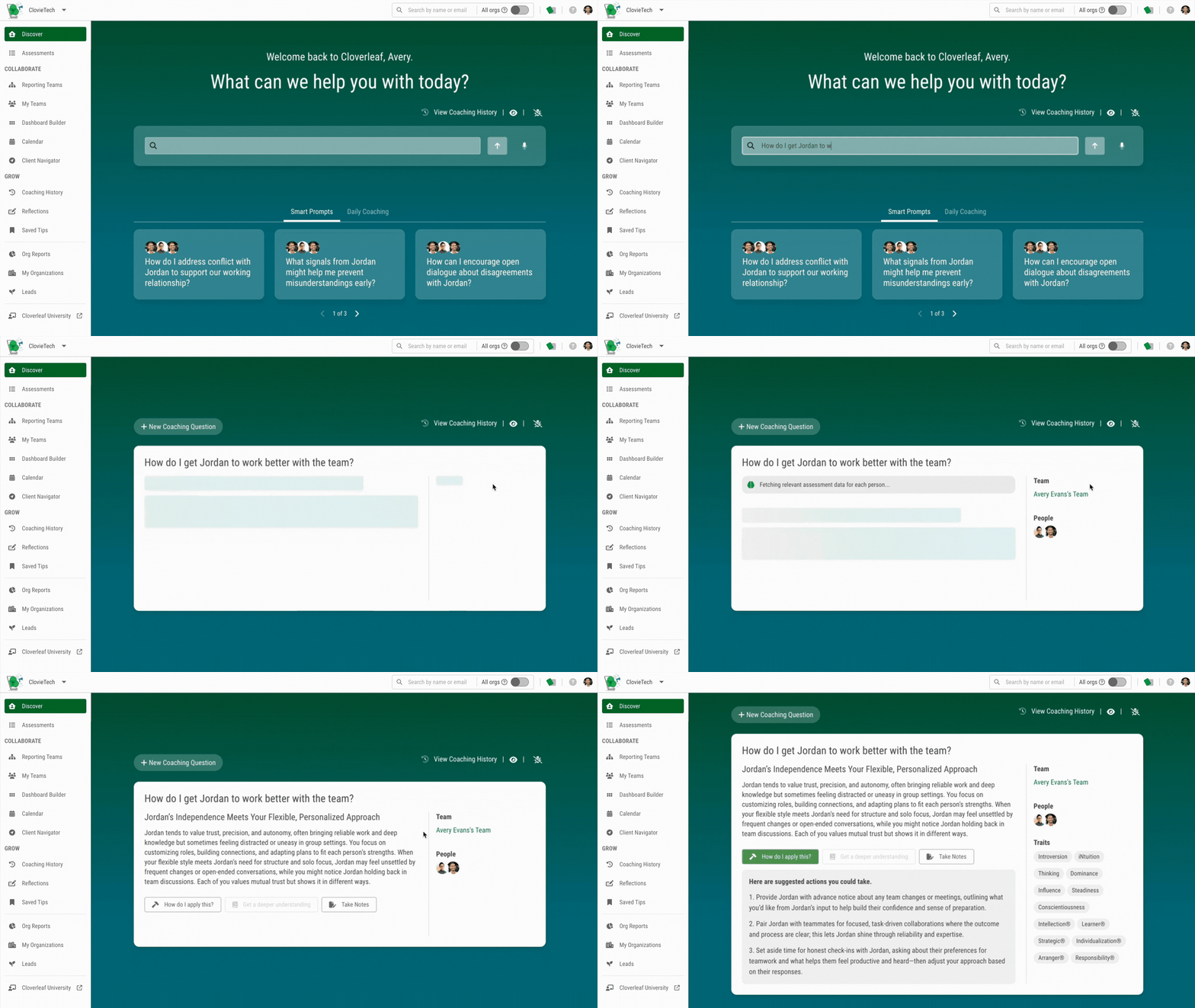
Wherever your company is—whether AI is tightly restricted or becoming fully integrated with your people data—Cloverleaf has a solution that empowers your people to grow in the uniquely human skills that all the research is showing our future demands: complex problem-solving, feedback conversations, leadership, cross-functional collaboration, creativity, innovation, etc, etc.
Why HR and Learning Leaders Must Act Now
When we began this journey ten years ago, we believed everyone should have their own coach in their corner, and that technology would make it possible. We knew the scattered data inside organizations held the key to deeply personalized growth. And we knew that people deserved more than static systems and disconnected tools.
Now, technology has caught up to vision. The disruption is here. HR has the chance to lead like never before.
This is the moment to demand more from your vendors. To settle for nothing less than solutions that empower every individual to thrive.
The world is changing fast. But for the first time, we can say: this is the future we’ve been waiting for. Let’s own this moment to make the next future the one we hope it to be: more human, more wise, more connected.
See What’s Possible with Cloverleaf: Try Our Interactive Demo
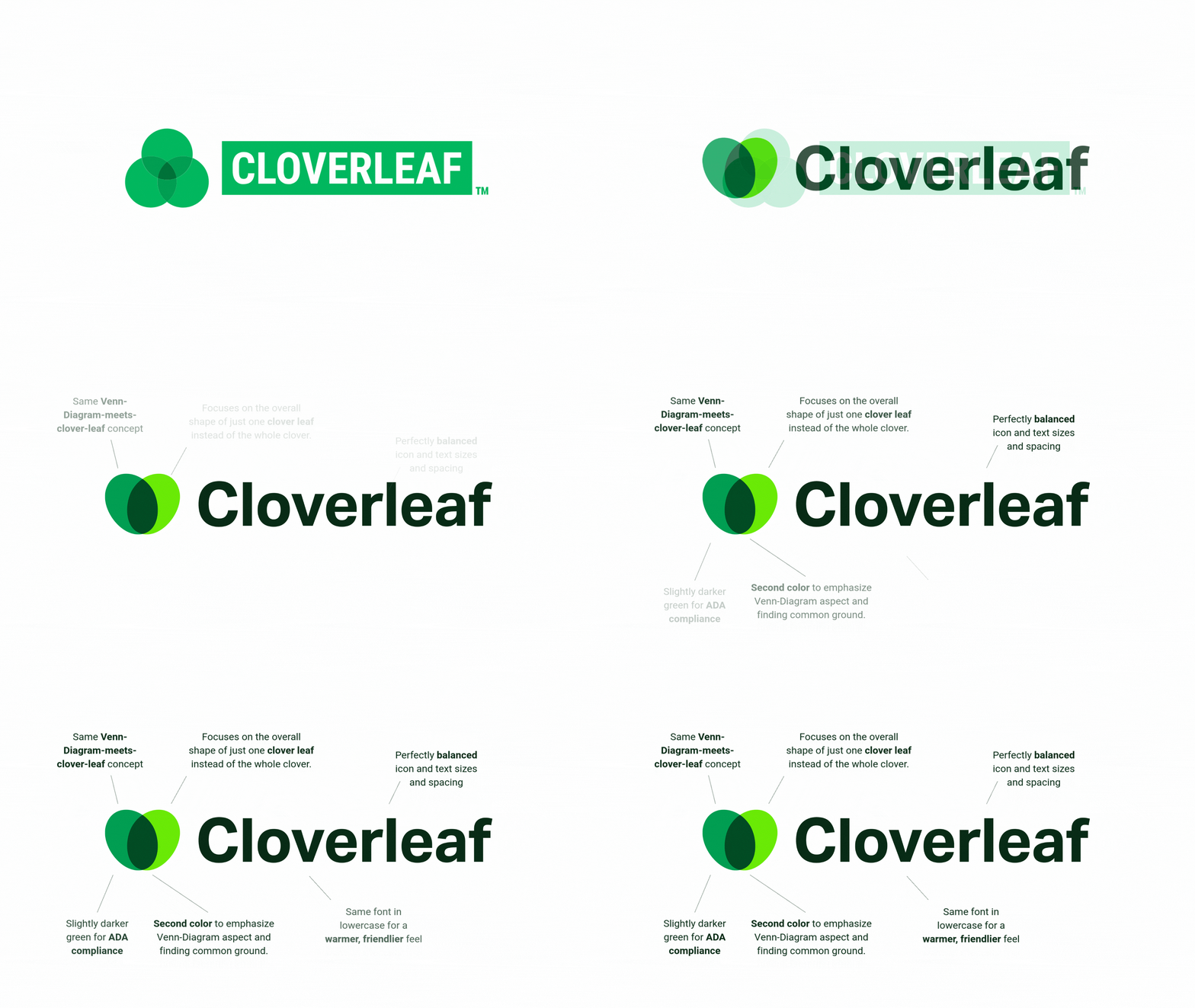
Cloverleaf’s New Brand Identity: The Future of Talent & Learning
As we launch this new suite of products, we’re also proud to introduce a refreshed Cloverleaf brand that reflects this next chapter.
Just as our products are designed to connect people and unlock growth, our new logo and visual identity sharpen that same promise: clear, approachable, and built to scale. It’s still us, just more confident, more connected, and more human.