In a given year, the average employee has about 220 interactions with HR. This includes everything—onboarding, benefits administration, compensation changes, performance reviews, training courses, talent reviews. The full spectrum of what HR touches across an employee’s year adds up to roughly 220 touchpoints.
Microsoft’s research into Office 365 calendar data and Teams messaging reveals something else: the average employee has approximately 14,640 people interactions per year. Meetings, group messages, email threads, collaborative projects. The actual work of collaboration happens 14,640 times annually.
Which means HR touches 1.5% of the interactions where development actually needs to happen.
This is a buyer’s guide. AI coaching promises to bridge that gap—but the market is filling with tools that vary wildly in what they actually do. Some are chatbots with framework databases. Some are role-play simulators. Some frustrate employees who expect answers. Here’s how to tell which tools can actually activate your talent investments in the moments that matter.
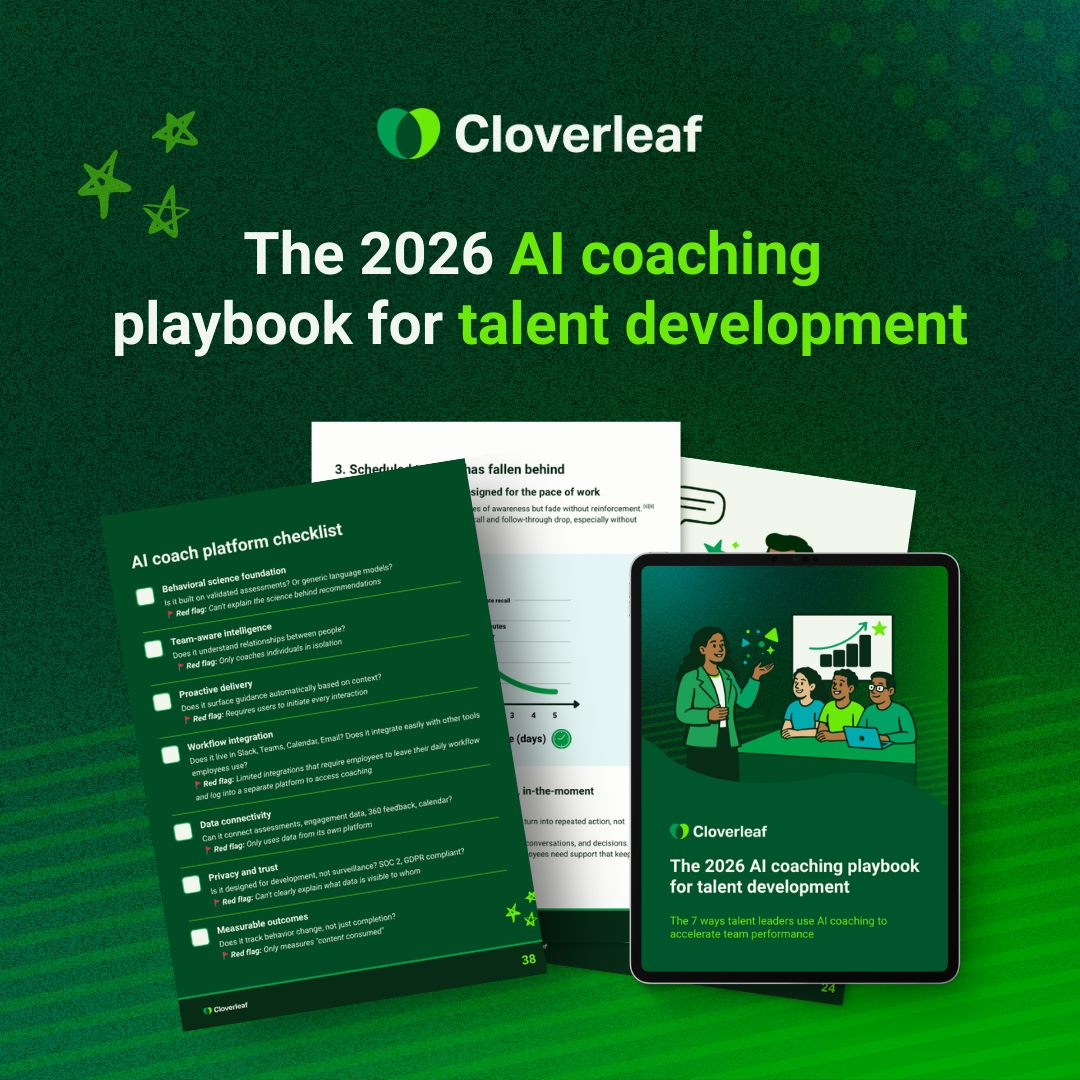
Get the 2026 AI coaching playbook to see how organizations are implementing AI coaching at scale.
The two promises of AI coaching—and which one delivers ROI for talent leaders
Promise 1: An AI coach can help teams do more faster with less.
Generate performance review drafts. Summarize feedback. Create development plans. This is the efficiency promise, and most talent leaders are already experimenting with it.
Talent leaders are willing to try things like using Gemini or other tools in their performance reviews because leaders are too busy. It can help write the reviews for them. However, most times they are not confident if it is a good idea or not and often feels like a gamble.
That’s the efficiency use case. It streamlines admin work. It saves time on documentation. It’s valuable—but it’s not transformative.
Promise 2: AI coaching can ensure ROI from the talent programs you’ve already paid for
You’ve invested in performance management systems, leadership development programs, feedback processes, 360s, culture initiatives. Those investments create valuable moments—the performance review conversation, the workshop debrief, the 360 results session.
Unfortunately, those critical insights are easily forgotten in the busyness and demands of work.
The manager and employee have a productive performance review. They identify a development goal. They both agree. They’re both clear on it. Three weeks later, the manager is preparing for their next one-on-one. The development goal doesn’t cross their mind. They’re thinking about project status, deadline pressure, what needs to get done this week. The goal that felt so important in the performance review? It’s in a system that hasn’t been opened since that conversation ended.
The workshop creates a breakthrough. The manager finally understands why they keep steamrolling their team in meetings. They leave energized to change. Two weeks later, in a tense project meeting, they do it again. They didn’t forget the workshop insight. They just didn’t remember it in the moment when their stress response took over and they needed it most.
The 360 feedback reveals a growth area. The employee reads it, reflects on it, commits to working on it. The PDF sits in their downloads folder. It doesn’t come up again until the next 360, six months later, when they realize they haven’t actually changed anything.
Your 220 HR moments create real insight. But that insight is not surfacing in the 14,640 interactions where it would actually change behavior.
AI coaching can layer on top of everything you’ve already built and activate it. It takes the goals, the insights, the feedback from those 220 HR moments and surfaces them in the 14,640 interactions where managers and employees actually work together.
Consider this common scenario:
Manager preparing for their weekly one-on-one.
Slack notification appears ten minutes before the meeting: “You and this employee agreed to work on delegation in their performance review two weeks ago. Here’s a way you can coach them on it today.”
Right there in the notification, the manager can launch a role play to practice the conversation. Or they can open a chat with the AI coach: “I’m worried about bringing this up. I think they’re going to get defensive because they’re already stressed about the project deadline.”
The AI coach responds based on that employee’s behavioral data—how they receive feedback, what motivates them, how they handle stress. The manager gets specific guidance for this specific person in this specific situation. Not a framework. Not a reminder to “use your training.” Actual coaching on how to have this conversation with this employee today.
The manager walks into the one-on-one equipped. The performance review goal doesn’t get buried under project updates—it surfaces in the exact moment when the manager can actually coach on it.
That’s the promise worth building a business case for: your 220 HR moments start working in the 14,640 interactions where development actually needs to happen. The investments you’ve already made—they start delivering ROI every single day, not just in the moments you can directly be present or available for.
See How Cloverleaf’s AI Coach Works
What your AI coach should automate—and what it should never touch
Before evaluating specific AI coaching tools, you need a framework for thinking about where AI should and shouldn’t be used. Because if AI coaching is replacing human judgment or relationships, you’re solving the wrong problem.
Where AI wins: Speed, accuracy, and pattern recognition
AI is never biased—if the data it’s trained on is clean.
That’s a big if. But when the data is good, AI performs consistently no matter what time of day it is, no matter how many meetings happened before, no matter what’s going on in the background.
Humans don’t work that way. What you had for breakfast changes how fast your brain works. If you’ve been in back-to-back meetings all day, you’re tired by 4pm. We all carry unconscious biases we don’t even realize are shaping our decisions.
AI doesn’t have recency bias. January performance and November performance are weighted the same—assuming it’s been trained that way.
AI also processes massive amounts of data instantly and spots patterns humans would never catch. You want to look at 500 employees’ development goals and identify common themes? AI does that in seconds. A human would spend hours manually reviewing and still miss half the connections.
Where human intervention wins: Transferable knowledge, creativity, leadership
You might not be an accountant, but you can generally understand competing departmental goals. You can figure out how finance thinks about risk differently than sales thinks about revenue opportunity. You can navigate cross-functional dynamics because you understand organizational context.
AI trained on finance data has to start from ground zero when you ask it about sales. The race toward AGI—artificial general intelligence—is real. But we’re not there yet. Right now, humans significantly outshine AI in cross-functional understanding.
Creativity is another area where humans win. AI can seem creative. It generates novel combinations of existing ideas. But all it can do is imitate. It recombines what it’s been given.
True innovation comes from humans who look at market conditions, competitive dynamics, available tools, economic constraints and say: “Here’s a completely new approach nobody’s tried.”
Leadership is where humans are irreplaceable. Trust, culture, loyalty, inspiration—these don’t come from bots.
One of the biggest barriers to AI adoption isn’t the technology. It’s lack of trust in leadership. Employees worry: “If I use this tool, what data does my employer see about me? If I train AI to do my job really well, am I just going to lose my job?”
Those fears aren’t solved by better AI. They’re solved by better leadership. Trust, vulnerability, courage—that’s how organizations actually win with AI. And that’s work only humans can do.
What this means for talent leaders evaluating AI coaching tools
AI should handle speed and pattern recognition. It should surface insights from your siloed systems—performance reviews, engagement surveys, skills data, learning history, calendar data. It should deliver personalized nudges based on patterns humans can’t track manually across hundreds of employees.
But the AI coach should be pushing people back toward human intelligence. Toward cross-functional collaboration. Toward creative problem-solving. Toward relationships.
If the AI coaching tool you’re evaluating is designed to replace manager conversations or reduce human connection, you’re looking at the wrong tool. It’s solving the wrong problem.
For more on why development infrastructure needs to support human relationships, see why 2026 is the year talent development becomes business infrastructure.
Five features that separate AI coaching systems from glorified chatbots
We’ve been getting a specific type of sales call lately. Talent leader says: “We tried an AI coach last quarter. People used it for two weeks and then stopped. It felt like a glorified chatbot with a framework database. We’re disappointed.”
When you dig into what went wrong, a pattern emerges. The tools that fail share common gaps. The tools that succeed share five specific features.
Feature 1: Proactively shows up in the flow of work before you remember you need it
Even on your best days, you don’t wake up thinking: “You know what I’m going to do? Spend my first 15 minutes reviewing that training I took and figuring out how to apply it today.”
You wake up thinking: “Do I have time to prep for that meeting? I didn’t even pack lunch for my kid yet.” You’re busy. You’re stressed. Development goals don’t surface naturally when you’re focused on immediate work demands.
Nobody wants another login. Nobody wants to remember to find another tool. Your AI coach needs to exist where people already work—Workday, LLMs, Microsoft Teams, Slack, email, wherever the 14,640 people interactions are actually happening.
But it’s not enough for AI coaching to just be available there. The differentiator is whether the AI coach understands what’s happening in your day and proactively surfaces guidance before you think to ask for it.
“I see you’re walking into this meeting with the product team. Remember you wanted to work on not dominating the conversation. Here’s one thing to try: Ask a question and count to five before you speak again.”
Not a five-minute video.
Not a long article.
Three sentences.
That’s all people have time for between meetings. Just a nudge. Just a reminder. Right in the flow of work where it can actually get applied.
Feature 2: Remembers your past conversations
If someone starts from ground zero every time they interact with the AI coach, it doesn’t feel like the coach actually knows them.
The AI coach should remember: “You’ve really struggled with defensiveness when your manager gives you feedback. Let’s keep working on that.” Or: “I’ve noticed you keep asking questions about delegation. What’s making this so hard right now?” Or: “In your last 360, your peers said you need to create more space for others to speak in meetings. How’s that going?”
If your organization has 360 capabilities or lightweight feedback tools integrated with your AI coach, can the coach know what feedback you’re getting from peers and coach you on those specific themes?
Memory creates the experience of working with someone who actually understands you—not just accessing a database that forgets everything the moment you close the window.
Without memory, every interaction starts from scratch. The AI coach asks you the same diagnostic questions every time. You answer the same background information over and over. You stop engaging because it feels like you’re training the tool instead of the tool helping you.
Feature 3: Coaches you on your specific situation, not generic advice for your role
Many tools claim “personalization” but what they actually mean is: “We know your title, so we’ll send you content for people at your level.”
Here’s what false personalization in AI coaching often looks like:
Manager gets a notification about a “personalized learning opportunity”—it’s a seven-minute video on delegation. The subject line says “Based on your role as Manager Level 3.” The manager already knows how to delegate. They’ve been managing people for five years. The video is noise. After the third generic “personalized” notification, they stop opening messages from that system.
True personalization means the coaching addresses what you’re stressed about right now, what you’re excited about, what’s in front of you today. Not generic advice for people with your job title.
You need AI coaching that understands: This person is stressed about an upcoming difficult conversation scheduled for tomorrow. This person is excited about a new project but doesn’t know how to structure the kickoff meeting happening this afternoon. This person just got promoted last week and is overwhelmed by suddenly managing people who used to be peers.
If your AI coach is only trained on frameworks, it will feel generic. If it’s trained on your behavioral data, your performance history, your current projects, your team dynamics—it can deliver coaching that’s actually relevant to what you’re dealing with today.
Feature 4: Connects data across your talent systems
How much data can your AI coach actually access? If it only knows what happens inside its own platform, it can’t connect the dots that make coaching useful.
Can it pull from your performance management system? Your engagement surveys? Your skills taxonomy? Your learning history? Your HRIS data—who reports to whom, when someone got promoted, when teams restructured?
Can it know behavioral assessment data—DISC profiles, Enneagram types, CliftonStrengths, communication preferences?
Can it understand calendar context—who you’re meeting with, when you have one-on-ones scheduled?
Consider what’s possible when data actually connects:
Manager preparing for one-on-one with Jordan. Gets notification ten minutes before the meeting: “You’re meeting with Jordan in 10 minutes. Jordan’s top CliftonStrength is Responsibility, but their current project isn’t utilizing that strength. That might explain the disengagement you mentioned in last week’s skip-level. Consider asking: ‘Does this project feel aligned with what you’re best at?'”
That single notification required three data sources working together: performance system (disengagement observation from skip-level), assessment data (CliftonStrengths profile), calendar (meeting in 10 minutes). If your AI coach can’t connect across those systems, it can’t deliver that kind of insight.
The more data sources your AI coach can integrate, the more useful it becomes. If your AI coach lives in a silo, it’s just another tool with partial information.
Feature 5: Knows when to ask questions and when to give answers
Most AI coaching tools try to be pure coaches. They try to ask the right questions. They attempt to help you reflect. They guide you to discover your own insights.
However, there is an interesting dynamic that occurs when people use tools like this:
Manager opens the AI coach. “I have a difficult conversation with an employee tomorrow. They’re underperforming and I need to address it.”
AI coach: “What specifically is making this conversation feel difficult for you?”
Manager: “I don’t know how to bring it up without them getting defensive.”
AI coach: “What do you think defensiveness might signal for this person?”
Manager closes the tool. Thinks: “I came here for help and it’s just asking me more questions. I already have questions. I need answers.”
People expect AI to give answers, not just facilitate their thinking.
When the AI keeps asking “How do you feel about that?” or “What do you think you could try?” without ever providing concrete guidance, people get frustrated and stop using it.
Your AI coach needs to be versatile.
Sometimes it should coach—help you process your thinking, ask questions that surface your own wisdom. Sometimes it should mentor—surface the right information from your talent systems and give you specific guidance for this specific situation.
Example of coaching mode: “You seem frustrated about this conversation. What specifically made it frustrating? When have you felt this way before? What helped then?”
Example of mentoring mode: “You’re about to give feedback to someone with High S on DISC—they need softer delivery and time to process. Try starting with what they’ve done well, then frame the feedback as an observation, not a criticism. Give them space to respond without filling the silence.”
For more on how AI coaching activates specific assessment data at moment of need, see how AI coaching can activate assessment data for for manager development.
Four types of AI coaching in the market (and what each one actually does)
When you start looking at AI coaching tools, you’ll notice they’re all pretty different. They’re not trying to solve the same problem. The market breaks into four categories, each with distinct use cases.
Type 1: Q&A functionality
This is the most basic form. It’s essentially a chat interface trained on frameworks, best practices, or your organization’s existing content. You ask it a question—”How do I give feedback in this situation?”—and it retrieves relevant information from its training data.
Some platforms have added this type of AI coach. It’s trained on coaching and leadership frameworks. You can ask whatever question you want and it pulls from what it knows.
Some tools let you customize the training. If you’ve already invested in specific frameworks through your leadership development programs—CCL, Blanchard’s Situational Leadership, others—you can train the AI on those models your organization already uses.
Quick access to frameworks without digging through your LMS. But knowing a framework doesn’t mean you’ll use it in a stressful moment.
Type 2: Role play
Almost every AI coaching tool offers role play. The most common use case is practicing difficult conversations before they happen. Most tools let you customize the role play to frameworks your organization already uses.
One differentiated example: some tools focus specifically on sales and customer support. You can upload past sales calls or customer service interactions, and their AI role-plays based on those actual scenarios. It’s highly specific to sales enablement and frontline support training—not general leadership development.
Managers can practice high-stakes conversations in a low-stakes environment. But knowing you should practice doesn’t mean you will.
Type 3: Human-like coaching experience
A smaller segment of AI coaches aims to make executive-level coaching accessible to everyone in the organization. Their goal is to make the experience feel like talking to a human coach. Some include video simulations of a person. Others use voice chat. You can talk with it as if it were an actual coach—someone who asks thoughtful questions, helps you process your thinking, guides you to insights.
Some tools offer cohort-based leadership development training where the AI coach follows up on what you learned in the program. These are focused on data within their own platform, which makes them a specific use case rather than a broad organizational tool.
A critical feature to look for in this category: memory (see Feature 2 above).
Makes coaching accessible to everyone, not just senior leaders. But people expect AI to give answers, not just ask questions.
Type 4: Full talent lifecycle integration
This is where AI coaching becomes genuinely differentiated. Can your AI coach pull together data from segmented systems—performance reviews, engagement surveys, skills inventories, learning history, career pathing, behavioral assessments, calendar data—and deliver personalized support based on all of that context?
Can it surface a performance review goal three months later when that goal is actually relevant to today’s one-on-one? Can it know who’s attending a meeting and flag: “You’re the only introvert presenting to a room of extroverts—here’s how to structure your message so it lands”? Can it understand that this employee’s top CliftonStrength is Responsibility and their current project isn’t utilizing that strength, which might explain their recent disengagement?
Some HRIS platforms like Workday have opened up their systems for custom integrations, making it possible for AI coaches to connect across the talent lifecycle. If your HRIS doesn’t have that level of openness, there are still ways to connect data—but it requires intentional integration work.
This type activates your existing talent investments in the moments where they’re actually needed. It makes your siloed data useful. The tradeoff: it requires significant integration work and data connectivity. It’s not plug-and-play for most organizations.
Most organizations exploring AI coaching will encounter tools in categories 1-3. Very few tools are attempting category 4. When you’re evaluating, ask explicitly: “Which category does this tool fall into, and does that match what we’re trying to accomplish?”
Your evaluation checklist: Five features and four questions
The infrastructure to bridge that gap—to activate your performance reviews, your 360s, your engagement insights, your behavioral assessments, your leadership programs in the 98.5% of interactions you can’t directly reach—that infrastructure can exist now.
But not all AI coaching tools are solving that problem. Some are chatbots with framework databases. Some are role-play simulators. Some are question-asking tools that frustrate people who expect answers.
The tools that work deliver five things:
- Proactive nudging in the flow of work
- Memory that creates continuity
- True personalization beyond role-based templating
- Data breadth across your talent lifecycle
- Versatility between coaching and mentoring
For guidance on measuring ROI and building your business case, see how to calculate AI coaching ROI. For details on data security and integration requirements, see AI coaching integrations and security.
When you’re evaluating AI coaching tools, ask explicitly about those five features. Ask for examples of how the tool delivers each one. Ask to see the data integrations. Ask how it handles privacy and trust.
The market is noisy. The solutions vary wildly. But the organizations that get this right—that choose AI coaching systems instead of glorified chatbots—they’re the ones who’ll activate talent development in the moments that actually matter.