Category: Leadership

lessons from hidden brain

Negotiation, Bias, and Emotional Intelligence: Lessons from Hidden Brain

Reading Time: 6 minutesI’m a big fan of the Hidden Brain podcast by Shankar Vedantam. Shankar has spent his entire career focused on human behavior, and if you’re interested in organizational behavior or leadership development, his work is essential. The most recent episode, “Relationships 2.0: Become a Better Negotiator,” instantly became one of my all-time favorites—and it’s a must-listen. In this episode, Shankar speaks with behavioral scientist Max Bazerman about how cognitive biases can quietly undermine our ability to negotiate effectively. What struck me most was Bazerman’s insight that while we often focus on persuading others in negotiation, we rarely examine our own blind spots. We assume we’re objective, rational, or “right”—but our overconfidence and self-centered thinking can lead to outcomes that are far from optimal. This article isn’t a negotiation playbook. It’s about something more profound: how emotional and relational intelligence shape the way we communicate, influence, and make decisions, particularly in environments where collaboration and alignment matter. Because let’s be honest—negotiation doesn’t just show up in boardrooms or contract talks. It’s there when you’re aligning cross-functional teams, giving feedback, proposing new ideas, or trying to secure resources. And often, what gets in the way isn’t the other person. It’s us. Get the free guide to close your leadership development gap and build the trust, collaboration, and skills your leaders need to thrive. What We Get Wrong About Negotiation In the episode, Max Bazerman highlights something most of us miss: our most significant obstacle in negotiation isn’t usually the other party—it’s ourselves. We’re often so focused on persuading or winning that we fail to recognize the hidden cognitive biases shaping our own approach. Bazerman explores how overconfidence and self-centered thinking consistently derail even the most well-intentioned negotiators. We assume our logic is sound, our goals are fair, and our strategy is smart. But when we neglect to account for how our own blind spots distort reality, we walk away with less-than-ideal outcomes—and sometimes, without even realizing it. One concept he introduces is the “veil of ignorance”—a powerful mindset shift that asks us to consider decisions as if we didn’t know which side of the outcome we’d be on. It’s a way of neutralizing our self-interest and approaching negotiation from a place of fairness and perspective-taking. Bazerman backs this up with real-world stories, like Robert Campo’s acquisition of Federated Department Stores and Matthew Harrington’s baseball contract negotiations. In both cases, personal bias and lack of perspective led to missed opportunities or fractured deals, not because the negotiators lacked strategy, but because they lacked self-awareness. This isn’t just theoretical. Research shows that overconfidence is one of the most pervasive decision-making biases in business. According to a 2012 study published in Organizational Behavior and Human Decision Processes, individuals who are overconfident tend to overlook critical information and underestimate risk, two tendencies that are particularly costly in collaborative environments. And while these examples come from the world of business and sports, the dynamics are just as present in everyday workplace negotiations: A manager pushing for budget approval without understanding competing team needs. A team member advocating for their project without listening to leadership’s broader goals. Or two departments struggling to align on shared priorities because no one paused to ask: “What assumptions are we making?” If negotiation is about outcomes, then awareness—of self and others—is the most overlooked advantage. Make Team Development More Impactful See how high performing teams use tech to equip their leaders Why Self-Awareness Alone Isn’t Enough The essence of this episode is clear: it takes both self-awareness and other-awareness to increase our capacity for emotional intelligence. It isn’t enough to simply understand yourself better, which the traditional behavioral assessment market has done an adequate job of in the past. It requires that you understand yourself in the context of the people you are trying to communicate with in order to effectively sell ideas and achieve the desired outcomes. This is illustrated in the following graphic. On the left, we see what most traditional learning experiences focus on—solo development. These tools often provide valuable individual insights, but they are static. They lack the dynamic interplay that happens in real relationships. You learn about yourself, but not how your behavior impacts others, or how theirs impacts you. On the right is the model Cloverleaf was built around: ☘️ A continuous loop of learning about others and growing with others ☘️ Self-awareness that’s active, contextual, and relational ☘️ Growth that happens not in isolation, but in the actual flow of work and interaction This distinction matters. As organizational psychologist Tasha Eurich puts it, People who have high internal self-awareness and low external self-awareness can come across as arrogant or oblivious. In other words, knowing yourself isn’t enough if you can’t see how others experience you. Most development and assessment platforms deliver data and reports, but rarely provide the context needed to act on them in relationships. That’s why even well-intentioned training programs struggle to create lasting behavior change: the learning doesn’t live where the communication happens. At Cloverleaf, we intentionally designed our experience to go beyond the individual. Not just to teach people about themselves, but to teach people how to interact more effectively with the people they work with every day. Try a Demo Turning Insight Into Practice: What Teams Need to Reinforce Human Skills The challenge isn’t understanding the importance of emotional intelligence—it’s consistently applying it in the messy, fast-moving reality of daily work. Reading an article, listening to a podcast, or attending a workshop can spark awareness. But unless those insights are revisited and reinforced in real interactions, they rarely change how people communicate, collaborate, or lead. This is the gap Cloverleaf was built to close. It’s not just a reflection tool—it’s a system designed to bring awareness into moments that matter most. Consider a few everyday scenarios: Before a feedback conversation, Cloverleaf reminds you that your teammate tends to process input more slowly and prefers written reflection before discussing live. So, instead of jumping in during a meeting, you follow

super communicators in the age of ai

What Super Communicators Do Differently in the Age of AI

Reading Time: 5 minutesI recently read the book Super Communicators by Charles Duhigg. This is a must-read for anyone who cares about building people skills in any organization. It’s a timely topic, given the fast move toward and adoption of AI technologies that is swinging the focus of skill building in organizations away from “hard skills” like software development and accounting, which can increasingly be replaced by AI, to skills that are a unique reflection of our human-ness. As automation reshapes entire industries, technical expertise is no longer the only differentiator. The skills that will define the next era of leadership and collaboration are deeply human: the ability to connect, to listen, to navigate complexity in conversation. These are the skills AI can’t replicate—and the ones organizations can’t afford to overlook. LinkedIn recently released its fastest growing skills of 2025, and among the top 10 are skills that directly relate to our ability to communicate and connect with others: #2 – Conflict Mitigation   #6 – Public Speaking   #7 – Solution-Based Selling   #8 – Customer Engagement and Support What do these have in common? They all rely on a person’s ability to read the room, build trust, and adapt how they communicate in real time. These aren’t just traits—they’re skills that can be developed and strengthened. At Cloverleaf, we believe technical skills will keep evolving, but human connection is the constant that drives collaboration, trust, and performance. And the good news is: it’s not something you’re either born with or not. It’s something you can practice daily. Get the free guide to close your leadership development gap and build the trust, collaboration, and skills your leaders need to thrive. What Super Communicators Understand About Human Connection While there are many concepts, ideas, and resources in Super Communicators, I wanted to highlight a couple that often go overlooked—and that Cloverleaf has been specifically designed to support. Duhigg’s core idea is simple but powerful: great communication isn’t about being the loudest voice in the room or the most charismatic. Super communicators aren’t born—they’re made. What sets them apart is their ability to prepare intentionally, stay curious in conversation, and create connection through active listening. These are not vague soft skills. They’re specific behaviors backed by research. And more importantly, they can be practiced. Our platform helps individuals and teams turn these habits into part of their daily workflow through calendar-based meeting prep, tailored coaching prompts, and reflection tools that support better conversations in real time. When communication becomes a habit, connection becomes a competitive advantage. Make Team Development More Impactful See How High Performing Teams Use Tech To Equip Their Leaders Preparation: The Underused Power Skill One key aspect of becoming a super communicator is preparing well for meetings and conversations with others. Duhigg highlights the importance of setting yourself up with a curious mindset—one that’s ready to ask questions and learn before pushing an agenda or selling an idea. We are well served to do a bit of prep work before a dialogue begins. Researchers at Harvard and other universities have looked at exactly which kind of prep work is helpful. Participants in one study were asked to jot down a few topics they would like to discuss before a conversation began. This exercise took only about thirty seconds; frequently, the topics written down never came up once the discussion started. But simply preparing a list, researchers found, made conversations go better. There were fewer awkward pauses, less anxiety, and afterward, people said they felt more engaged. This isn’t just good advice—it’s a repeatable practice. The best conversations start before the meeting even begins. Cloverleaf makes this prep work easy. When you connect your calendar to your Cloverleaf account, you receive a daily digest delivered directly to your inbox each morning. It includes personalized insights to help you prepare for the people you’re meeting with—like knowing a teammate prefers direct communication, or that a collaborator is energized by brainstorming. That kind of insight can shape how you approach a conversation and dramatically improve how your message is received. Great communicators are prepared communicators—and that starts with emotional intelligence and a thoughtful understanding of how others think and interact. You can learn more about all the great meeting insights and preparation features Cloverleaf offers by viewing our help doc here. Listening: The Shortcut to Real Connection It’s not enough to simply prep well for a conversation or meeting. To create meaningful connection—and drive better outcomes—you also need to listen with intention. Duhigg dedicates a chapter to this idea, exploring the power of asking emotionally resonant questions that build connection. He shares the story of a husband-and-wife research team that brought strangers together to test different theories for forming connection and found: There was only one method tested that could reliably help strangers form a connection: a series of 36 questions that elicited ‘sustained, escalating, reciprocal, personalistic self-disclosure.’ The key was creating vulnerability that led to emotional syncing—or emotional contagion. This kind of connection doesn’t happen by accident. It comes from listening not just to respond, but to understand. Super communicators ask questions that invite reflection. They create space for others to feel seen, heard, and valued. That’s what builds trust—and drives real collaboration. That insight is central to why we added discussion questions as a tool for team building in the Cloverleaf dashboard. Not every prompt is designed to surface deep vulnerability, but they are built to foster meaningful connection. And after reading Super Communicators, we even added a few new ones—see if you can spot them. At Cloverleaf, we believe connection is built through small, intentional moments. When people feel heard, they engage more deeply with their work, their teammates, and their purpose. Try a Demo Making Communication a Daily Habit Super Communicators makes the case that great communication isn’t a personality trait—it’s a pattern of behaviors anyone can build. But even the most powerful insights fade if they aren’t applied when they matter most. And that’s the real challenge: how

2025 leadership coaching strategies

How To Make Leadership Coaching Strategies Scalable And More Impactful

Reading Time: 8 minutesLeadership coaching is one of the most effective ways to develop strong, capable leaders—yet, in many organizations, it’s still reserved for executives. The reality is, leadership happens at every level. First-time managers, mid-level leaders, and senior executives all face moments where they need guidance, perspective, and support to navigate challenges and grow. But leadership development doesn’t happen by accident. Great leaders aren’t just born—they’re shaped through self-awareness, feedback, and continuous coaching that helps them improve how they communicate, make decisions, and develop their teams. Yet most companies don’t provide leadership coaching where it’s needed most. 👉 68% of managers have never received formal leadership training—leaving them to figure it out on their own. (Source: The HR Director) 👉 46% of managers have been asked to provide more constructive feedback, but only 28% feel HR has prepared them for it. (Source: Lattice State of People Strategy Report) 👉 Only 30% of HR leaders say their leadership programs are effectively preparing leaders for future challenges. (Source: Gartner: Top 5 Priorities for HR Leaders in 2025) For leadership coaching to truly work, it can’t just be a one-off experience or a luxury for a select few. It needs to be practical, relevant, and integrated into the daily moments where leadership actually happens—whether that’s navigating team conflict, giving tough feedback, or adapting to change. The question isn’t whether leadership coaching is valuable—it’s how to make it work for more people in a way that’s meaningful, actionable, and built to last. Get the free guide to close your leadership development gap and build the trust, collaboration, and skills your leaders need to thrive. What Is The Goal Of Leadership Coaching Leadership coaching is the process of helping leaders improve how they interact with others, make decisions, and develop their teams. It’s not just about individual self-improvement—it’s about equipping leaders to create real impact in their organizations. A great leader isn’t someone with all the answers. It’s someone who knows how to ask the right questions, adapt to different situations, and bring out the best in others. Leadership coaching provides structured guidance to help leaders grow—not in isolation, but in the context of their teams, their challenges, and their day-to-day decisions. 3 Ideas That Strengthen Leadership Coaching’s Impact Most leadership coaching follows a traditional, one-on-one model—focused on individual growth, often reserved for executives or high performers. But practicing leadership isn’t just a top-level function—it can happens at every level of an organization. ✅ Leadership coaching should be accessible at every stage. From first-time managers to senior executives. When mid-level leaders don’t get coaching, they’re left to figure things out alone, which weakens teams and slows progress. ✅ Leadership coaching isn’t just about the leader—it’s about the team. Leadership doesn’t happen in a vacuum. Effective coaching helps leaders understand their teams’ unique dynamics, improve collaboration, and create an environment where people can thrive. ✅ Leadership coaching should be integrated into daily work—not just scheduled sessions. Leaders don’t need advice weeks after a tough conversation—they need guidance in the moment, when it matters most. Make Your Leadership Coaching More Impactful See How High Performing Teams Use Tech To Equip Their Leaders Great Coaching Can Lead To A High-Performing Culture 🟢 Self-awareness that leads to action. Leaders need more than just insight into their strengths, biases, and blind spots—they need to know how to apply that awareness in real interactions. Coaching ensures that self-awareness isn’t just theoretical, but something leaders can actively use to make better decisions and foster stronger teams. 🟢 A focus on building strong teams. Coaching isn’t just about making a leader better—it’s about helping them bring out the best in others, develop talent, and build trust. When leaders are supported through coaching, they create environments where people feel heard, valued, and empowered to perform at their best. 🟢 Actionable feedback, not vague theories. Effective leadership coaching offers practical, real-time insights leaders can apply immediately—not just high-level concepts about leadership. The best coaching doesn’t just teach theory; it helps leaders navigate the complexities of managing people, giving feedback, and driving change in the moment 🟢 Scalability and consistency. Coaching should be continuous, relevant, and available to every leader—not a one-time experience for a select few. When coaching is integrated into daily work, it becomes a consistent driver of growth, rather than an occasional intervention. The impact is real. One study found that for every $1 spent on coaching, companies saw a return of over $7. Coaching doesn’t just develop better leaders—it leads to smarter decisions, stronger teams, and better business outcomes. When leaders are equipped with the right coaching, they reduce costly mistakes, improve retention, and create cultures of accountability that drive long-term success. Impactful leadership coaching strategies realize it isn’t just about developing individuals—it’s about changing how leadership happens in an organization. When development opportunities are embedded into daily work—instead of separate initiatives—the effects of coaching start to drive real, lasting change. 4 Principles That Make Leadership Coaching More Effective? Coaching is about helping leaders apply new learning and discovery to improve team dynamics, decision-making, and workplace culture. But for coaching to drive lasting impact, it has to be personalized, relevant, team-centered, and continuously reinforced. Let’s break down the key principles that make leadership coaching effective. 1. Personalization: Coaching Should Be Tailored to the Leader and Their Team No two leaders—or teams—are the same. Coaching should be customized to individual strengths, leadership styles, and team dynamics rather than following a generic framework. How Personalization Makes Leadership Coaching More Effective ✅ Self-awareness is At The Core Of Better Leadership Leaders who understand their own tendencies, strengths, and blind spots can make better decisions, communicate more effectively, and create environments where people thrive. Behavioral assessment platforms with tools like DISC, MBTI, or Enneagram help leaders understand their natural tendencies, communication styles, and decision-making patterns. Strength-based assessments (like CliftonStrengths®) highlight what energizes leaders, helping them maximize their potential. When assessment insights can be layered, even better! Leaders get a multi-dimensional view of themselves and their teams—leading to

How Revel Coach Used Cloverleaf To Scale Impact at XL Parts | Cloverleaf Case Study

How Cloverleaf Helped Revel Coach Expand Impact & Business at XL Parts | TPH

Reading Time: 3 minutesHow can Cloverleaf help coaches scale their impact, grow their business, and become indispensable to their clients? That’s exactly what Marcy Stoudt of Revel Coach has experienced. By integrating Cloverleaf into her coaching engagements, she’s been able to reach more leaders, drive continuous development, and unlock new opportunities within XL Parts/TPH—a growing company with 500+ engaged Cloverleaf users. If you’re a coach wondering how Cloverleaf can help you differentiate your business and secure long-term client relationships, Marcy’s journey with XL Parts/TPH offers real-world answers. Increasing Coaching Impact Without Adding More Hours Most coaches are limited by time—you can only work with so many clients in a day. However, Marcy found that Cloverleaf allowed her to scale her coaching impact beyond the leaders she worked with directly. 💡 How Cloverleaf Expanded Marcy’s Reach & Impact ✔️ More People, Less Time: Instead of coaching only a few executives, she introduced Cloverleaf to 30 high-potential leaders in a structured leadership program. This quickly scaled to 60 leaders and, eventually, 500+ employees engaging with the platform. ✔️ Continuous Development Between Sessions: With daily coaching nudges, leaders weren’t just learning during workshops—they were reinforcing insights every single day. ✔️ Bridging the Gap Between Sessions: One of Marcy’s early coachees was initially skeptical. But when he saw how accurate his Cloverleaf insights were, he was sold: “I was skeptical about coaching at first. But when I saw myself in Cloverleaf, I realized—this coach really gets me. We didn’t have to waste time figuring each other out. We could dive right into improving how I lead.” Coaches often struggle with regression between sessions—clients forget key insights, fall back into old habits, and lose momentum. Cloverleaf’s automated nudges and team insights kept leaders engaged without Marcy needing to be present. https://youtu.be/7Wit1avPTYo How Cloverleaf Helped Secure New Coaching & Training Opportunities Cloverleaf wasn’t just an enhancement—it was a gateway to new business opportunities within XL Parts/TPH. 💡 How Cloverleaf Helped Marcy Expand Her Coaching Business ✔️ From Individual Coaching to Company-Wide Adoption: What started as coaching for one leader quickly expanded into a company-wide leadership development initiative. ✔️ New Training & Coaching Programs: A structured leadership development program using Cloverleaf as the foundation Monthly voluntary coaching calls, with 120+ employees opting in A new “Respected Leaders” virtual course, run by XL Parts/TPH leaders trained in Cloverleaf ✔️ Reaching All Levels of the Organization: The HR leader at XL Parts/TPH, Linda, saw an opportunity to integrate Cloverleaf more deeply: “We went from a handful of leaders using Cloverleaf to 500+. It became a core part of how we develop people—not just another tool.” Because Cloverleaf wasn’t just an assessment but a daily coaching tool, it created natural expansion within the company. Leaders began using it with their teams, which created more coaching and training opportunities for Marcy. https://youtu.be/2CladJ4C5SI A Data-Driven Approach That Proves ROI For coaches working with large organizations, data is key to proving impact and securing long-term contracts. Cloverleaf gave Marcy valuable insights into her coachees and the broader organization. 💡 How Cloverleaf’s Data Strengthened Coaching & ROI ✔️ Better Coaching Strategies: Instead of relying solely on what a coachee said, Marcy could use data on their personality, team dynamics, and behavioral tendencies to personalize her approach. ✔️ Insights That Strengthen Business Cases: Linda saw firsthand how the data-driven approach changed leadership conversations: “A manager used Cloverleaf before a performance review and realized his employee preferred direct feedback. He stopped sugarcoating and got straight to the point—and the employee thanked him for it.” ✔️ Usage Data That Demonstrates Engagement: Coaches can track how clients are using the platform, proving ongoing value and making it easier to justify continued coaching engagements. “Cloverleaf isn’t just another assessment—it’s an always-on coaching companion. It keeps teams engaged long after the workshop ends.” https://youtu.be/6NC503GFy-E Turning Assessments into a Revenue Generator Many coaches view assessments as an added cost, but Cloverleaf turns them into a revenue-generating tool. 💡 How Marcy Monetized Cloverleaf in Her Coaching Business ✔️ Flat-Rate Pricing = Unlimited Assessments: Instead of paying per assessment, Marcy could provide unlimited access to clients—bundling it into coaching packages. ✔️ Selling Coaching + Technology as a Package: Rather than just selling coaching hours, she sold a scalable leadership solution that combined her expertise with Cloverleaf’s automation. ✔️ A Foot in the Door for Larger Contracts: The initial coaching engagement led to additional contracts for leadership development programs, workshops, and ongoing coaching calls. Cloverleaf is more than an assessment for coaches looking to increase revenue—it’s an entry point to larger, long-term engagements. Why Coaches Should Consider Partnering with Cloverleaf If you’re a coach wondering whether Cloverleaf is the right fit for your business, here’s what Marcy’s experience proves: 🚀 Increase Your Impact ✔️ Scale coaching beyond a handful of leaders✔️ Keep clients engaged between sessions with automated coaching nudges✔️ Improve client outcomes with team insights and personalized strategies 💰 Grow Your Business ✔️ Turn assessments into revenue instead of a cost✔️ Secure longer contracts and more embedded partnerships✔️ Reach more people without adding hours to your workload 🎯 Differentiate Your Coaching Brand ✔️ Offer a data-driven, digital-first coaching experience✔️ Compete with national coaching firms by providing scalable, tech-enabled coaching✔️ Provide large enterprise clients with the security & integrations they expect https://youtu.be/riZCfMHd4Uw Inspired by Marcy’s Success? Here’s How to Get Started. 🔹 Coaches & Consultants: Want to see how Cloverleaf can scale your impact? Explore Cloverleaf for Coaches. 🔹 Want to talk? Book a consultation to see how Cloverleaf fits your coaching practice. ☘️ Ready to See Cloverleaf in Action Experience how Cloverleaf can scale your coaching impact and create new business opportunities. Try the interactive demo below and see firsthand how it works. Try a Demo

Executive Coaching Assessment Tools

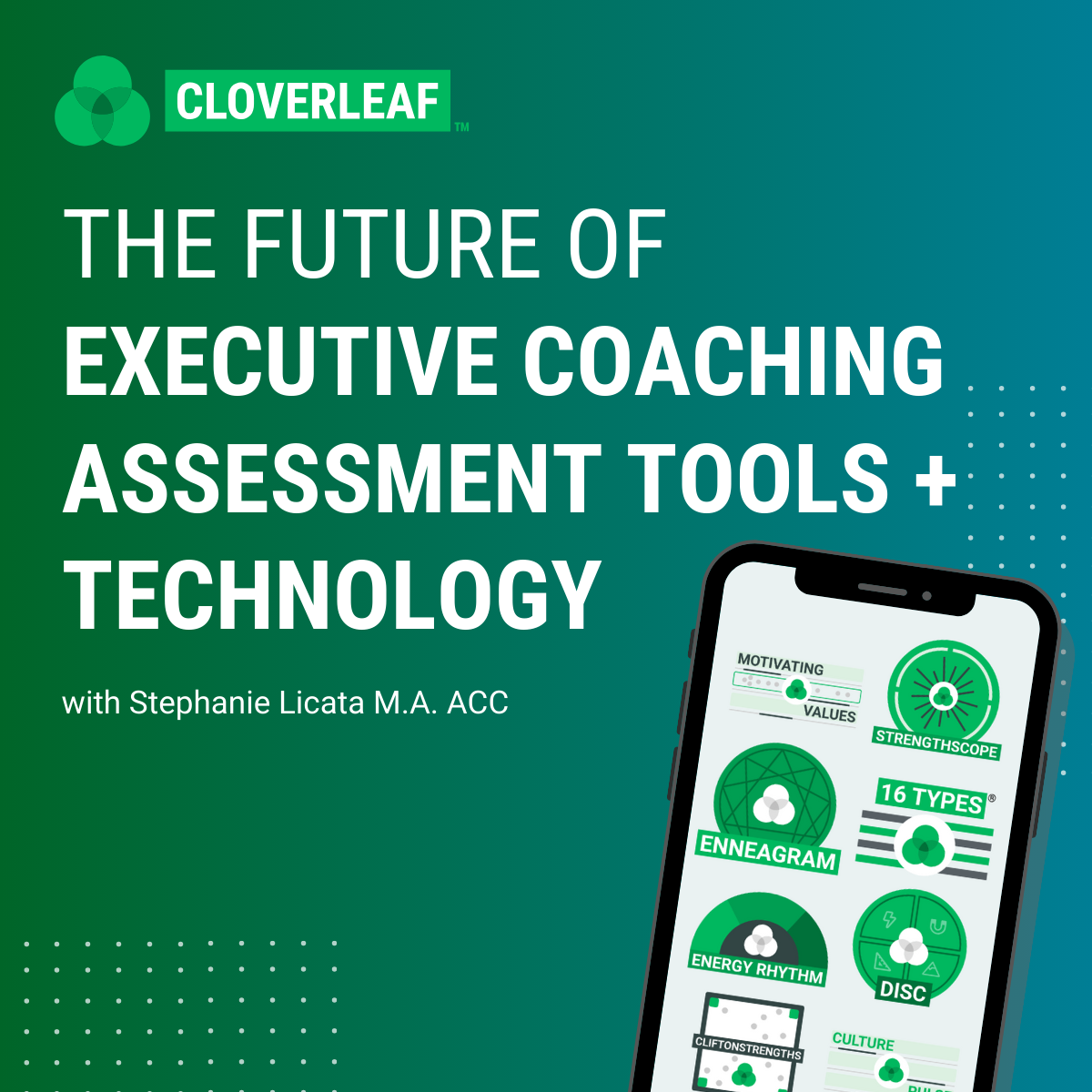
The Future of Executive Coaching Assessment Tools + Technology

Reading Time: 10 minutesWhen leadership fails to evolve, organizations pay the price. Misaligned priorities, disengaged teams, and slow decision-making can ripple through every layer of a business, creating costly delays and missed opportunities. Yet even as companies invest heavily in technology and technical skills, the critical human capabilities—like communication, adaptability, and emotional intelligence—often take a back seat. For executive coaches, this presents both a challenge and an opportunity. It’s no longer enough to deliver value during sessions alone. True impact happens in the moments between meetings, where behaviors are shaped, decisions are made, and leadership growth truly takes root. This is where executive coaching assessment tools can shine. By combining the depth of proven assessments (for example: DISC, 16 Types, Enneagram, and others) with the power of technology to automate just in time insights, coaches can amplify their influence—helping leaders align behaviors with business outcomes, even when you’re not in the room. The Untapped Potential Of Executive Coaching Assessment Tools​ Leadership assessment tools have long been a cornerstone of executive coaching, but their true potential often goes untapped. For many coaches, these tools remain static—limited to diagnostic reports or one-off feedback sessions. Yet today’s most pressing leadership challenges—communication bottlenecks, low emotional intelligence, and burnout under constant change—demand a more dynamic approach. Get the full report to build a talent assessment strategy that works as hard as your team. See Cloverleaf’s Powerful Assessment Tools In Action Try a Demo Executive leaders don’t need abstract personality reports—they need tools that help them show up better in their daily interactions, from critical decision-making meetings to one-on-one conversations with their teams. Popular coaching assessments like DISC, 16 Types, and StrengthsFinder are powerful starting points, but their real potential lies in how they’re applied. The challenge for coaches is ensuring that the insights uncovered during a session actually translate into meaningful action when it matters most. Here’s the good news: technology is making it possible to move beyond static assessments. Digital coaching tools can integrate insights and data-driven insights from assessments into a leader’s daily workflow, delivering timely and personalized coaching nudges that reinforce behavior change and emotional intelligence. These nudges don’t replace coaching sessions—they enhance them, giving leaders practical reminders to apply what they’ve learned in the real-world context of their workday. How do different assessment tools support executive leaders’ most pressing challenges: DISC: Communication bottlenecks are a common pain point for leaders managing diverse teams. DISC helps pinpoint where a leader’s communication style may be creating friction. When paired with technology, DISC insights can provide specific tips before meetings—like how to tailor messaging to the decision-makers in the room—resulting in faster alignment and stronger collaboration. 16 Types (MBTI-Based): Leaders often face cognitive diversity in their teams, which can lead to misaligned priorities. MBTI helps leaders understand their own problem-solving style and how it complements (or clashes with) others. When integrated into a platform like Cloverleaf, these insights become actionable, reminding leaders to adjust their approach during critical conversations to foster better strategic outcomes. Enneagram: Emotional blind spots can erode trust and hinder resilience in high-pressure situations. Enneagram reveals patterns of stress and motivation, helping leaders recognize and manage their triggers. With digital coaching, these patterns can be transformed into ongoing prompts—such as how to reframe challenges during periods of stress—building a foundation of emotional agility. StrengthsFinder (CliftonStrengths): Leaders who lean into their natural strengths can inspire greater team engagement and performance. StrengthsFinder helps identify these strengths, and digital coaching ensures leaders have actionable reminders—like how to use a strategic mindset to resolve conflict—embedded directly into their day-to-day tasks. Technology enables these assessments to go beyond diagnostic tools. By delivering just-in-time insights exactly when and where they’re needed—whether before a team meeting or via on-demand searchability—digital coaching platforms bridge the gap between awareness and action, helping leaders practice and refine key behaviors in the moments that matter most. The result is a new way of thinking about assessments: not just as tools for discovery but as dynamic instruments coaches can use with their clients to create real change. By leveraging technology to personalize and contextualize these insights, coaches can extend their impact, ensuring leaders are equipped to overcome the complex challenges of their roles every single day. Choosing and Applying the Right Assessment Tools Assessment tools are not one-size-fits-all. For executive coaches, the value lies in choosing tools that align with both the unique needs of their clients and the goals of the organizations they lead. It’s not just about identifying strengths or stress triggers—it’s about matching the right tool to the right leadership challenge, ensuring the insights are actionable and lead to measurable change. 1. Tailoring Tools to Leadership Challenges Each assessment brings a different lens to understanding leadership behaviors: DISC is ideal for leaders navigating communication and collaboration challenges across departments. 16 Types (MBTI-Based) works well for teams grappling with cognitive diversity and strategic alignment. Enneagram is very helpful for leaders working through E.Q. development or managing high-pressure environments with diverse groups of people. StrengthsFinder (CliftonStrengths) helps leaders shift focus from fixing weaknesses to maximizing their natural talents for team success. 2. Integrating Technology for Seamless Application Traditional assessments provide foundational insights, but pairing them with digital coaching platforms transforms them into actionable tools. Digital platforms allow coaches to: Provide leaders with timely coaching nudges that align with their daily challenges—reminders and actionable prompts delivered exactly when they can be applied to reinforce behavior change and emotional intelligence Connect coaching outcomes to leadership’s core objectives by focusing on productivity gains, cost efficiency, and employee retention. Highlight measurable improvements, such as faster project delivery times, reduced turnover, or enhanced customer satisfaction, to showcase coaching as a strategic, long-term investment.. Ensure coaching insights remain impactful by integrating them into key workday moments, such as preparing for high-stakes meetings, delivering constructive feedback, or making critical decisions. This context-driven approach keeps growth tied to real-world leadership priorities. 3. Balancing Diagnostic and Developmental Use While some assessments excel at diagnosing leadership tendencies, others provide more developmental guidance. For example: Use

People Development Strategies For Talent Leaders

New People Development Strategies For Talent Management Leaders

Reading Time: 8 minutesPeople development is no longer a matter of simply offering training sessions. Today’s leaders face a more complex challenge: building stronger teams while proving the ROI of these initiatives, all without sacrificing productivity. With traditional training methods struggling to keep up, the challenge is no longer just about offering learning opportunities but integrating them into everyday work in a way that drives measurable outcomes. For example, consider companies that invest heavily in leadership workshops but struggle to see these skills applied on the job. This gap between training and real-world application leads to stagnant growth and missed opportunities. Employees are left juggling development and productivity as two opposing forces, often feeling that time spent learning pulls them away from their responsibilities. What is the real challenge? Training disconnected from daily work feels like a waste to participants and upper level leaders. Organizations need strategies to improve performance faster. Adding more training sessions is rarely the answer; it often comes down to embedding practical guidance into the flow of work so development happens when it’s needed most—on the job, in real time. The Productivity vs. People Development Paradox One of the toughest challenges for Talent Development leaders is the constant pull between getting work done and helping teams grow. High performance is always expected, but so is developing your people. This creates a paradox: time spent learning can result in time lost on the job. Workshops, one-on-one coaching sessions, or LMS can struggle to bridge this gap. While they can help provide valuable learning, these insights can seem abstract and disconnected from an individual’s daily responsibilities. As a result, people walk away with great ideas but rarely get the chance to apply them where they’d have the most impact. Research shows that growth happens when development isn’t at odds with productivity. The 70-20-10 model shows that learning is most applicable when relevant and contextual to one’s work. The 70-20-10 Model indicates that 70% of learning is experiential—in other words, it happens through doing. Another 20% comes through social interactions like mentorship or team discussions, and only 10% is formal. Yet, most traditional programs focus too heavily on that 10%, missing out on the opportunity to make development relevant to daily work. How much time and budget are wasted on programs and training models that don’t lead to meaningful improvements in team performance? The cost isn’t just lost time—it’s reflected in low engagement, high turnover, and missed growth opportunities. Ready To Scale People Development In Your Organization?​ Try a Demo People Development Strategies Are Evolving Workshops, formal training, and one-on-one coaching have their place but can struggle to match the speed and complexity of modern work environments. People need support that speaks directly to their work challenges. Teams face people problems, difficult feedback conversations, or collaboration issues that can’t wait for scheduled training sessions. What If Development and Work Do Not Have to Compete As Opposing Forces? Forward-thinking organizations have realized that pulling employees away from their daily responsibilities for formal training is not a one-and-done solution. Instead, development needs to happen where the work happens. By embedding personalized coaching into employees’ daily routines, companies can ensure that learning is relevant and immediately applicable, driving growth and performance without disrupting productivity. Effective development cannot happen by squeezing learning into downtime—instead, it should partner with work through practical, actionable learning. Teams need in-the-moment guidance that directly addresses the challenges they’re facing. It’s not about theory—it’s about helping individuals solve the problems they’re tackling right now, whether it’s managing team dynamics, navigating a tough conversation, or preparing for a project. Providing this kind of actionable support makes development practical and results-driven. Picture this: a manager preparing for a difficult conversation receives a personalized tip a few hours before the meeting, helping them adjust their approach. It’s fast, easy, and directly impacts the outcome of that interaction. This kind of support not only builds better skills but does so without pulling people away from their work. When development becomes a natural part of daily tasks, its impact grows exponentially. An integrated approach ensures that development directly influences employee growth and team performance to soften the tension between learning and productivity. Microlearning Tools To Build Skills in the Moment Microlearning addresses a critical gap in traditional development. Waiting for scheduled sessions often means teams miss out on immediate solutions to pressing challenges. Teams facing conflicts, feedback issues, or urgent decision-making can’t afford delays. In these fast-paced environments, learning that happens on demand and in direct response to current problems is vital. For example, an employee dealing with a tough client interaction can’t wait for a quarterly workshop on communication—they need help managing the situation effectively. Microlearning shines in these instances. It integrates learning directly into workflows, providing timely solutions that drive quick decision-making without interrupting productivity. Time-sensitive problem-solving becomes seamless when learning is immediately available. Whether it’s handling a difficult conversation or adapting project strategies, microlearning delivers insights precisely when needed, ensuring that development is actionable and applicable in the moment. This approach doesn’t just build skills—it ensures those skills are immediately put to use, allowing for continuous improvement and growth without sacrificing team performance. Using Tech To Support & Develop People In Every Role Personalized coaching used to be limited to top executives; however, with massive technological advancements, so much is possible today that was implausible a few short years ago. Using data from behavioral and strength assessments, learning can now be customized to each individual’s specific needs and situations. This means employees receive relevant guidance based on what they’re currently facing, whether it’s a challenging meeting or improving communication with a teammate. Unlike one-size-fits-all solutions, people development tools can provide context-specific advice that speaks directly to the person and their role. For instance, someone preparing for an important meeting might receive tips on how to better collaborate with a teammate who has a different problem-solving style. This way, coaching becomes practical, directly helping people navigate their daily responsibilities. Because this coaching is embedded into tools