When a single comment in a team meeting erodes the trust you’ve spent months building, generic leadership advice isn’t enough. Here’s how behavioral assessment-powered AI coaching provides the personalized strategies leaders need to rebuild trust—one personality type at a time.
Why are so many leaders struggling to rebuild trust on their teams?
Sarah thought she was being direct and efficient when she cut off her team member mid-presentation with, “Let’s just get to the point—this is taking too long.” What she didn’t realize was that her high-S (Steadiness) team member, who values harmony and process, experienced this as a personal attack on their competence and worth.
Within days, Sarah noticed the change. Her team member stopped contributing in meetings, avoided eye contact, and began responding to her messages with terse, formal replies. The trust that had taken months to build crumbled in a single moment.
Sarah’s experience reflects a broader crisis in leadership trust. According to PwC’s 2024 Trust Survey, while 86% of executives believe employees highly trust them, only 60% of employees actually do. This 26-point trust gap isn’t just a perception problem—it’s costing organizations productivity, innovation, and talent retention.
But here’s what most leaders don’t realize: the path to rebuilding trust isn’t one-size-fits-all. The same apology that resonates with a high-D (Dominance) personality might feel hollow to a high-C (Conscientiousness) team member. The transparency that builds trust with an Enneagram Type 8 might overwhelm a Type 9.
This is where the intersection of AI coaching and behavioral assessments creates unprecedented opportunities for leaders to rebuild trust with precision, not guesswork.
Why personality differences influence the way trust is rebuilt
Most leadership advice treats trust rebuilding like a universal formula: apologize sincerely, be transparent, follow through on commitments, and give it time.
While these elements matter, they overlook an important reality of human behavior: people experience and rebuild trust in different ways, shaped in part by their personality and communication style.
Research in organizational psychology and behavioral science shows that personality traits and communication preferences strongly influence how individuals perceive and repair trust after a breakdown.
People don’t just respond to broken trust with logic — they respond through emotion, values, and preferred ways of communicating. A behavior that feels like accountability to one person might feel like criticism to another.
Get the free guide to close your leadership development gap and build the trust, collaboration, and skills your leaders need to thrive.
Consider these personality dynamics and how they can impact trust:
Imagine a leader’s dilemma who is a high-D on DISC:
“I made a quick decision without consulting my team, and now they don’t trust my judgment. I’ve explained my reasoning multiple times, but they’re still resistant.”
For this leader, the issue isn’t lack of explanation—it’s mismatch. Their direct, results-focused style clashes with teammates who value collaboration and reflection. A high-S (Steadiness) personality, for instance, needs reassurance that their input will be considered next time, not another logic-driven justification.
The Enneagram helps articulate personality complexity and differences too:
A Type 1 (Perfectionist) who makes a mistake rebuilds trust through clear structure and prevention plans. A Type 7 (Enthusiast) interprets that same structure as criticism and instead needs optimism and relational reassurance. The same “I’m sorry” lands in two completely different ways.
Behavioral economics helps explain this. When trust breaks, the brain’s threat system activates; people become hyper-alert to signs of future harm. The stimuli that trigger this alertness—and the signals that calm it—depend on individual traits.
Leaders need situational empathy—an understanding of how each person’s behavioral style shapes what trust repair actually looks like to them.
This is precisely where AI coaching grounded in validated assessments becomes powerful. By combining behavioral data from tools such as DISC, Enneagram, and 16 Types with real-time context, AI coaches can translate psychological theory into practical, everyday language and coaching: what to say, how to say it, and when it will resonate most.
How can AI use personality data to help leaders rebuild trust
Rebuilding trust after a leadership misstep takes more than a good apology—it requires understanding how each person experiences that rupture.
Cloverleaf Coach brings that understanding to life by combining **validated behavioral assessments** (DISC, Enneagram, 16 Types, CliftonStrengths®, and others) with AI coaching to provide personalized trust rebuilding strategies.
Here’s how it works: the AI interprets a leader’s team personality data, identifies potential blind spots in communication or decision-making, and provides real-time guidance on how to repair and strengthen trust.
Instead of offering generic advice, Cloverleaf transforms personality insights into specific, situation-aware actions that help leaders rebuild relationships with precision and empathy.
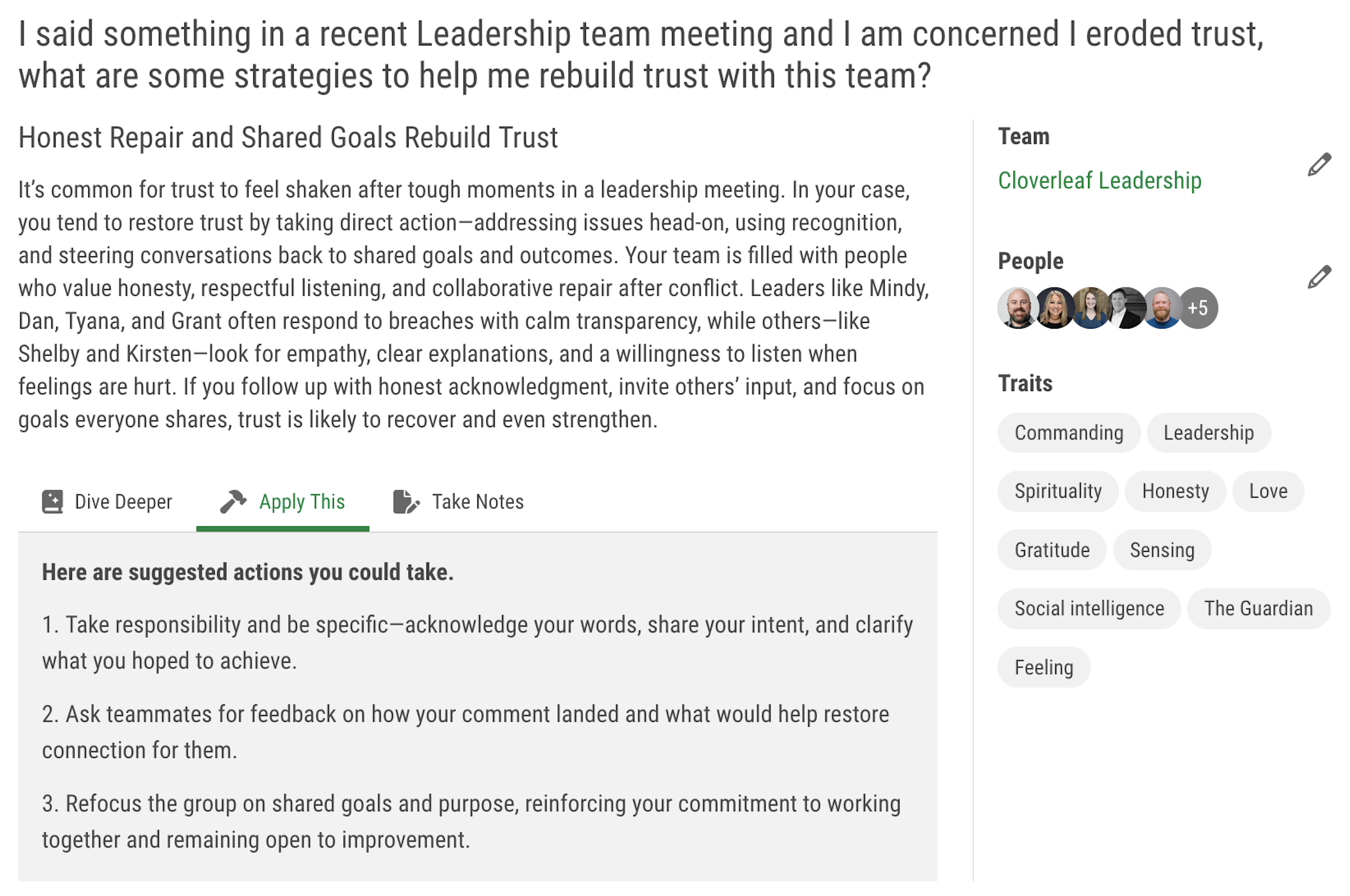
See Cloverleaf’s AI Coaching in Action
AI coaches can interpret personality insight to recommend useful next steps for rebuilding trust
Cloverleaf Coach transforms behavioral assessment data into actionable trust recovery strategies through several key capabilities:
1. Searchable, Situational Guidance
Cloverleaf allows leaders to type in specific scenarios: “How do I rebuild trust with Avery after giving them inaccurate project requirements?” The AI provides coaching tailored to both the situation and the personality involved.
2. Real-Time Micro-Moment Coaching
Trust isn’t rebuilt in one grand gesture—it’s restored through consistent, everyday interactions. Cloverleaf’s AI delivers **bite-sized nudges** through Slack, Teams, and email based on each person’s behavioral tendencies and timing within the workday.
👉 Morning nudge: “Jordan values consistency. Consider starting today’s 1:1 by acknowledging their reliable contributions before discussing new changes.”
👉 Pre-meeting prompt: “Remember: Riley processes decisions through security concerns. Frame your proposal in terms of risk mitigation, not just opportunities.”
3. Team Dynamics Intelligence
Cloverleaf is team intelligent because it understands how different personality combinations interact. It can predict potential friction points and suggest preventive strategies:
💡 “Your high-D communication style may feel overwhelming to Kai. Consider slowing your pace and asking for their input before moving to solutions.”
💡 “The tension between your Type 8 and Type 9 team members likely stems from different conflict styles. Here’s how to facilitate their next interaction…”
How AI coaching can turn trust building into a cultural practice
Most trust breakdowns don’t happen because leaders don’t care — they happen because leaders don’t recognize how their behavior lands differently with each person. Knowing that is one thing; remembering to adjust in the moment is another.
That’s where AI coaching becomes useful. It doesn’t “fix” trust or prescribe scripts. Instead, it helps leaders stay aware of how their actions affect others, and it reinforces those adjustments over time — so repairing trust becomes something people practice, not just talk about.
Rather than following or attempting to remember a rigid framework, AI coaching helps reinforce habits of of building or repairing trust:
1. Understanding What Broke Trust
When relationships feel strained, it can be hard for a leader to see the situation clearly. AI coaching helps by combining behavioral data with everyday context — who’s involved, what the interaction looked like, and what personality factors might be shaping the reaction.
It might highlight that a direct message came across as dismissive to someone who prefers more collaborative discussion, or that a lack of follow-up made a detail-oriented team member question reliability.
This isn’t about blame. It’s about perspective — helping the leader see the situation through the other person’s lens so their repair efforts start from understanding, not assumption.
2. Finding the Right Next Step
Once leaders understand what went wrong, the next challenge is knowing how to re-engage. Cloverleaf’s AI uses personality and communication data to suggest phrasing, timing, or approaches that fit both the relationship and the moment.
That might sound like:
“Before tomorrow’s meeting, take a minute to acknowledge how this change may have felt sudden to Jordan. Reinforcing stability first will help them hear what’s next.”
The goal isn’t to automate empathy — it’s to make it easier to express. By surfacing reminders and suggestions in tools like Slack or Teams, leaders can show up with intention instead of reacting on autopilot.
3. Rebuilding Trust Through Small, Consistent Signals
Trust repair doesn’t happen all at once; it happens through steady, reliable behavior. Cloverleaf’s AI nudges help leaders stay consistent — to follow up, recognize effort, and check in when it matters most. Over time, these micro-interactions start to reshape how people experience the relationship.
It might mean remembering to circle back after feedback, or taking a moment to name progress in a project recap. These are small actions, but they signal care and accountability — the foundation of trust.
4. Recognizing When Trust Has Started to Recover
One of the hardest parts of leadership is knowing whether your efforts are making a difference. Because Cloverleaf tracks behavioral patterns and feedback moments, it can surface early signs of recovery: participation returning in meetings, warmer tone in responses, or greater collaboration across the team.
These subtle changes often go unnoticed, but when leaders see them reflected back, it reinforces that consistency pays off. That reinforcement makes trust repair not just possible, but sustainable.
In essence: AI coaching doesn’t replace emotional intelligence; it helps leaders *apply* it more consistently. It keeps the science of behavior change close to the moments that matter — the quiet, everyday interactions where trust is either rebuilt or lost.
The Future of Developing Trust-Aware Leadership
The integration of AI coaching with behavioral assessments represents just the beginning of trust-aware leadership. Emerging capabilities include:
Predictive Trust Analytics
Cloverleaf’s AI is developing the ability to predict trust issues before they occur by analyzing communication patterns, personality combinations, and team dynamics. Leaders receive early warnings: “Your upcoming decision may create trust concerns for your high-S team members. Here’s how to frame it…”
Cultural Trust Intelligence
As organizations become more global and diverse, Cloverleaf is expanding beyond personality assessments to include cultural intelligence, helping leaders navigate trust building across different cultural contexts while maintaining personality awareness.
Organizational Trust Mapping
Future capabilities will provide organizational-level trust mapping, showing trust networks, identifying trust influencers, and suggesting systemic interventions to build high-trust cultures at scale.
Rebuilding Trust Always Starts With Understanding
The most sophisticated AI coaching in the world can’t replace authentic human connection, but it can help leaders ensure that their efforts to rebuild trust land in ways that resonate with each team member’s unique personality.
Sarah, the leader from our opening story, discovered this firsthand. When she used Cloverleaf Coach to better understand her high-S teammate, the suggestion was simple but powerful:
“I realize my comment made you feel like I don’t value your thorough approach. Your attention to detail is exactly what this project needs, and I want to make sure you feel supported in bringing that strength forward.”
That one shift — from explanation to empathy — changed the tone immediately. Within days, their collaboration returned to normal.
Trust doesn’t have to be rebuilt through trial and error. When you understand how different personalities experience trust breaches and recovery, you can rebuild relationships with precision, authenticity, and lasting impact.
Even the smartest AI can’t repair trust for you — but it can help you understand where to begin.
Ready to accelerate how you build trust with your team? Cloverleaf Coach combines validated behavioral assessments with AI-powered coaching to provide the personalized strategies you need. Because trust isn’t one-size-fits-all—and neither should your approach to rebuilding it.
86% of users say their teams become more effective with Cloverleaf Coach. Discover how behavioral assessment-powered AI coaching can help you rebuild trust and strengthen your leadership impact.