
Why emotional intelligence matters in the age of AI
As artificial intelligence becomes embedded across nearly every aspect of organizational life, companies are discovering that technology alone can’t close the gap between efficiency and employee engagement. The real opportunity lies in using AI not just to automate tasks, but to elevate human connection and emotional intelligence across the workforce.
Recent studies highlight this disconnect: while over 90% of Fortune 500 companies report adopting AI tools, only about one in three employees use them daily—often citing lack of trust, context, or personal relevance as the reason (Deloitte 2024 Human Capital Trends Report; Accenture 2024 Work Trend Index).
This gap isn’t technical—it’s emotional. Employees won’t engage with systems they don’t trust, and no algorithm can replicate true empathy or human connection. That’s why the next wave of AI transformation will be defined by emotional intelligence (EI) — not artificial empathy, but authentic understanding.
Get the free guide to close your leadership development gap and build the trust, collaboration, and skills your leaders need to thrive.
What most companies get wrong when trying to make AI more emotionally intelligent
Most organizations today try to make AI seem emotionally intelligent—training it to recognize facial expressions, tone, or sentiment. But even the most advanced large language models can’t truly understand nuance, empathy, or human intent (MIT Sloan Review, 2024).
Tools that may sound empathetic but often fail to respect context or cultural sensitivities. Employees sense this disconnect, which can lead to mistrust or even pushback against workplace AI initiatives.
Instead of trying to make AI more “human,” the more effective path is to use AI to make humans more emotionally intelligent. That’s the foundation of Cloverleaf’s philosophy: leveraging behavioral data from validated assessments to build emotional intelligence in people—helping teams communicate better, build trust faster, and lead with empathy.
It’s not about AI having emotional intelligence—it’s about AI helping people practice and apply theirs more effectively.
As AI adoption accelerates, many companies are realizing that building technology that do not consider emotional intelligence leads to adoption failure.
What’s the problem with trying to build emotional intelligence directly into AI systems?
Many organizations assume that the next competitive edge lies in teaching AI systems to feel or understand human emotions. While this sounds futuristic, it misunderstands both the limits of current technology and the real challenge of organizational adoption.
Even advanced large language models can simulate empathy, but they don’t experience it. As the MIT Sloan Management Review notes, AI tools can analyze tone and sentiment, yet they lack the contextual awareness that defines genuine emotional intelligence — understanding why a person feels something and how to respond appropriately in a team setting.
This gap creates risk for organizations that deploy “emotionally aware” AI too quickly:
- Perceived insincerity: When AI-generated responses mimic empathy poorly, employees disengage or lose trust.
- Cultural misalignment: Emotion detection models often perform inconsistently across languages or cultural contexts (Harvard Business Review, 2024).
- Privacy and ethics concerns: Emotional data collection (e.g., facial analysis or voice stress) raises surveillance fears that can erode psychological safety.
Ultimately, embedding emotional intelligence directly into AI isn’t just technically difficult—it can backfire. It risks replacing human connection with algorithmic mimicry, exactly when workplaces need more empathy, not less.
The most successful organizations are taking a different approach: using AI to develop emotional intelligence in people, not to replicate it in machines.
Technology can surface insights, but only people can create connection.
See Cloverleaf’s AI Coaching in Action
What’s a better way to combine AI and emotional intelligence at work?
The most effective organizations are flipping the question. Instead of asking “How can we make AI more emotionally intelligent?” they ask “How can we use AI to make our people more emotionally intelligent?”
That’s a seemingly small but powerful shift, one that redefines the future of leadership and learning.
AI doesn’t need to imitate human emotion to be valuable. Its strength lies in processing behavioral data at scale and translating that data into timely, actionable insights that help people understand themselves and others more deeply.
When used this way, AI becomes a coach, not a chatbot — a system that reinforces empathy, communication, and collaboration in the moments that matter most.
This is precisely the philosophy behind Cloverleaf’s AI Coach. By combining validated behavioral assessments like DISC, Enneagram, and 16 Types with workplace data, Cloverleaf delivers personalized coaching insights directly within tools people already use — such as Microsoft Teams, Slack, email, and entire HRIS systems. The result is continuous, context-aware coaching that strengthens relationships and drives performance.
Unlike tools that try to simulate empathy, Cloverleaf’s approach helps real humans practice it — supporting leadership development, feedback conversations, and team collaboration. It’s not AI that replaces human understanding, but AI that multiplies it.
True emotional intelligence at work doesn’t come from machines that can display a sense of feeling. It comes from humans who are able to understand and respond to one anothr — and AI that helps them do it better.
How can organizations use AI to build emotional intelligence in real workplace workflows?
Start With Human Outcomes
Define success by how AI deepens connection and understanding—not just productivity. Prioritize outcomes such as trust, adaptability, and communication effectiveness.
Pro tip: Anchor your AI strategy in validated behavioral frameworks to ensure every insight ties back to human growth, not system optimization.
Certainly, development programs — quarterly trainings, manager bootcamps, or annual offsites — create awareness.
But without consistent reinforcement, even the best leadership and emotional intelligence training fades by Monday morning.
AI can solve that dynamic by moving coaching from the classroom into the workday itself.
An AI coach does what no human or chatbot can. It captures the data and context that shape how someone actually works — their communication style, relationships, goals, and upcoming challenges — and delivers insights in the moments when they can be applied.
That’s the difference between knowledge and behavior change.
1. Beyond human insight
AI coaching systems can connect data from behavioral assessments, collaboration patterns, and role expectations to see the whole picture of how a person works — not just their title or skill level.
This deeper understanding makes emotional intelligence practical. Instead of vague advice like “be more empathetic,” AI can surface context-specific guidance, such as how to adapt your feedback for a teammate who values precision over speed.
2. Delivers the right insight at the right time
Most learning happens in micro-moments: before a meeting, during feedback, or while preparing a difficult message.
An AI coach can detect those moments and proactively surface relevant insights — without the employee having to seek them out or even know what to ask.
It turns “I wish I’d remembered that workshop tip” into “That’s exactly what I needed, right now.”
3. Connects every data point in the employee experience
A true AI coach draws from multiple systems — HR platforms, performance data, team structures, and validated behavioral assessments — to understand not just what people do, but how and with whom they do it.
By connecting these data points, the AI can provide coaching that aligns with individual goals and team dynamics, reinforcing learning between human coaching sessions or L&D programs.
4. Intelligence on every team dynamic
Growth doesn’t happen in isolation. An AI coach understands that development is relational — how people collaborate, communicate, and make decisions together.
By recognizing patterns across teams, it can prompt inclusive behaviors, prevent friction, and strengthen collaboration before issues escalate.
In this sense, AI becomes not just a personal coach, but a team coach — amplifying the impact of emotional intelligence across entire departments.
Implementing AI with emotional intelligence means using data and behavioral science to help people grow — not to replace human connection, but to strengthen it.
Bringing Emotional Intelligence to Life with AI
Implementing AI with emotional intelligence isn’t about adding another system or automating empathy. It’s about designing technology that helps people become more self-aware, connected, and capable in the moments that matter.
Start with what you already know about your people — validated behavioral data, feedback loops, and team dynamics — and build from there. Prioritize privacy and consent, ensure transparency, and use AI to reinforce what great leadership programs already teach: empathy, adaptability, and communication.
When AI operates with emotional intelligence, it amplifies human potential. It reminds us that insight only becomes impact when it reaches people at the right time, in the right way.
The question isn’t whether AI can understand us. It’s how we’ll use it to understand one another better.
Explore the Future of Coaching — Human + AI
The most effective organizations aren’t choosing between human or AI coaching — they’re blending both.
Human coaches bring depth, empathy, and context. AI brings scale, consistency, and reinforcement in the moments that matter most.
Together, they create a continuous learning ecosystem where leadership development becomes personal, measurable, and sustainable.
👉 See how AI and human coaching work together to help organizations democratize growth without losing the human connection that makes it meaningful.
I’m a big fan of the Hidden Brain podcast by Shankar Vedantam. Shankar has spent his entire career focused on human behavior, and if you’re interested in organizational behavior or leadership development, his work is essential.
The most recent episode, “Relationships 2.0: Become a Better Negotiator,” instantly became one of my all-time favorites—and it’s a must-listen. In this episode, Shankar speaks with behavioral scientist Max Bazerman about how cognitive biases can quietly undermine our ability to negotiate effectively.
What struck me most was Bazerman’s insight that while we often focus on persuading others in negotiation, we rarely examine our own blind spots. We assume we’re objective, rational, or “right”—but our overconfidence and self-centered thinking can lead to outcomes that are far from optimal.
This article isn’t a negotiation playbook. It’s about something more profound: how emotional and relational intelligence shape the way we communicate, influence, and make decisions, particularly in environments where collaboration and alignment matter.
Because let’s be honest—negotiation doesn’t just show up in boardrooms or contract talks. It’s there when you’re aligning cross-functional teams, giving feedback, proposing new ideas, or trying to secure resources. And often, what gets in the way isn’t the other person. It’s us.
Get the free guide to close your leadership development gap and build the trust, collaboration, and skills your leaders need to thrive.
What We Get Wrong About Negotiation
In the episode, Max Bazerman highlights something most of us miss: our most significant obstacle in negotiation isn’t usually the other party—it’s ourselves. We’re often so focused on persuading or winning that we fail to recognize the hidden cognitive biases shaping our own approach.
Bazerman explores how overconfidence and self-centered thinking consistently derail even the most well-intentioned negotiators. We assume our logic is sound, our goals are fair, and our strategy is smart. But when we neglect to account for how our own blind spots distort reality, we walk away with less-than-ideal outcomes—and sometimes, without even realizing it.
One concept he introduces is the “veil of ignorance”—a powerful mindset shift that asks us to consider decisions as if we didn’t know which side of the outcome we’d be on. It’s a way of neutralizing our self-interest and approaching negotiation from a place of fairness and perspective-taking.
Bazerman backs this up with real-world stories, like Robert Campo’s acquisition of Federated Department Stores and Matthew Harrington’s baseball contract negotiations. In both cases, personal bias and lack of perspective led to missed opportunities or fractured deals, not because the negotiators lacked strategy, but because they lacked self-awareness.
This isn’t just theoretical. Research shows that overconfidence is one of the most pervasive decision-making biases in business. According to a 2012 study published in Organizational Behavior and Human Decision Processes, individuals who are overconfident tend to overlook critical information and underestimate risk, two tendencies that are particularly costly in collaborative environments.
And while these examples come from the world of business and sports, the dynamics are just as present in everyday workplace negotiations:
- A manager pushing for budget approval without understanding competing team needs.
- A team member advocating for their project without listening to leadership’s broader goals.
- Or two departments struggling to align on shared priorities because no one paused to ask: “What assumptions are we making?”
If negotiation is about outcomes, then awareness—of self and others—is the most overlooked advantage.
Make Team Development More Impactful
See How High Performing Teams Use Tech To Equip Their Leaders
Why Self-Awareness Alone Isn’t Enough
The essence of this episode is clear: it takes both self-awareness and other-awareness to increase our capacity for emotional intelligence.
It isn’t enough to simply understand yourself better, which the traditional behavioral assessment market has done an adequate job of in the past. It requires that you understand yourself in the context of the people you are trying to communicate with in order to effectively sell ideas and achieve the desired outcomes.
This is illustrated in the following graphic.
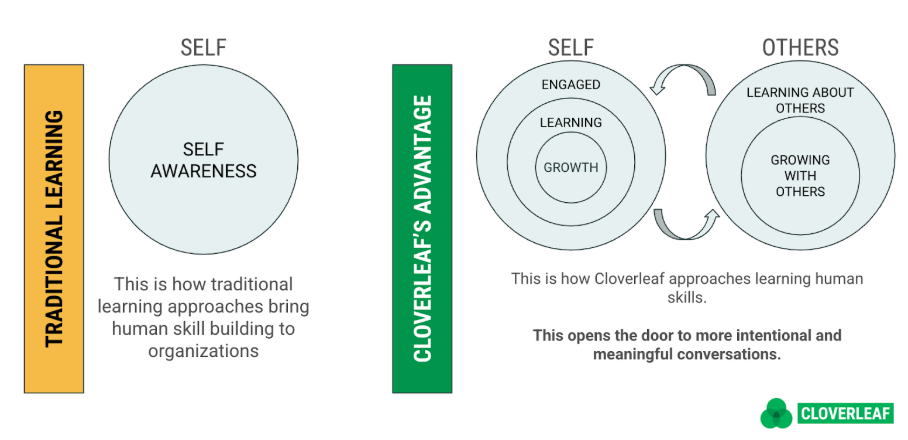
On the left, we see what most traditional learning experiences focus on—solo development. These tools often provide valuable individual insights, but they are static. They lack the dynamic interplay that happens in real relationships. You learn about yourself, but not how your behavior impacts others, or how theirs impacts you.
On the right is the model Cloverleaf was built around:
☘️ A continuous loop of learning about others and growing with others
☘️ Self-awareness that’s active, contextual, and relational
☘️ Growth that happens not in isolation, but in the actual flow of work and interaction
This distinction matters.
As organizational psychologist Tasha Eurich puts it, People who have high internal self-awareness and low external self-awareness can come across as arrogant or oblivious. In other words, knowing yourself isn’t enough if you can’t see how others experience you.
Most development and assessment platforms deliver data and reports, but rarely provide the context needed to act on them in relationships. That’s why even well-intentioned training programs struggle to create lasting behavior change: the learning doesn’t live where the communication happens.
At Cloverleaf, we intentionally designed our experience to go beyond the individual. Not just to teach people about themselves, but to teach people how to interact more effectively with the people they work with every day.
Turning Insight Into Practice: What Teams Need to Reinforce Human Skills
The challenge isn’t understanding the importance of emotional intelligence—it’s consistently applying it in the messy, fast-moving reality of daily work.
Reading an article, listening to a podcast, or attending a workshop can spark awareness. But unless those insights are revisited and reinforced in real interactions, they rarely change how people communicate, collaborate, or lead.
This is the gap Cloverleaf was built to close. It’s not just a reflection tool—it’s a system designed to bring awareness into moments that matter most.
Consider a few everyday scenarios:
- Before a feedback conversation, Cloverleaf reminds you that your teammate tends to process input more slowly and prefers written reflection before discussing live. So, instead of jumping in during a meeting, you follow up with an email and a plan to talk tomorrow, ensuring the conversation lands more effectively.
- During a project kickoff, you scan your team’s Cloverleaf dashboard and notice one colleague thrives on structure, while another gets energized by open brainstorming. You build a hybrid approach that plays to both styles, avoiding tension and building momentum.
- After a tough meeting, a coaching prompt surfaces on your dashboard: a reflection on how your communication style may have been perceived. It doesn’t just call out a blind spot—it invites you to adapt and grow.
These aren’t afterthoughts; they’re embedded into the flow of work. That’s the point. Emotional intelligence doesn’t live in content. It lives in context.
Research backs this up. According to the Ebbinghaus forgetting curve, we forget up to 75% of new information within six days if it’s not reinforced. But when insights are tied to real-time action—and especially when they involve other people—they stick. That’s the power of social and situational learning.
Cloverleaf doesn’t just help individuals learn about themselves—it helps teams learn with and through each other. And that’s how human skills become real habits.
What Talent Development Leaders Are Asking
These insights from Hidden Brain and Max Bazerman aren’t just interesting for individual professionals—they strike at the heart of what HR, Talent Development, and People Leaders are actively trying to solve:
👉 How do we move from individual learning to meaningful team development?
👉 How do we measure growth in emotional intelligence or negotiation skills, especially when outcomes are relational?
👉 How do we make soft skill development stick, beyond a one-time workshop or LMS module?
These aren’t abstract questions. They reflect the real tension between what organizations say they value (collaboration, communication, empathy) and how they actually support people in developing those skills.
These concepts are part of a broader shift—a move away from static content and solo learning experiences toward something more relational, more integrated, and more enduring. A shift from “training” to practice.
If emotional intelligence, bias-awareness, and better negotiation habits are going to become part of your team’s operating system, they need:
- Reflection prompts that appear when needed, not six months later.
- Collaborative learning experiences that reveal not just how I think, but how we interact.
- Tactical ways to practice, like reframing a disagreement using the “veil of ignorance,” or preparing for a conversation by considering how someone else sees the situation.
These moments are small—but they’re how real change happens. And the more intentional we are in designing for them, the more likely our learning programs will actually lead to lasting behavior change.
Because the truth is, no one develops communication skills in isolation. And no one becomes a better negotiator by just learning to win. They grow by seeing more clearly—both themselves and the people they work with.
What Might Change If You Started With Curiosity?
At its core, this episode of Hidden Brain isn’t just about negotiation. It’s about perspective. And the reminder that success in communication—whether in a deal, a team meeting, or a tough conversation—starts not with talking, but with seeing clearly.
That means noticing our own blind spots. It means pausing before we push our agenda to consider how someone else might see the same situation. It means asking better questions, not just having better answers.
So here’s one to sit with:
Where are my blind spots in how I communicate, collaborate, or lead—and who might help me see them?
If that question resonates with you, take 30 minutes to listen to the episode. Then try putting one insight into practice—not in a high-stakes negotiation, but in your next team conversation.
Relational learning isn’t just a theory. It’s a shift in how we show up. The more intentional we are about incorporating it into our everyday work, the more powerful it becomes.