
HR teams today are expected to deliver personalized, scalable, and seamless employee experiences—without adding more complexity or headcount. But the very systems built to support those goals are often the biggest barrier.
Most enterprise HR stacks have grown bloated and fragmented. With siloed COEs, disconnected tools, and a growing backlog of AI-powered solutions, leaders are left wondering how to drive meaningful impact without overwhelming their teams.
Workday remains a critical foundation—the system of record for people data, transactions, and compliance. But to meet the needs of today’s workforce, Workday AI integration must evolve beyond basic workflows. HR leaders need to rethink how Workday connects to coaching, learning, and cross-functional experiences that actually move the needle.
Get the free guide to close your leadership development gap and build the trust, collaboration, and skills your leaders need to thrive.
Why HR Tech Feels Fragmented (Even When You Have Good Tools)
The traditional approach to HR technology was built for process control, not people enablement. It focused on consistency, compliance, and automation—but fell short on adaptability, personalization, and strategic value.
Here’s what that often looks like today:
- COEs manage disconnected slices of the employee journey—each optimizing their own domain, often at the expense of the whole.
- Tools are underutilized or overlapping, with unclear ownership and inconsistent user experience.
- AI is bolted on as an afterthought, not integrated into workflows or connected to outcomes.
It becomes a patchwork of systems that fails to deliver on the promise of transformation. Employees still feel invisible. Managers are overwhelmed. And HR is stuck reacting instead of leading.
Make Team Development More Impactful
See How High Performing Teams Use Tech To Equip Their Leaders
The Biggest Barriers to Great HR Aren’t Tech—they’re Structural
Even in organizations with modern HR systems, the biggest blockers to transformation aren’t always technical—they’re structural. Silos form not just between departments, but within HR itself. Different COEs—like talent acquisition, L&D, and HR operations—often define and execute the same processes differently, leading to fragmented experiences and dropped handoffs.
One clear example: onboarding. Who owns it? Talent acquisition might claim it through pre-boarding, while L&D might say it belongs in development. But without a unified owner or shared framework, the employee gets a disjointed experience—and valuable context is lost before they even start.
This is more than a process flaw—it’s a culture problem. When data, tools, and responsibilities live in silos, it’s nearly impossible to deliver personalized coaching, integrated feedback, or cohesive growth plans that span the employee lifecycle.
Over the last 12 to 14 months of implementing Cloverleaf, we’ve started to see some silos fall… more cross-organization collaboration… that’s just the beginning. 💬 Kevin Mills, INSP
When teams can better understand each other—and leadership has visibility into who people are and how they work—collaboration becomes easier, culture becomes cohesive, and retention improves.
Silos don’t just block efficiency. They block trust, alignment, and the very outcomes HR is tasked with improving.
A Smarter Way to Build on What Workday Already Does Well
For many HR leaders, the instinct is to buy or build new tools to solve every emerging challenge—especially when AI enters the conversation. But layering new solutions on top of an already complex system often creates more fragmentation, not less.
That’s why organizations like GE HealthCare are taking a different approach: Workday first.
Rosellen Beck, Head of HR Technology and AI Enablement at GE HealthCare, shared that after GE’s corporate split, they inherited a tech stack designed for a massive conglomerate—not a streamlined healthcare business. Rather than starting from scratch, they audited their Workday environment to ask three key questions:
- Can Workday do it?
- Should Workday do it?
- Is Workday the right experience for this use case?
This considerations allowed them to consolidate vendors, reduce compliance risks, and streamline operations. It also provided a clean foundation for layering smarter, more human-centric solutions—like personalized coaching, skills mapping, and AI-driven insights—on top.
They invested in reworking security models, time and attendance, and talent processes directly within Workday. For example:
- Payroll was brought fully into Workday for better audit readiness
- Their talent lifecycle model was redesigned to reflect how the business actually works, not how the system defaulted
- Clunky 360 feedback was removed and replaced with facilitated, contextual conversations
In short, the platform became a launchpad for strategic evolution, not just a transactional engine.
💡 You can’t build a future-ready organization with legacy HR structures. — Rosellen Beck, Global HR Technology and AI Strategist
But GE HealthCare didn’t stop at process optimization—they used Workday’s simplification as a catalyst for rethinking how HR itself was structured and how change could be led cross-functionally.
Rosellen described their approach as “blowing up” traditional COEs and shared services, challenging whether HRBPs or People Ops teams should own development. It wasn’t just about streamlining tools—it was about building cultural readiness for transformation.
When Workday is used as a unified system of record—not a siloed set of features—it creates the data integrity and process backbone needed to power everything else: learning, coaching, feedback, planning, and more.
Visible Skills Data = Better Coaching, Planning, and Mobility
Skills-based talent management is one of the most talked-about priorities in HR today—but it’s also one of the most misunderstood. Too often, companies wait until they have a fully defined taxonomy, airtight governance, and clean data before launching anything at all.
GE HealthCare did the opposite—and it worked.
Rather than over-engineer a skills framework from the top down, they simply turned skills on in Workday. Employees were encouraged to self-report their skills—without validation, without structure, and without fear of doing it wrong. It was intentional. The goal wasn’t perfection—it was visibility.
And what they found was game-changing:
The skills employees said they had didn’t match what the business expected.Job profiles didn’t reflect the real skills needed to perform effectively.Learning paths weren’t aligned to either.
These gaps created instant value. Instead of investing months in design, GE had real data to spark real conversations: How are we defining success in key roles? Are we training for what we actually need? Where are our blind spots in succession planning?
Skills data didn’t need to be perfect to be powerful—it just needed to be surfaced.
💡 Pro Tip: GE began by piloting this strategy with a single business unit. By tying Workday’s native dashboards to grassroots mapping work, they created feedback loops between actual needs, stated capabilities, and strategic learning.
As Rosellen noted, the outcome wasn’t just a cleaner skills database. It was a better way to:
- Spot hidden talent and capabilities
- Prioritize role-specific learning and coaching
- Enable the business to co-own the strategy—not just HR
This is the future of skills: visible, conversational, and iteratively refined—not frozen in policy documents.
AI Connects the Dots—Workday Holds the Data, Cloverleaf Delivers the Coaching
AI is often hyped as a game-changer for HR—and it can be. But only when it’s used to make the employee experience simpler, faster, and more human—not just more automated.
At GE HealthCare, AI isn’t seen as a shiny dashboard. It’s being deployed to solve real-world workflow problems: how to reduce friction, enable proactive nudges, and help managers focus on people—not process.
Roslin described their approach as a “bot of bots” strategy: connecting Microsoft Copilot, ServiceNow, Salesforce, and Workday into one coordinated AI layer. This system isn’t just reactive—it’s designed to anticipate needs:
- Surfacing mid-year review reminders based on calendar activity
- Drafting check-in feedback based on goals, meetings, and priorities
- Identifying lagging sales metrics and suggesting coaching strategies
This kind of proactive AI creates time, clarity, and focus. Instead of waiting for HR reports or login prompts, employees get relevant coaching in the flow of their work.
Rather than an isolated assessment, I get a feel for the team from a much more holistic perspective… Cloverleaf really works to address specific team issues in particular. -💬 Erin Mires, Galen College of Nursing
Galen’s team is using Cloverleaf’s behavioral insights and AI-driven prompts to design development plans tailored to real team dynamics, not generic frameworks. By layering in assessments like DISC, Enneagram, or 16-types, they’re able to coach teams with specificity—without spending hours on analysis.
This is the sweet spot: Workday provides the structure and people data. AI connects the dots. Cloverleaf delivers coaching that lands.
This mentality can lead to a more personalized, scalable way to support managers and enable better conversations—without adding more tools or process.
Cloverleaf Is the Coaching + Personalization Layer for Workday
Workday is powerful—but it wasn’t designed to be personal. It excels at capturing people data, executing transactions, and enforcing compliance. What it needs is a way to bring that data to life through behavioral insight, human connection, and real-time coaching.
Cloverleaf acts as a personalization and coaching layer on top of Workday—helping organizations turn raw data into daily impact. Through seamless integrations (via Workday Extend or Built-on Workday apps), Cloverleaf connects directly to the systems HR already uses, enhancing—not replacing—existing processes.
Here’s how it works:
- 🔄 Skills Inference: Cloverleaf can suggest skills based on assessment data and feedback, enriching Workday profiles without requiring a new system or process.
- 💬 AI Coaching Nudges: Delivered through Slack or Teams, Cloverleaf provides
proactive, personality-informed insights to help managers lead more effectively. - 📈 Feedback Quality Boosters: Cloverleaf’s AI helps employees craft better feedback based on the recipient’s communication style, increasing psychological safety and clarity.
- 🧠 Integrated Development Plans: L&D teams use Cloverleaf to embed team dynamics and reflection tools into individual or team development journeys—without needing to leave their flow of work.
From health systems to higher education to media companies, organizations are using Cloverleaf to:
- Improve retention
- Reduce team turnover
- Enable distributed collaboration
- Coach new managers on real-world dynamics—not just abstract models
And with Workday as the backbone, Cloverleaf ensures every insight is grounded in source data, system-connected, and privacy-safe.
A Practical Path to People-Centered HR
The future of talent strategy isn’t about buying more tools—it’s about connecting the dots between the systems you already trust and the people you’re trying to serve.
Workday provides the structure. Cloverleaf brings the personalization. AI connects the two.
Together, they create a scalable, people-centered approach to HR—one that replaces disconnected systems and reactive processes with proactive coaching, skills visibility, and real-time enablement.
Transformation doesn’t require a 5-year roadmap. It starts with:
- Turning on visibility, even before governance is perfect
- Empowering teams to move fast with coaching nudges—not more training
- Using AI to reduce friction, not add complexity
- Measuring outcomes that matter: alignment, trust, performance, and growth
You don’t need to build it all yourself. You just need the right foundation—and the right partner to bring it to life.
Want to see what Cloverleaf looks like inside your team’s day-to-day?
Take a self-guided tour of Cloverleaf and experience how real-time coaching shows up in the moments feedback matters most.
🙋 FAQ
Q: Isn’t turning on skills without governance risky?
A: Not if your goal is insight. GE HealthCare’s approach shows that visibility leads to alignment. Governance can follow—not precede—adoption.
Q: Do I need Workday Extend to use Cloverleaf?
A: No. Cloverleaf offers both Built-on Workday apps and external integrations, depending on your Workday configuration.
Q: Can I use Cloverleaf without Workday?
A: Yes. Cloverleaf operates independently or as an enhancement to existing HRIS systems, including Workday.
Q: How is Cloverleaf different from traditional L&D or feedback tools?
A: Cloverleaf is the only science-backed AI coaching experience—so every nudge is tailored to how people actually think, work, and collaborate. It’s also fully customizable to your org’s leadership models and built into one platform, not bolted onto another. The result? Daily coaching that feels personal, reflects your culture, and actually drives behavior change.
Are you responsible for developing leadership and talent across an organization of hundreds—or even thousands—of employees?
You know how important coaching is for improving performance, fostering growth, and retaining top talent. But here’s the problem: how do you make that coaching truly personalized for each individual without adding a massive burden to your already full plate?
Scaling personalized coaching is one of the biggest challenges leaders face today. While there are countless development platforms out there promising personalization, most fall short when it comes to delivering insights that feel relevant and timely to each individual.
Leaders often end up with generic advice that’s loosely tied to broad milestones or role changes, leaving employees feeling disconnected from the coaching process. In modern organizations where efficiency and effectiveness matter more than ever, personalization at scale isn’t just a “nice-to-have”—it’s a necessity.
Why Personalization Matters To Your Leaders
A one-size-fits-all approach to talent development will struggle to resonate with participants. People want—and need—coaching that reflects their unique challenges, strengths, and daily work contexts.
Generic coaching content not only feels impersonal, but it can also lead to missed opportunities for growth, poor engagement, and even higher turnover.
Personalized coaching, on the other hand, ensures that each employee receives guidance tailored to their specific needs, making it far more impactful.
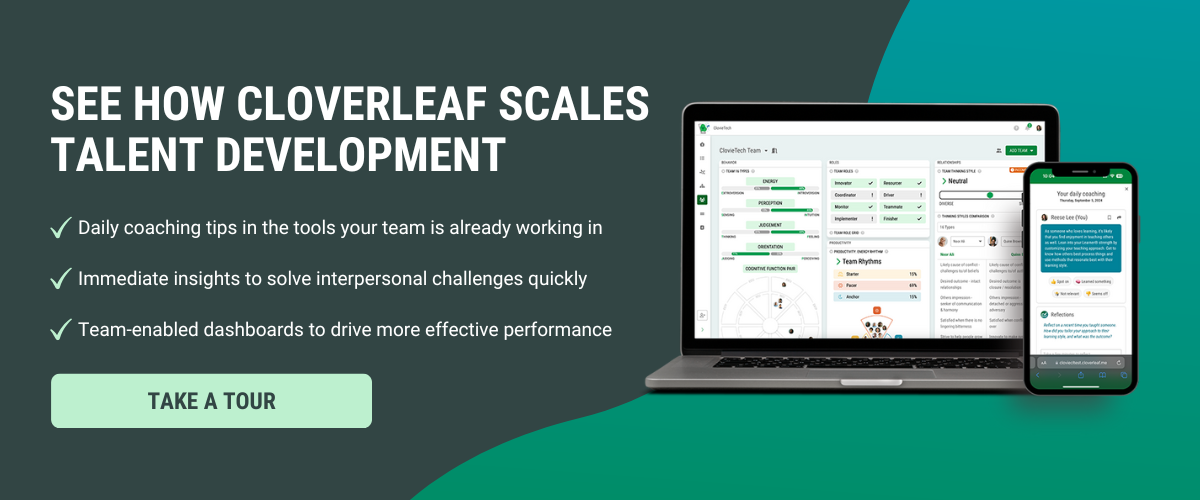
Most organizations struggle to provide individualized support at scale. Traditional coaching programs require time, money, and manual effort—resources that are in short supply. That’s why the ability to automate personalized coaching has become so crucial.
Automating real-time, context-specific insights allows organizations to deliver tailored support to every employee without burdening their leaders. This kind of personalization is meaningful and can transform your talent development strategy, making it scalable, relevant, and deeply impactful.
The Evolution of Personalized Coaching
Coaching has undergone a significant transformation over the past few decades. Historically, coaching was reserved for senior executives and was often and only delivered through face-to-face programs that focused on broad leadership skills or milestones like promotions. As companies recognized the value of coaching for leadership development, the approach started to shift towards more tailored methods.
One of the key moments in this evolution was adopting a coaching leadership style in the late 1990s, which emphasized individual challenges and goals rather than a programmatic model. This shift was driven by an understanding that people respond better to personalized feedback. Fast-forward to today, coaching has become increasingly data-driven, thanks to the rise of digital coaching tools that allow organizations to collect and analyze behavioral data in real time.
Solutions like automated coaching represent the next phase in this evolution. Platforms like Cloverleaf use technology to provide personalized feedback available at any moment that is specific to the person and their team. This approach moves away from previous methods of sharing coaching or advice during scheduled times or only if people hit job role changes.
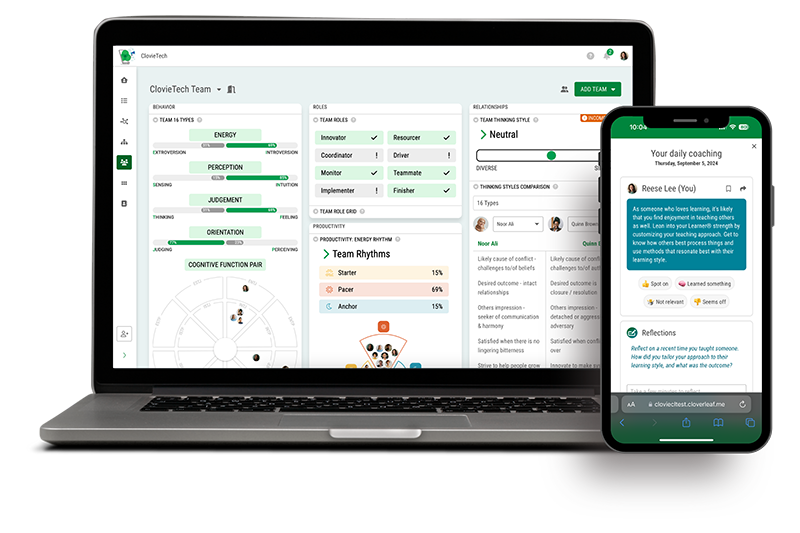
See How Cloverleaf Scales Talent Development
- Daily coaching tips in the tools your team is already working in
- Immediate insights to solve interpersonal challenges quickly
- Team-enabled dashboards to drive more effective performance
4 Trends That Are Shaping The Future Of Personalized Coaching
1. AI-Powered Coaching:
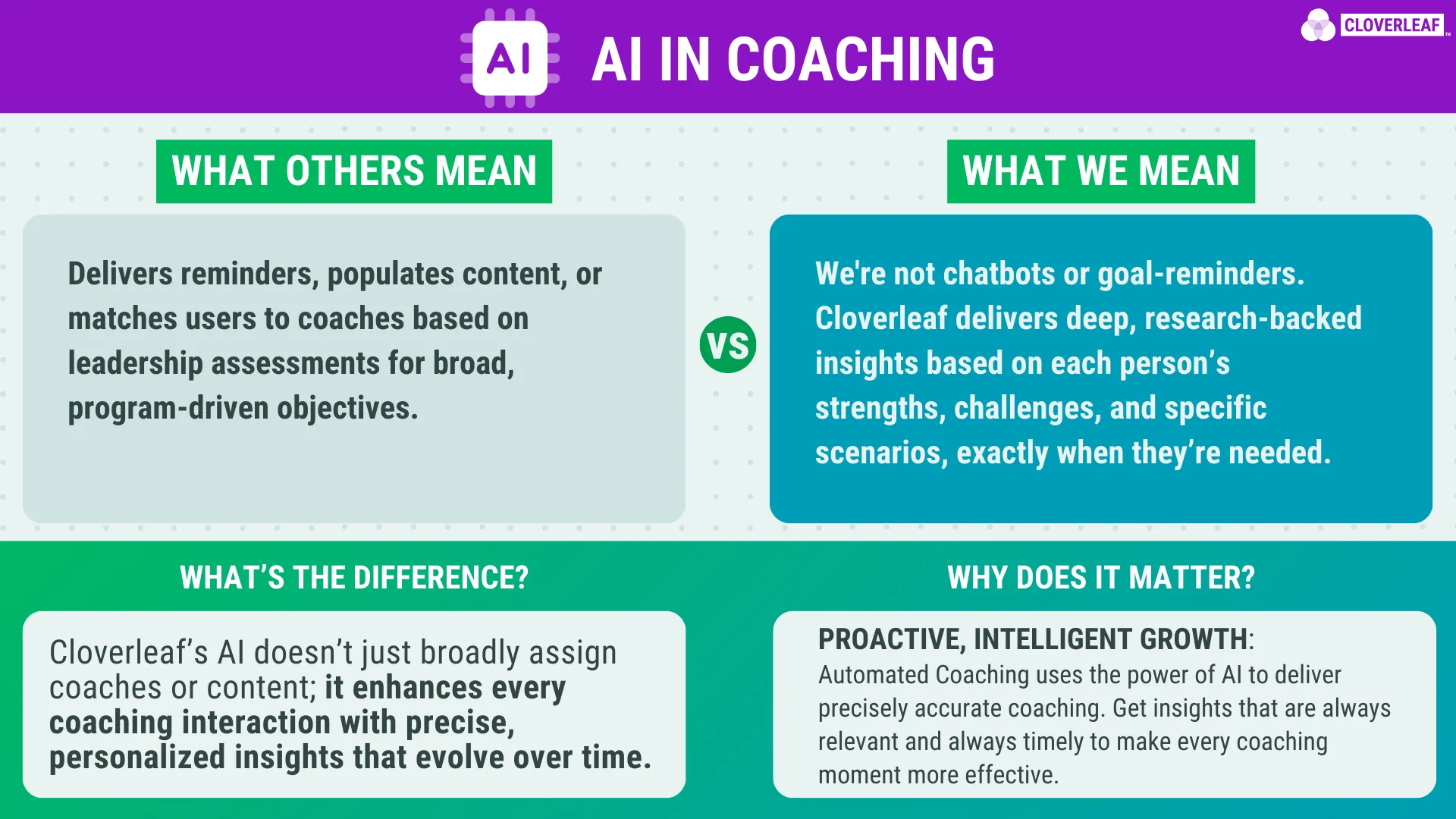
Generative AI and other technologies are being used to support and enhance coaching efforts. Rather than replacing human coaches, AI acts as a “co-pilot,” offering personalized nudges and prompts to reinforce valuable learning that happens in development programs or during coaching sessions. This extends the coaching process beyond scheduled meetings, ensuring that individuals receive continuous, tailored support.
2. Data and Performance Metrics:
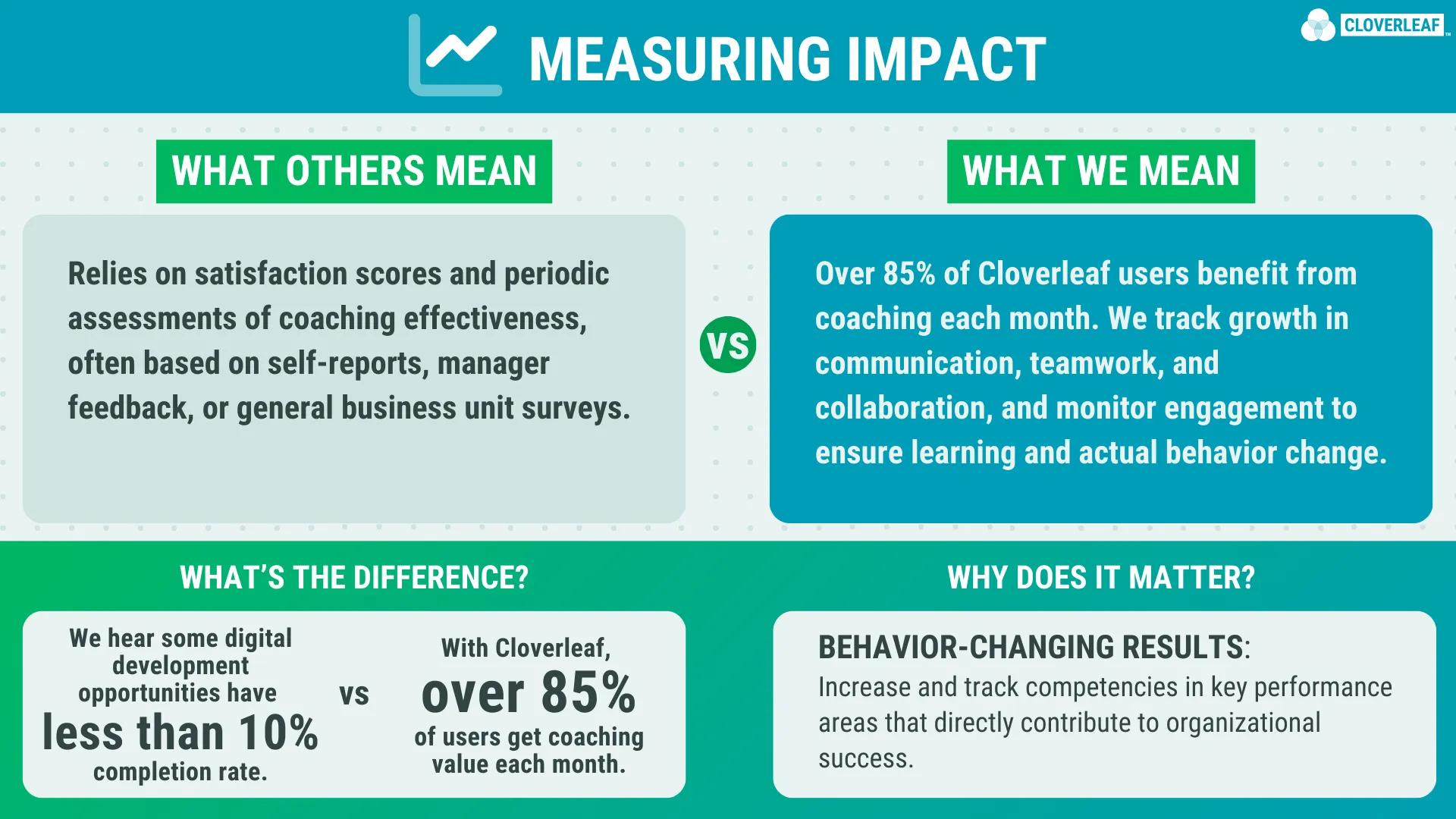
Leaders want to know the real impact of coaching. It’s not just about new learning or positive feedback—what matters is whether coaching is actually moving the needle on team performance. Is there a measurable change in behavior and skill application? What’s the return on investment (ROI)? Beyond sentiment and new knowledge, organizations need to see if people’s behaviors are changing in ways that improve the business.
3. Contextualization:
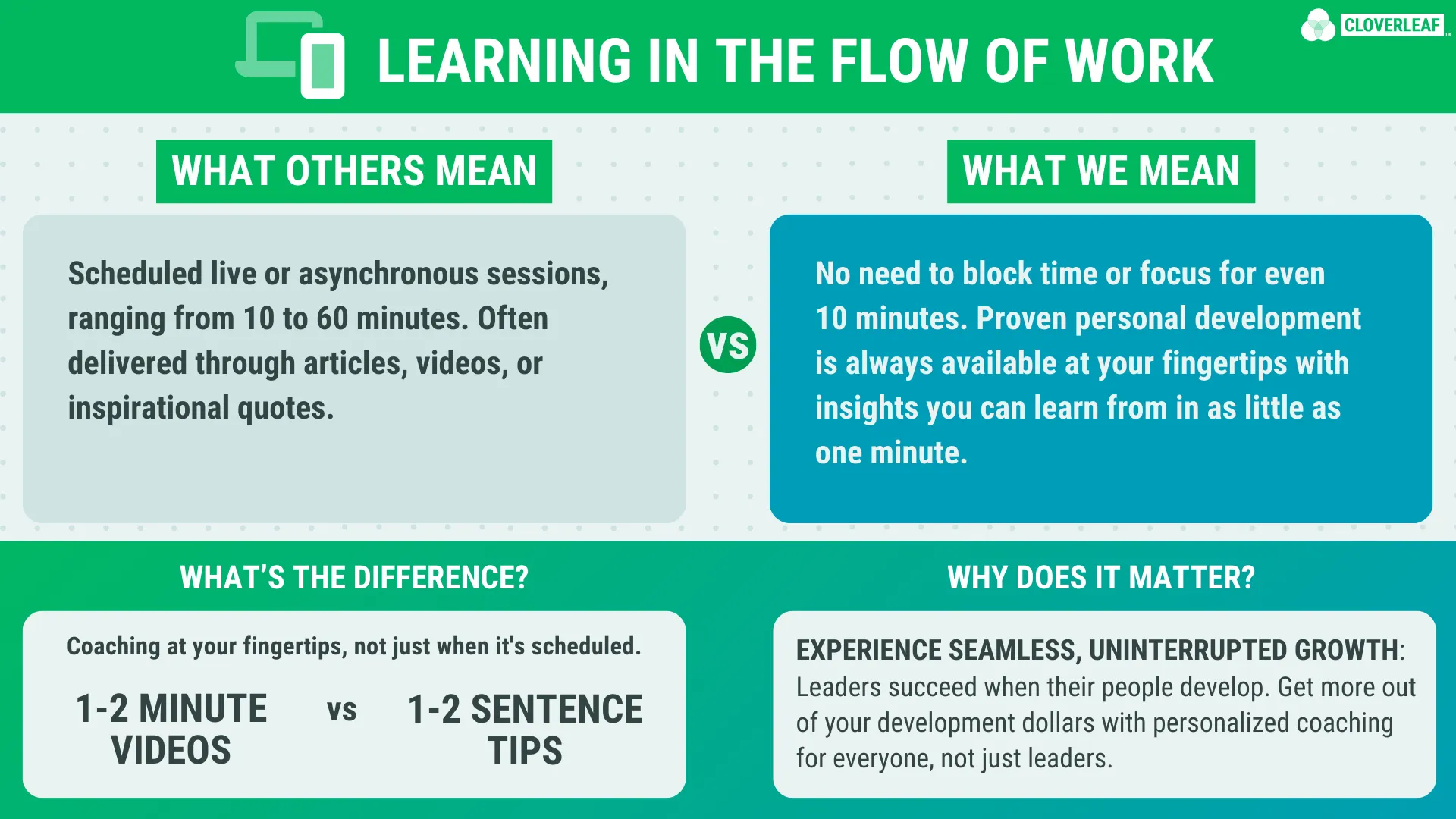
Unlike traditional coaching, available at predetermined times, contextual coaching delivers situation-specific guidance based on an employee’s current work challenges and interactions.
This approach ensures that coaching is actionable and relevant to what’s happening right now, allowing employees to apply the advice immediately, whether it’s before an important meeting or during a critical project, or whenever is best for the individual.
Contextual coaching integrates learning and development into the flow of work, making it both timely and impactful.
This trend is becoming essential as organizations strive to provide more targeted support without adding unnecessary friction to employees’ day-to-day tasks.
4. Remote and Hybrid Coaching:
The shift toward remote and hybrid work environments has pushed coaching to evolve. Virtual coaching, already gaining traction before the pandemic, has now become standard. This trend is further escalated by tools that provide micro coaching moments to ensure each team member receives timely, tailored coaching tips based on their current work challenges and team dynamics throughout their day.
The Demands For Personalization Are Pressing
Despite the advancements in coaching, many platforms struggle to deliver truly personalized coaching at scale. A common issue is that much of the “personalization” offered by many platforms is topical—often limited to role-based advice or broad, milestone-driven coaching. These solutions tend to trigger generic content based on fixed objectives, leading to disengaged participants who don’t feel that the coaching is truly relevant to their immediate needs.
In contrast, automated coaching solves these issues by offering timely, specific advice that is relevant to the individual’s behaviors, strengths, and current work situation. Rather than giving broad, general feedback, it provides coaching that’s action-oriented and contextual because it is about what is happening in the moment. This way, organizations can offer personalized coaching to everyone without overloading their leaders.
By understanding this evolution and leveraging technology, Talent Development Leaders can address the challenges of scaling personalized coaching to drive behavior change and improve performance across their organizations—without overwhelming themselves in the process.
See How Cloverleaf Scales Personalized Coaching
Take a look at Cloverleaf’s key features that can empower your people, build trust, and scale development effortlessly.
The 3 Necessary Components of Effective Personalized Coaching
For personalized coaching to be meaningful and drive behavior change, there are three essential elements to consider: aligning with individual needs, helping employees manage emotions and relationships, and providing support during key moments of work.
Each of these components ensures that coaching becomes practical and relevant, offering insights that people can apply right away to their unique challenges.
1. Resonance with Individual Needs:
For personalized coaching to be effective, it must genuinely connect with each person’s unique challenges and goals. Automated coaching platforms can layer behavioral assessment data like DISC, Enneagram, or 16 Types to better understand how people think, communicate, and approach tasks. This isn’t just about labeling personality traits—it’s about using those insights to provide advice that fits how an individual works in specific situations.
For example, someone who tends to be more detail-oriented may struggle in fast-paced environments. Automated coaching can recognize this tendency and send reminders or strategies to help them manage their workload more effectively in those moments. Likewise, for someone who thrives on collaboration but finds themselves in a remote working situation, the platform can suggest ways to stay connected and communicate more effectively with their team.
This process is powerful because the advice doesn’t come as a generic suggestion, like “work better with your team,” but as specific, situational guidance that feels relevant to what they’re dealing with right now. This could be a tip about managing time before a deadline or a suggestion on how to better frame an idea in a meeting with a team member who thinks differently. In short, it’s advice that feels useful immediately, helping employees put it into practice in the moment.
By providing this type of direct, situation-specific guidance, automated coaching tools make it easier for team members to take what they learn and use it right away, ensuring that the coaching feels both timely and effective.
2. Assist With Managing Emotions and Relationships in Real Time
Another aspect of effective personalized coaching is understanding how emotions and relationships influence workplace success. Emotional Intelligence (EQ) is about recognizing and managing your own emotions, as well as understanding how others feel and react in different situations. Automated AI coaching technology can consider this by analyzing an employee’s emotional tendencies, such as how they handle stress, communicate under pressure, or lead a team.
Rather than simply giving generic advice, these platforms offer specific, emotionally-informed tips that help employees manage difficult conversations, reduce stress, or adapt their leadership style based on their emotional strengths and challenges.
What makes this approach powerful is that it delivers insights exactly when they’re needed. So, instead of waiting for a coaching session to discuss these challenges, employees receive timely suggestions—for example, a quick reminder to take a breath and stay calm before a high-stakes conversation. Emotional intelligence coaching helps employees stay grounded in the moment and improve how they respond to stressful situations, leading to better team interactions and overall performance.
In high-pressure scenarios, like giving feedback to a team member or handling a tough client call, this coaching helps employees navigate their emotions effectively. By receiving a helpful nudge—like a suggestion to approach the conversation with empathy or patience—they can adjust their behavior accordingly, ensuring their emotional response aligns with their goals for the interaction.
3. Getting Guidance When You Need It
One of the most valuable aspects of modern coaching technology is its ability to deliver advice that fits a person’s exact situation. In the past, coaching often relied on set times, like scheduled sessions, quarterly reviews, or weekly meetings. But these broadly dispersed times don’t always match up with the challenges employees encounter day to day.
Automated coaching can provide specific advice exactly when it’s needed so that the guidance is contextual. Employees no longer have to wait for formal meetings to get helpful input. Instead, they can receive coaching during the moments that matter—while they’re working on a project or navigating a tricky conversation with a teammate.
For instance, imagine an employee working on a tight deadline with a teammate with a different communication style. Individuals can populate personalized coaching tips in real time on how to better approach that teammate to collaborate more effectively right then and there. This approach means coaching becomes part of the daily workflow, making it easier for employees to apply what they learn.
Effective personalized coaching relies on the ability to provide employees with advice and guidance that fits their unique needs, challenges, and emotional awareness, nudged to them or available on demand.
Platforms that can bridge the gap between traditional, scheduled coaching sessions and the immediate demands of the workplace are necessary.
By using data from behavioral assessments, these platforms can offer tailored insights that help individuals and teams adapt their communication, leadership styles, and emotional responses, with access help when it is needed or preferred.
Practical Steps for Automating Personalized Coaching
Before introducing any coaching platform, it’s essential to identify where personalized coaching will have the greatest impact. This process requires assessing the specific needs of your organization to ensure coaching is targeted to areas that need it the most. Key areas to consider include:
- High-turnover teams: Coaching can be pivotal for teams struggling with retention. It helps create a stronger connection between individuals and the organization, improving engagement.
- First-time managers: New leaders often need extra support in building leadership skills and navigating team dynamics. Automated coaching can provide timely, actionable feedback to help them grow more quickly.
- Internal conflict and low morale: If your organization is experiencing internal conflict or a poor culture, coaching can help team members improve communication, collaboration, and overall team dynamics.
- New or cross-functional teams: Teams that are newly formed or undergoing changes in structure often benefit from automating personalized coaching to help individuals understand each other’s work styles and enable better communication.
Assessing these needs helps ensure that coaching is introduced in areas that make the most immediate and visible difference.
Selecting a Coaching Platform
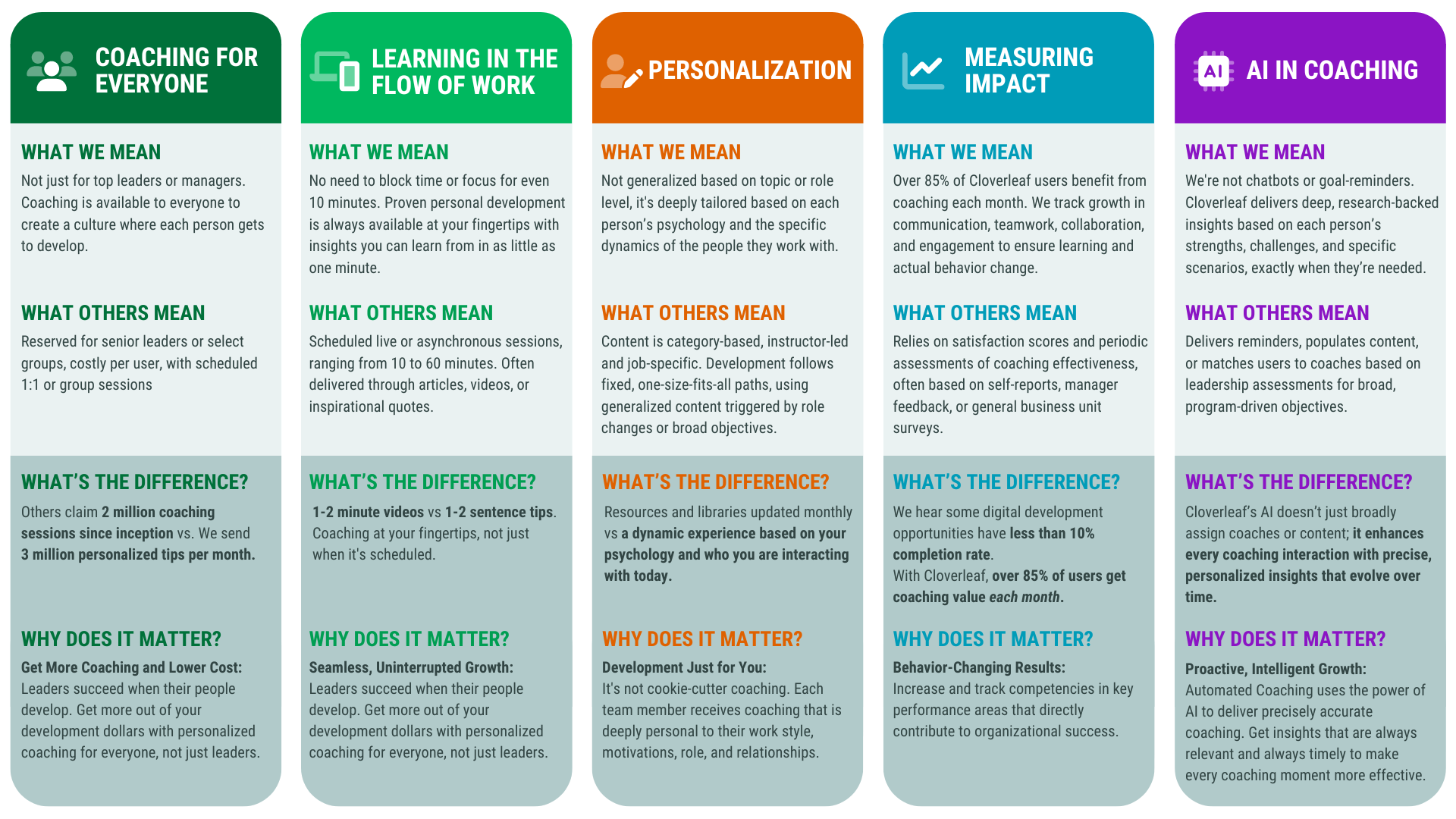
Not all coaching platforms do the same things; selecting the right one is critical for success.
When evaluating potential tools, you should consider:
- Integration into daily workflows: Look for platforms that integrate with tools your teams already use to ensure coaching is seamlessly delivered in the flow of work.
- Behavioral insights: Ensure the platform provides data-driven coaching that can adapt to the individual needs of your employees.
- Scalability: Consider whether the platform can handle the size of your organization and provide consistent, personalized coaching at scale without burdening leaders.
- Contextual: Choose a platform that delivers timely, actionable support so employees receive the coaching when it’s most relevant to their work challenges.
For more information on choosing the right platform, you can refer to Which People Development Software Is Best for Your Team, which offers a deeper dive into various options.
Rethinking The Possibilities Of Personalized Coaching For Your Team
As the workplace evolves with more remote and hybrid environments, automated coaching provides a solution that meets modern demands, offering scalable, emotionally informed, and context-specific feedback that makes a real impact. For Talent Development Leaders, the path to successful coaching at scale is clear: leverage technology to provide meaningful, personalized support to every employee, no matter where they are.
Automating personalized coaching is not just a way to streamline leadership development—it’s a critical approach to scaling meaningful, real-time feedback that aligns with each employee’s unique needs and work context.
By embracing technology that offers tailored insights, organizations can overcome the common pitfalls of traditional coaching models, such as generic advice and disengagement.
Platforms like Cloverleaf enable leaders to deliver personalized, actionable coaching without adding to their workload, making it possible to improve both individual and team performance.