Effective coaching is a critical element for success in any modern workplace. Without employee coaching conversations, leaders can struggle to motivate individuals, achieve high-performance levels, or retain top talent. Leaders face numerous challenges, including managing team dynamics, ensuring productivity, and developing individual potential.
It’s no wonder that organizations invest in helping their leaders upskill to become good coaches. A coaching culture is critical to successful leadership and can improve employee engagement. Plus, leaders who coach can increase professional development, enhance productivity, better identify high-potential employees, and ultimately, drive organizational growth.
Whether you’re a seasoned leader or new to coaching, keep reading to find valuable insights and actionable strategies for improving your coaching competencies to achieve better outcomes for your organization.

What Is Employee Coaching?
Employee coaching is a structured process through which leaders empower individuals and teams to achieve their full potential by drawing out their knowledge and ideas. It involves asking questions, providing feedback, and offering support to help employees overcome challenges and achieve their goals. By developing a coaching relationship with team members, leaders serve as thinking partners rather than managers to assist employees in self-directing to reach desired outcomes.
Coaching isn’t supposed to be used for everything. If someone asks where to find a specific file or spreadsheet – tell them! But when employees come to leaders with challenges to solve or goals to set, it is tempting to go into advising, training, or mentoring rather than coaching.
While coaching in the workplace isn’t a new idea, leaders and organizations still struggle to articulate what it is and how to empower their leaders to do it. As a result, some leaders may struggle to transition from the traditional “Boss” role to a more collaborative and empowering “Coach” role. (We even wrote a whole playbook about it here!).
Leaders who adopt a coaching approach can tap into the knowledge and ideas of their employees rather than simply directing them from a position of authority. Effective employee coaching operates from the belief that individuals are competent and resourceful, with leaders serving as facilitators rather than directors. This approach allows leaders to guide and support their employees’ development, leverage their existing skill sets, and enhance their problem-solving capabilities.
Real-World Examples of How Leaders Can Coach Employees
Imagine an employee approaches their leader with the desire to work towards a leadership position. In one scenario, the leader offers advice based on their own experience and suggests a book and a course in leadership. While nothing is inherently wrong with this approach, it may not be the most effective way to develop the employee.
In contrast, in a coaching scenario, the leader focuses on employee development by helping the individual to recognize their strengths and areas for growth, then offers support and guidance to help them create an action plan.

A Coaching In The Workplace Scenario
Scenario: An employee approaches their leader to express their ambition to grow into a leadership role within the organization.
Directive Management:
Leader: This sounds great. This reminds me of when I was first exploring leadership. I read this book that made all the difference and helped me to become the leader I am today. You should also check out a course in leadership to help you develop your communication skills.
Let’s stop this interaction here. Is there anything wrong with it? No. However, it’s more focused on the leader rather than the employee. It’s not horrible to share for the leader to share their favorite leadership book. Still, successful coaching takes the focus off of oneself to help reveal what’s driving the individual and support the employee’s progress.
Effective Workplace Coaching
Leader: This sounds like a good goal for you. What strengths do you want to leverage in a leadership role?
Employee: Well, I know that I like to problem solve like I did last week as we were approaching that deadline; I think I can use that skill, especially in our department.
Leader: That was extremely helpful when you helped us stay on track last week. I can see that as an asset for our department. What areas do you need the most support in when taking on a leadership role?
Employee: Well, I am pretty conflict avoidant. I tend to people please or shy away from having difficult conversations. I know I will need support here.
Leader: I think that’s a great area to focus on developing. How can I support you in developing that skill?
Do you recognize the difference? Employee coaching is about leveraging and developing the existing talent and ability of the person in the moment. A coaching process requires asking questions, providing constructive feedback, and offering support.
During coaching sessions, leaders may make assumptions and treat them as valid without confirming their accuracy. Coaches can better understand their employees’ perspectives, experiences, and challenges by adopting a curious approach. This approach can unlock their full potential by tapping into their unique strengths and capabilities, allowing them to thrive individually and as a part of the broader team.
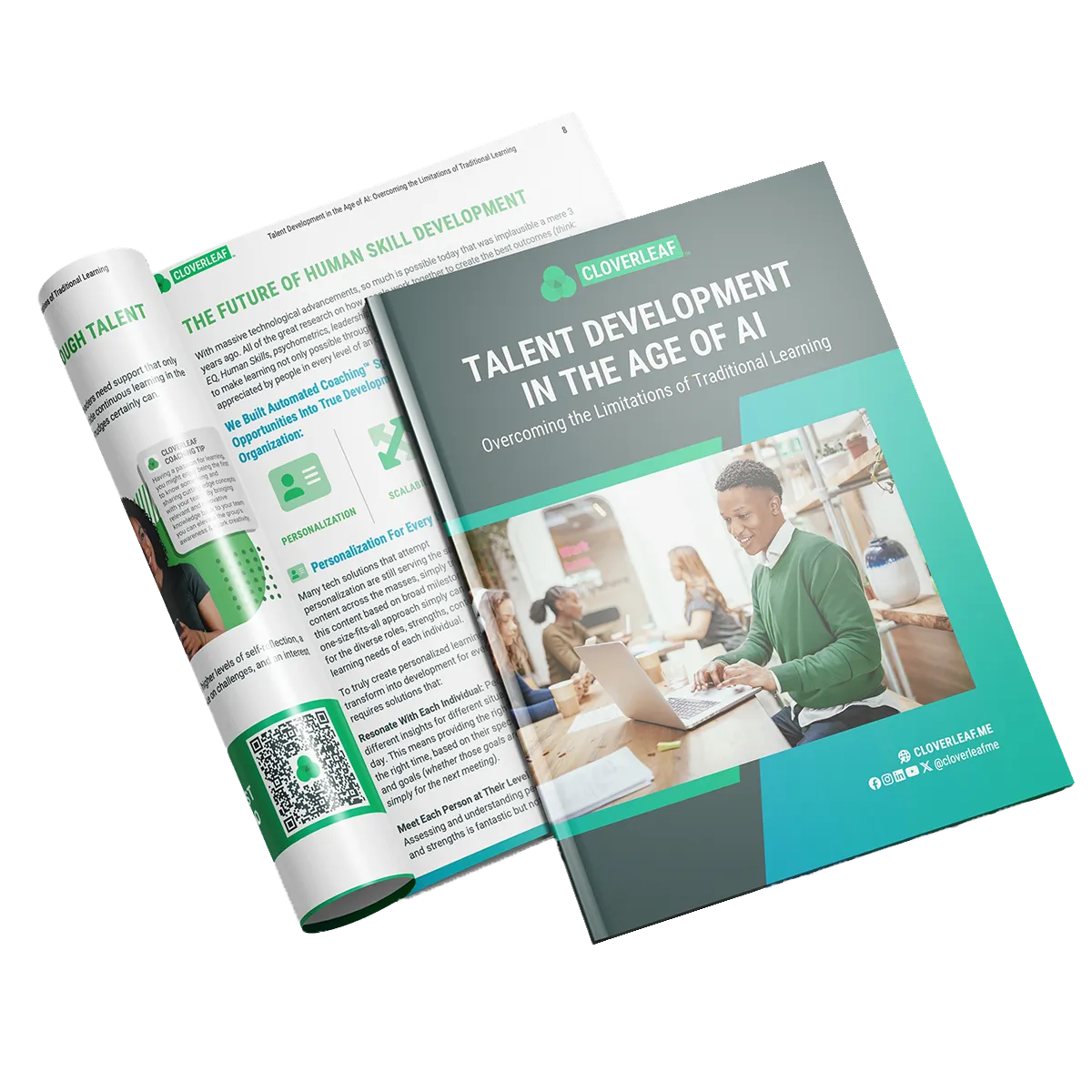
HUMAN SKILL PROGRAMS ARE HITTING LIMITATIONS...
5 THINGS THIS FREE RESOURCE WILL TEACH YOU
- Close the widening gap between learning and on-the-job application
- Overcome the tension of pausing productivity for development opportunities
- Integrate learning so it is actually in the flow of work
- The evolution of human skill development
- What Automated Coaching™ is and how it works.
Unlocking Employee Potential: Exploring the Key Benefits of Employee Coaching
According to Up Coach, coaching in the workplace can increase employee engagement (67%), improve employee perceptions of leadership quality (60%), strengthen leadership bench strength (54%), improve productivity (50%), and enhance the quality of work (44%).
And yes, at the end of the day, coaching can affect the bottom line. About 63% of organizations that provide employee coaching report higher revenue and income growth than their competitors.
If you must, you can google down a rabbit hole of how to measure the ROI of coaching and how it affects engagement, or you can trust your instinct here. (We also share about defining the goal of coaching moments and how to measure if it is successful HERE.)

When companies invest in coaching skill training for their leaders or external coaching to support employee development and well-being, it helps team members experience a healthy work environment and improves retention.
It’s no secret that engagement can result in organizational loyalty. A loyal team member who feels invested in by their employer will often invest back into the organization through effort, quality outputs, and longevity.
Why Access To Coaching Is Essential For Employees
Think of an employee as a vehicle. The more fuel it receives and the more cylinders it runs on, the farther it travels and faster. Coaching is not only the language of leadership; it’s the ultimate employee performance accelerator. It encourages employees to be proactive about setting goals and navigating challenges and keeps them thinking.
Coaching is also something that shows its value subtly and over time. It’s not an overnight benefit; it’s the repetition of receiving coaching that ultimately opens the employee up to new possibilities, new ways of thinking, and new goals to set.
Allowing team members to engage in their own thought processes and explore what makes them effective can make them more intentional in their actions and decision-making.
Effective Strategies For Coaching Employees In The Workplace
In traditional coaching models, providing every employee a one-on-one personal coach is typically impossible. Therefore, empowering leaders to use coaching skills through comprehensive training solutions is fantastic. However, even that might not always be realistic; this is where Cloverleaf makes the difference.
Through Automated Coaching™, using personally curated assessment data, Cloverleaf provides that extra cylinder of support to employees daily. Supporting individuals and teams to leverage strengths and identify gaps, Cloverleaf offers relevant insights into the flow of work that usually remain blindspots within an individual or team.
By increasing the frequency of coaching moments, organizations can empower employees and teams to work to their potential and contribute their best work… who doesn’t want that?
Final Thoughts
Coaching is vital for any modern workplace to motivate employees, improve performance levels, and retain top talent. It’s no wonder more organizations are investing in helping their leaders upskill to become good coaches. Coaching is not just the language of leadership; it’s the ultimate employee performance accelerator. With the right approach and tools, organizations can empower employees to work to their potential and contribute their best work.
In today’s rapidly evolving workplace, businesses constantly strive to improve employee performance and foster a motivating coaching culture. One emerging trend in achieving this goal is the use of Automated Coaching.
But why is Automated Coaching™ so valuable? As businesses aim to provide targeted and impactful coaching, they face challenges in developing effective training programs tailored to employees’ needs.
By leveraging data-driven insights and personalized coaching, organizations and teams can effectively identify skills gaps, develop tailored training programs, and drive learning and development initiatives aligning with organizational goals.
Let’s look at what Automated Coaching™ is and discover why it’s quickly becoming an essential component of leadership development in the modern workplace.
Key Takeaways:
👉 Despite numerous L&D initiatives, employee behavior is only modestly impacted.
👉 Optimized learning occurs when the experience is customized, integrated into the workflow, and available on demand.
👉 Automated Coaching™ offers relevant, real-time prompts for improved emotional intelligence, communication, collaboration, and conflict resolution.
👉 Employees require smaller, well-timed insights that can be processed and applied daily for growth.
👉 Automated Coaching™ can scale to provide development opportunities for all employees.
Take A Tour Of Automated Coaching In Action
Automated Coaching Is An Evolution in Self-Directed Growth and Development
Traditional coaching entails the dyadic relationship between coach and coachees, which involves a process of collaborative goal-setting, constructing solutions, and fostering the coachee’s self-directed growth.
With Automated Coaching™, the goal is pre-defined (i.e., enhancing self-awareness and other-awareness), and the automated coaching system generates solutions that foster the coachee’s self-directed growth.
In turn, Automated Coaching™ provides relevant, in-the-moment prompting and insight that individuals can directly apply to increase emotional intelligence, strengthen communication, identify opportunities for collaboration, and work through conflict successfully with teammates.
Cloverleaf uses assessment data to provide digital nudges to everyone within a team or organization to improve performance, increase managerial effectiveness, strengthen cross-functional collaboration, and inspire personal development.
A consolidated dashboard provides insights into employee strengths, weaknesses, and areas for improvement. From validated personality and strengths assessments to daily coaching, this approach can help organizations improve collaboration, strengthen performance, and better understand the needs of their teams.
Get the full guide to Talent Development in the Age of AI. Empower your people to address conflict, strengthen collaboration, and create a culture of trust.
How Automated Coaching™ Revolutionizes Daily Growth and Development in the Workplace
One of the advantages of Automated Coaching™ is that it can be “pulled” at the coachees’ convenience and that it can be “pushed” every day, as many times as the system is programmed.
Unlike other L&D opportunities, Automated Coaching™ can facilitate coachee growth on a day-to-day basis. This approach aligns with several theories in organizational behavior.
Organizational Behavior Theories That Support Automated Coaching Strategies
1️⃣ According to social learning theory, human beings can only attend to, process, and retain a limited amount of information. Said differently, people can’t internalize information like super-computers. If organizations want their employees to grow, they must deliver smaller, digestible, well-timed insights that they can process and apply daily.
2️⃣ Research concerning clinical psychology on using “micro-interventions”–small and short interventions void of human contact–can help patients with anything from anxiety to addiction.
These microlearning interventions align with what’s called metacognitive prompt theory, which suggests that you can nudge people to be more aware of their situation through purposeful reflection, which leads to more heightened self-regulation and behavior change.
📊 Cloverleaf has researched this phenomenon, and the results are promising. The extent to which users engaged with the automated coaching program positively impacted several important outcomes, including:
👉 An enhanced desire to learn more about themselves and their work,
👉 Improved interactions with team members,
👉 And an overall better mood while at work.
The Problem with Traditional Learning and Development Initiatives
Leadership and development (L&D)—the process of helping employees increase performance and well-being in organizational settings—is a $366B industry.
L&D is everywhere, with larger organizations having in-house L&D departments/positions, Universities offering L&D-specific degrees (e.g., master’s degrees, executive education), dozens of the world’s largest consulting firms specializing in L&D offerings, and hundreds of thousands of small businesses and solopreneurs engaging in L&D through individual and team-based coaching and consulting.
Despite the sheer magnitude of L&D interest and initiatives, meta-analytic evidence suggests that its impact on employee behavior is relatively modest.
The source of the issue is that learning and development typically manifest as a one-time initiative where participants are inundated with recommendations.
This approach is misaligned with the fact that human beings can only process and retain a limited amount of information in one setting. Further, L&D is typically delivered as a pre-packaged and static offering, which overlooks that individuals are different and that their priorities, careers, and lives are constantly in flux.
Research suggests that learning and behavior regulation are optimized when the experience is customized to users’ characteristics and needs, integrated within one’s workflow, and available on demand.
💡Human beings can’t accommodate these features at scale, but technology certainly can. Automated Coaching™ can make a substantial impact for talent leaders who want to change the culture and reach more people.
Is Your People Development Strategy Keeping Up?
See How Leading Teams Use Tech To Stay Ahead.
Will Automated Coaching™ Replace Or Support Traditional Coaching Practices?
Automated Coaching™ will supplement, not replace, traditional coaching. Prior research illustrates that, when done well, coaching increases coachee performance and well-being.
Automated Coaching™ gives coaches a more efficient method for staying connected with their coachees. It also gives them richer material to discuss with their coachees. In an ideal world, employees have access to both.
Unfortunately, many don’t experience the benefits of coaching, given the cost, lack of access, or time commitment. Technology can help close this gap by lowering costs and making coaching more scalable and widely available to diverse groups.
Is Automated Coaching™ The Same Thing As Artificial Intelligence?
Automated Coaching™ is broader than artificial intelligence (AI). However, where appropriate, AI can play a fundamental role in helping make Automated Coaching™ more adaptive and impactful.
We are far from “strong AI,” whereby machines are fully autonomous with general intelligence. Indeed, AI is making substantial process over the last decade, making it easier for organizations to incorporate into products like Automated Coaching™.
However, applying “weak AI,” whereby specific algorithms are embedded to solve particular problems, is more representative of what coaching and Automated Coaching™ have the potential to incorporate in the short term.
How Can Development Leaders Adapt To What’s Possible With Coaching for Today’s Workplace
Traditional coaching strategies have shortcomings that can be felt across an organization. However, scaling the development of team members is more tangible today.
As outlined here, there are four significant challenges to traditional coaching models that hinder their effectiveness in the workplace:
- It is often limited to the coachee’s perspective
- Providing a human coach is costly
- Relevance and timeliness are limited due to scheduling
- Proving impact that affects organizational results
As such, innovation is needed to address these challenges related to organizational training and development. Automated Coaching™ overcomes the challenges leaders are familiar with in delivering coaching to their employees.
Automated Coaching Technology Is:
✅ Scalable
✅ Timely
✅ Measurable
Unlike traditional coaching models, Automated Coaching™ can scale to increase access to development opportunities for everyone in an organization. This means that employee coaching is no longer limited to a select few but can widely extend throughout a company.
What’s more, Automated Coaching™ provides employees with a greater number of coaching moments than traditional practices.
Instead of relying on monthly sessions where individuals hopefully gather a handful of understanding, Automated Coaching™ integrates into the user’s workday to offer in-the-moment, relevant insights and tips.
Additionally, Automated Coaching™ offers a unique advantage in the form of user feedback, allowing individuals to provide input on the coaching tips they receive.
This immediate feedback response enables users to obtain better insights and more applicable coaching tailored to their specific growth. Therefore, Automated Coaching™ can adapt to the needs of each individual, making it a powerful tool for employee development and organizational performance.
A Powerful Tool For Collective People Development
As businesses seek new ways to streamline training and deliver impactful coaching, Automated Coaching™ provides a unique solution. With the ability to adapt to the specific needs of individuals, it is a powerful tool for employee development and organizational performance.
The future of leadership development lies in this customized, on-demand coaching that can enhance skills and increase performance, transforming the workplace for years to come.
CINCINNATI – November 09, 2022 – Cloverleaf, an Automated Coaching™ technology designed to bring out the best in workers and teams, is partnering with The Ken Blanchard Companies® to bring more coaching resources to work teams and companies.
The Ken Blanchard Companies® define coaching as focused conversations that accelerate performance and development. With Blanchard’s coaching methodology and personal and team insights, and daily coaching from Cloverleaf, people are more likely to achieve their goals.
“Leveraging the power of Cloverleaf to augment Blanchard leadership development programs and coaching is such a great way to keep the momentum, reinforce new skills to become habits, and support teams as they develop along the continuum to high performance. The ease of having data in one place to better understand yourself and others is so powerful. We see this as a truly symbiotic relationship in which our solutions truly complement each other,” says Lael Good, Director of Global Consulting Services at The Ken Blanchard Companies.
According to Darrin Murriner, CEO of Cloverleaf, “The partnership with The Ken Blanchard Companies® will help us to offer more well-rounded coaching to our current and prospective Cloverleaf users. The rich content provided by Blanchard will help individuals and leaders to build relationships, develop leadership skills, overcome challenges and achieve their goals.”
Curated articles, blogs, podcasts, and research from The Ken Blanchard Companies are now available to users as part of the Resources Feed within the Cloverleaf platform. Start your 14-day team trial at Cloverleaf.me.
About Cloverleaf®
Cloverleaf is a powerful coaching tool that unleashes people to do their best work, together. Cloverleaf’s technology sends personalized, meaningful coaching tips that leverage respected psychology data from assessments like DISC, Enneagram, and Strengthscope. With a few sentences a day, we help every person tap into their unique value, build understanding, and improve collaboration.
Cloverleaf integrates seamlessly into the systems teams already use every day, including Google Workplace, Microsoft 365, and Slack. Companies like HP Enterprise, Kroger, and Monster Energy have already turned to Cloverleaf to maximize their organization’s talent.
Every month, Cloverleaf sends out millions of tips to more than one million users, 21,000 teams, and hundreds of coaches, helping people at the world’s best companies thrive at work. Start a free trial for your team at cloverleaf.me.
The Ken Blanchard Companies®
The Ken Blanchard Companies is a global leader in management training, consulting, and coaching. For more than 40 years, Blanchard has been helping organizations develop inspired leaders at all levels and create cultures of connection that unleash talent and deliver extraordinary results.
Blanchard’s SLII ® powers inspired leaders and is the leadership model of choice for more than 10,000 organizations worldwide. Blanchard also offers a suite of other award-winning leadership development solutions through flexible delivery modalities to meet the specific needs of its clients. Learn more at www.kenblanchard.com.
HUMAN SKILL PROGRAMS ARE HITTING LIMITATIONS...
5 THINGS THIS FREE RESOURCE WILL TEACH YOU
- Close the widening gap between learning and on-the-job application
- Overcome the tension of pausing productivity for development opportunities
- Integrate learning so it is actually in the flow of work
- The evolution of human skill development
- What Automated Coaching™ is and how it works.
The coaching industry is a dynamic and colorful industry. It has given us the likes of Tony Robbins, Marshall Goldsmith, and Sheila Goldgrab and helped millions of people discover who they are and how to succeed in whatever chapter of life they are in.
Though coaching has made its way into the mainstream and adopted new and innovative approaches to engaging with coachees, the model most coaches use to facilitate coaching moments hasn’t changed much in the past generation.
Most training and development resources still rely on information consumption models that are still susceptible to the forgetting curve hypothesis, which indicates that people’s memory, even of valuable information, will atrophy over time (and often very short periods of time) without good practices to retain it.
Plus, many assessment tools still use underlying research and analysis from Carl Jung and haven’t evolved much other than newer and fresher coats of paint (think colors instead of numbers, birds or animals instead of letters).
Even the coaching industry’s approach hasn’t changed much over the decades. Hourly sessions, at regular intervals, followed by the occasional check-in for accountability.
Valuable coaching conversations can lose momentum because they are confined to limitations familiar to common coaching approaches. However, in the moment coaching, especially within the workplace, is in greater demand and more relevant than ever.
Why Are Coaching Moments At Work So Valuable?
A coaching culture creates opportunities for managers and peers to help develop one another’s skills and performance.
Coaching is invaluable if an organization is to achieve its goals. It should be part of the continuous employee performance management by managers to maximize the potential of the employees. – quantic.edu
The benefits of a coach helping a team or individuals work through challenges can impact results that extend throughout the entire organization.
People are complex, and the best coaches consider context, realizing that every situation is different and requires nuance.
At Cloverleaf, we love coaches and believe strongly in the value they can provide to a team. But also believe it worth acknowledging that there are shortcomings to traditional coaching models that coaches and leaders need to consider.

HUMAN SKILL PROGRAMS ARE HITTING LIMITATIONS...
5 THINGS THIS FREE RESOURCE WILL TEACH YOU
- Close the widening gap between learning and on-the-job application
- Overcome the tension of pausing productivity for development opportunities
- Integrate learning so it is actually in the flow of work
- The evolution of human skill development
- What Automated Coaching™ is and how it works.
3 Challenges To Traditional Coaching Models:
Scalability
- Providing a human coach for everyone in the organization is cost prohibitive, and finding or training enough available coaches is difficult. Not to mention that there are diminishing marginal returns if everyone had a coach.
Timeliness
- A once-a-month connection between an individual and their coach can restrict relevant, timely coaching specific to the immediate problems that managers, leaders, or individuals face throughout their days/months.
Measurable Impact
- Proving and improving impact has been a challenge for the industry.

Often, even the best coaching relationships may only make the coachee feel better that they are doing something to improve themselves. But what about the ability to verify clear, measurable outcomes that indicate organizational results?
Measurement is another critical area where there hasn’t been much innovation in coaching solutions. Solving these three significant problems requires defining the long-term goal of coaching in the workplace.
What Is The Goal Of A Coaching Moment?
When I ask people in our network about their experience with a coach, they will often recall the last coaching session and point to some insight or discovery gained during that session.
Next, I follow up with a question about frequency – specifically, how many of these insights they typically encounter during an average 1-hour session. They may pull out a notebook and reference 3-5 bullet points of takeaways.
Typically, to measure the impact of those 3-5 insights, one could consider several points of impact:
- Leadership effectiveness
- Performance reviews
- 360 scores
While these are important indicators, the measurable impact of the coaching is limited because they only reflect a point in time concerning the individual (often without ongoing measurement or prone to inconsistent measurement over time.)
Plus, there are several additional factors (pay, relationships, proximity to the work, etc.) that can skew the results.
There is room for improvement. At Cloverleaf, we have a North Star that guides our measurement of successful employee coaching to ensure it is precise and worthwhile. It also influences all the product features and market decisions we make.
We call this North Star – ‘Successful Coaching Moments.’
The goal of every coaching moment in the workplace should be to improve emotional intelligence, collaboration, and organizational impact.
To determine our proximity to reaching this North Star, we measure the following elements (like any good North Star metric):
Reach or breadth of people (known internally as coached users)
- This element reflects how many team members or employees within an organization are impacted by Cloverleaf’s Automated Coaching™.
Depth or levels of impact (known internally as successful coaching per day)
- Unlike most coaching practices that depend on the 3-5 insights gathered within a 1 hour per month session – Cloverleaf’s typical user experiences, on average, nine successful coaching moments per day.
Frequency (known internally as days coached per month)
- Cloverleaf can help you reach clients and teams daily. Rather than waiting weeks until the next coaching session, coaches can foster consistent development to keep their clients on track.
Measuring the reach, depth, and frequency of the coaching at work teams’ experience provides context that can ensure ongoing coaching in the workplace is happening and that users are less susceptible to pitfalls like the forgetting curve or slow progress.
At this point, the big question you may ask yourself is, ‘how do we know if in the moment coaching tips are successful?’
After all, that is the key to overcoming the current shortcomings of standard approaches to coaching and capturing true impact. Further still, how can we ensure that results are accurate and not impacted by several other factors? How do we PROVE that Automated Coaching™ is successful?
How To Know If Coaching Moments Are Successful Within Your Team
The best way to determine if coaching is successfully impacting your team is by using data that can indicate an increase in emotional intelligence, improvement in collaboration, and organizational performance.
Additionally, gaining a pulse on team culture and how applicable the coaching is can help leaders accurately assess the value of in the moment coaching.
With Cloverleaf, coachees can rate every piece of coaching content. With each coaching tip, we ask simple questions like, was this coaching helpful? This immediate feedback is a starting point for users to provide even more context concerning the effectiveness and relevance of the coaching they receive.
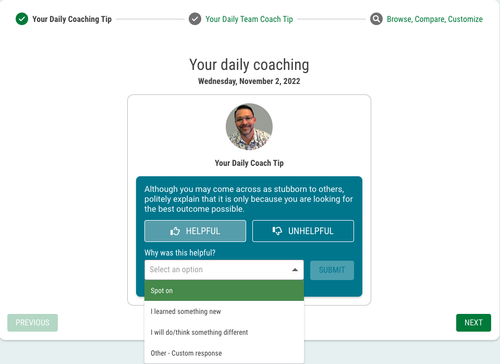
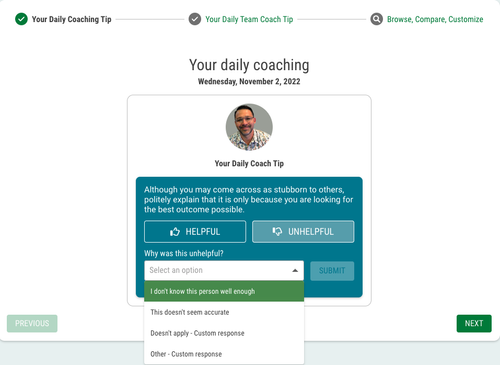
Next, team members can respond to additional contextual questions concerning why that coaching was helpful or unhelpful.
All of these data points are significant because they offer insight that correlates with the team and organizational sentiment, relevance to their role, and the ROI of Automated Coaching™.
The Big Question
The most important question is, how do we know that Automated Coaching™ improves emotional intelligence, team effectiveness, or belonging?
Cloverleaf’s Chief Research Officer, Scott Dust, runs regressions against the data to isolate the impact of Cloverleaf on outcomes, and here are some of the results.
Our monster pilot data essentially says that as the number of coaching moments increases, so does the increase in (a) team effectiveness, (b) feeling recognized by team members, and (c) feeling as if one’s strengths are valued by others.
These are great results, and we plan to further extend this analysis. We believe that Cloverleaf (an Automated Coaching™ solution) when used in conjunction with a human coach, can take employee and organizational development to even greater heights.
Cloverleaf is helping People Strategy Leaders change how they develop their leaders. Scaling coaching opportunities for leaders and managers is possible with access to popular validated assessments, personalized dashboards, and in-the-moment coaching tips.

Discover why Cloverleaf is the all-in-one tool for boosting emotional intelligence in the workplace. Schedule a demo to learn more about Cloverleaf ‘s impact on leadership development, managerial effectiveness, and driving behavioral change.
Part of being a great manager is knowing when to use certain approaches to leading. While coaching isn’t new, in the last 25 years coaching in the workplace has become more widely accepted. It’s important not to overcomplicate what coaching is and to recognize what it isn’t (it’s not therapy or feel-good fluff).
In its simplest definition, coaching is facilitating positive change with individuals and teams to unlock potential. This happens through a subtle nuance in how the leader communicates and empowers the team member to own their experiences. Effective coaching is also learning by…coaching. You can’t learn to coach by just reading a book or taking an online course. It’s a leadership skill that is honed over time.
Coaching Skills: It all starts with Listening
Active listening is one of the most critical fundamental leadership coaching skills you can develop. When we are actively listening we are NOT interrupting, interjecting our own stories and thoughts. We are OTHERS focused. We might ask some clarifying questions and comment on what the person is saying:
- It seems like you are really frustrated with the current situation, is that fair to say?
- Can you say more about __________ (Insert something you aren’t clear about)
- You’ve shared this challenge with me a few times, are you noticing any pattern?
- I want to thank you for coming to me with your feedback about the project. I really appreciate your attention to detail.
As you listen more intently, your team member will share information with you that can help clue you into asking the right questions. The coaching approach here is to keep the focus off of yourself, your knowledge, and your ideas. Yes, it’s true. Coaching is not about you.
Coaching Skills: Asking & Goal Setting
Once we are empowering team members in doing their own thinking, it’s important to support team members in making their ideas actionable. The next two critical coaching skills for managers to explore are powerful questioning and goal setting.
Powerful Questions
Part of learning this coaching style is ASKING before launching into TELLING. Many people believe that they are great coaches, but they are often great MENTORS, sharing expertise. Here are a few examples of powerful questions effective leaders use:
- What is the next step here given the goal you’ve set for yourself?
- What would it look like if this problem were solved?
- What would be the impact on you if you received this promotion?
Goal Setting
Ideas die unless they become actions. A good coach helps team members transform ideas into action.
- What is a goal you could set to help avoid this problem in the future?
- How can I support you in your goal to be promoted to leadership?
- What best practices would you need to adopt to support you in accomplishing your goal?
When To Use Coaching…and When Not To Use Coaching
That might all sound great, but am I constantly questioning everyone on my team? The answer is: NO. If someone asks you where a file is located, you are not going to respond: Well what would be the impact on you if I found that file?
You are going to give them the file or direct them on how to get it.
Part of understanding when coaching employees in the workplace is to understand more about its intent: to develop the competence and confidence within individuals by inviting them to do their best thinking. Here’s when you want to use coaching:
- When an employee is repeatedly coming to you with the same issue.
- When a team member is having interpersonal issues with another team member.
- When a team member expressed a desire to move up within the organization.
- When preparing a team member to take on new responsibilities.
As you continue in your leadership role you’ll develop the intuition and emotional intelligence to know when to coach and when not to coach.
HUMAN SKILL PROGRAMS ARE HITTING LIMITATIONS...
5 THINGS THIS FREE RESOURCE WILL TEACH YOU
- Close the widening gap between learning and on-the-job application
- Overcome the tension of pausing productivity for development opportunities
- Integrate learning so it is actually in the flow of work
- The evolution of human skill development
- What Automated Coaching™ is and how it works.
The GROW Model For Coaching
The GROW coaching model, designed by Sir John Whitmore is one of the easiest to execute applications of coaching in the workplace. Follow these simple steps in a formal or informal coaching conversation for optimal results. With each step of the model, you’ll find helpful questions to guide you at the facilitator.
Goal: The coaching process starts with establishing a goal. It could involve performance goals, development goals, problem-solving, decision-making, or a goal for the coaching session.
- What do you want to achieve from this conversation?
- What do you really want?
- What would you like to accomplish?
- What result are you trying to achieve?
- What outcome would be ideal?
- What do you want to change?
- What would the benefits be if you achieved this goal?
Reality: Next you want to get a read on the current state or situation. What is actually happening or NOT happening? Great managers take it slow here and leverage their active listening skills:
- What is happening right now in a nutshell?
- What steps have you already taken to reach your goal?
- On a scale of 1 to 10, how confident are you that you can accomplish this goal/resolve this problem?
- What strategies have you used in the past that were successful?
- What is the single biggest obstacle standing in the way of you achieving your goal?
- What is working well right now?
- What could you do better this time?
- What could be another possible interpretation of what _________said or did?
Options: Once you both have a clear understanding of the situation, the desired goal, or the problem, the coaching conversation turns to what the team member can do to reach their goal.
- What are your current options?
- What is the best next step you could take here?
- What would happen if you did nothing?
- What has worked for you already? How could you do more of that?
- What is the most challenging part of this particular goal?
- What is a similar situation you’ve faced in the past and what did you do to resolve it?
- What has helped you achieve goals in the past?
- What’s the upside/downside of your options right now?
- What option is your gut telling you to try first?
- How would you like things to go if there were absolutely no limits?
Will or Way Forward: You close out a coaching conversation by gaining commitment from your team member on specific actions they are going to take on. This is where the person begins to own their results.
- What do you think you need to do right now?
- What does success look like here?
- How can I support you with your desired result?
- Is there anything missing from your plan or next steps?
- What will one small step you take now?
- Is there anyone else you need to have a conversation with to ensure your success?
- Do you need to block time on your calendar for any relevant actions?
- When should we check back in on your progress?
It may seem like a lot of questions, and the truth is a successful coaching conversation is one where you don’t say much. You teach others to lead themselves. At times team members may get frustrated and just want to be told what to do. This is the path of least resistance for some, but in the long run, it keeps them stuck.
And in the midst of it all, remember that there are times when a leader needs to step in and be very direct in their approach in order to add clarity to a situation. This isn’t a coaching skill, but is a valuable tool that you’ll still need as you lead.
We hope this list of effective coaching skills for managers has helped you. To learn more about how to develop coaching skills, download our e-book right now for free.
About Stephanie Licata
With more than two decades of leadership and management experience, Stephanie Licata is a skilled professional coach, adult learning specialist, consultant and speaker. She has trained thousands of leaders and managers in the art and science of coaching as part of large-scale projects to develop coaching cultures within organizations. Stephanie received her professional coaching certification from New York University, and is also certified at the ACC level with the International Coaching Federation. She holds a BS in counseling and a Masters in Organizational Psychology from Columbia University.
We’re often asked, “What’s the difference between coaching, mentoring, and consulting?”. A coach is a thinking partner. They ask questions that lead you to self-discovery. They are not leading or directing you to the answers but helping you along the path of self-discovery.
A mentor is a guide. Someone who’s been there before. They’ve walked the road and they’re sharing their personal experiences. They lay out a roadmap. Choosing to walk that path is up to you.
A consultant is just an expert. They’re someone that has looked at the situation from all sides. They have expertise in the specific challenge and will give you that knowledge to support you.
Each approach has a distinct use case. They are not interchangeable, and each situation needs a different expert. They are not mutually exclusive and can be used in conjunction with each other to support the learning and development process.
At Cloverleaf, we believe in coaching for everyone. Learn more about coaching and why it’s important.
Scale Your Coaching Business Without Adding More Hours
Strategy to help you grow a more sustainable coaching business.