Reading Time: 6 minutes

Picture it: your team is humming along with most people in roles that suit them. You almost feel like things are on autopilot. You are grateful for your team’s work and are proud of their accomplishments.

And then, it happens. One of your key players utters those dreaded words. “After much thought, I decided it’s time to move on.”

And now, you’re in hiring mode to find new employees. Suddenly, the white space in your calendar is occupied with strategizing and troubleshooting. If you have support, you’ll likely ask your HR department to find the job description from when you hired the on-their-way-out individual.

Or, your organization is faced with making difficult decisions about staffing levels and restructuring, which can lead to layoffs and increased turnover. By taking a proactive approach to managing labor turnover, businesses can minimize its impact and ensure the organization’s continued success.

Managing turnover can become like a side gig when you have to replace a key team member. Leading through change or uncertainty can be daunting but also builds resilience. In the process, you may learn more about yourself as a leader and problem-solver than you thought possible.

Instead of becoming overwhelmed and succumbing to stress, it can be helpful to break down the areas that require your attention and energy. By focusing on specific areas and prioritizing tasks, you can tackle them one by one, alleviating stress and improving productivity.

Remember, some of these tasks may coincide, so managing your time effectively is essential. You can make your calendar your ally by using time-blocking and weekly planning strategies to prioritize tasks and ensure you can handle everything efficiently.

Critical Areas Of Focus & Priority When Turnover Happens

Negotiate The Last Day & Exit Strategy

employee transition plan template

Even though the standard “giving notice” time has been two weeks, this isn’t always the only option. Depending on the departing employee’s exit timing, you may be able to negotiate some additional transition time.

In cases where the employment relationship ends on a positive note, many people are willing to assist during the hiring and onboarding process of the new employee. This can help ensure a smooth transition for both the departing and incoming employees and minimize the impact of turnover within the organization.

Leadership Tip: You want to build trust with employees at all times. Organizational loyalty is a real thing. When an individual feels loyalty to the team and the organization, they will be more likely to support the transition.

Questions To Help Improve Employee Exits And Transitions

Would the departing team member be open to reviewing the job description and providing any valuable insights or updates that may be appropriate?

  • Having their input can be highly beneficial. As the person closest to the role, they can help refine the job description to improve the targeting of potential candidates.

Can the exiting employee provide support during the hiring and search process?

  • As you narrow down your options, involving the current employee in the selection process can be incredibly valuable. Their input on potential candidates can help ensure a seamless transition.

Would they be willing to assist in the onboarding process for the new hire?

  • While it may seem like a stretch, if the employee’s exit is positive, involving them in the onboarding process can be a dream come true for the new hire. An experienced team member can help the new employee confidently onboard, understand their responsibilities, and integrate into the organization.

Cover image of Cloverleaf’s free guide on scaling talent development and driving lasting behavior change in teams in the age of AI

HUMAN SKILL PROGRAMS ARE HITTING LIMITATIONS...​

5 THINGS THIS FREE RESOURCE WILL TEACH YOU

Prioritize Messaging To The Team

Collaborating with the departing team member on messaging is crucial to ensure everyone hears directly from you. However, before communicating with the entire team, it’s critical to have a high-level transition plan that can be shared to reassure team members. Remember to communicate this plan in a live or live-virtual conversation or meeting (not email) to ensure that everyone can ask questions and receive immediate feedback.

Before finalizing your communication about managing turnover or transition, consider the following factors that can impact the process:

When Is The Timing Of The Transition: After finalizing this with the departing team member, let the rest of the team know what this will look like. This will help ensure everyone is on the same page and can prepare for changes.

What Is Your Plan To Manage Possible Gaps: While it’s ideal to avoid burdening other team members during the transition, it’s not always feasible. Schedule dedicated time to collaborate with the team on navigating the change and workload effectively.

Emphasize Your Availability To Support The Team: Often, your team will need reassurance. To do so effectively, it’s essential to work through your stress and seek support from your leader before the meeting. Offer support during the transition and schedule 1-on-1 meetings with key team members most closely affected.

how to overcome employee turnover

Managing The Transition And Hiring Process

Your decisions must be informed and strategic during any reorganization involving people management. Avoid hasty decisions during the transition process by taking time to plan appropriately. Don’t rush to fill a vacant position; it is crucial to consider your options carefully and prioritize finding the most suitable candidate for the role.

To effectively manage the gaps mentioned earlier, leaders must consider the following needs of the team.

Indicate Which Strengths And Skillsets Are Crucial To The Role

In partnership with the departing team member and other key team members, observe the strengths and gaps of the individual and the team using various assessments.

  • What talents are necessary for the role?

  • Which skill sets are needed to help balance the team’s current gaps?

Use this information to identify which skills and talents are vital to the role and update the job description accordingly.

Identify Opportunities To Reassign Work To Existing Team Members

Consider what strengths of your existing team you can leverage. Hint: Integrating a career development conversation with team members during a transition can help you tap into strengths that may lie dormant within the team.

As you collaborate with the team, ask key team members which strengths they would like to leverage for their careers that can aid this transition process. This creates a win/win situation for the individual and the team.

Customize Interview Question Specific To Candidate’s Assessment Results

When interviewing new candidates, consider using various personality, behavioral, and strengths-based assessment results to create customized interview questions that focus on specific strengths or areas of development.

This interview strategy can help you gain deeper insights into the candidate’s potential fit for the role and their potential contributions to the team’s dynamics.

Provide Regular Updates To Your Team

You must keep the team informed of your progress throughout the hiring and transition process. If the hiring process takes a little longer, be sure to schedule regular check-ins with team members who are covering the gaps.

Improve The Onboarding Process

The initial days of an employee’s experience are foundational to a company’s retention strategy. According to Gallup®, employees who had an exceptional onboarding experience are more likely to feel satisfied with their job and workplace and are also more likely to stay with the company.

Onboarding cannot be limited to just completing a checklist of mandatory training. While these training sessions are important, adding fun to the onboarding process can leave a lasting impression on new hires and increase their excitement about their new role.

Cloverleaf offers a range of solutions to support leaders in managing and improving transitions and hiring processes. The team dashboard can be a valuable tool for identifying gaps and strengths in the existing team and reassigning work to leverage team members’ strengths.

Teams can also leverage the coaching insights on Cloverleaf to create custom questions for team members, ensuring adequate support during transitions. Similarly, the candidate can ask targeted behavioral questions during interviews and compare the candidate’s strengths with the existing team, enabling more informed hiring decisions.

Navigating change is difficult, but it is not impossible! Using a combination of leadership, communication, collaboration, and Cloverleaf, you can successfully move past this transition and experience greater results with your team!

how to reduce the impact of employee turnover

Conclusion

Managing employee turnover and transitions is an essential skill for every leader. Team members will inevitably leave for various reasons, but how a leader responds to and guides the process will determine its impact on the organization.

By prioritizing these critical areas and focusing on specific tasks, leaders can maintain a positive relationship with outgoing and incoming employees, build organizational loyalty, and ultimately support the organization’s future success.

Reading Time: 8 minutes

Is motivation fully automated yet? While much of our lives and work processes are automated, motivating employees still requires human interaction. As leaders and learning professionals, we still must ask ourselves a few questions about how to motivate employees:

  • How are we motivating people in our organization?

  • What is new concerning how organizations are motivating employees?

  • Are we using old (and outdated) employee motivation tactics?

  • How are we supporting managers with tools and resources to support their effort to motivate their team?

Staying current on motivating employees is crucial as the workforce and the job market evolves. Technology can undoubtedly help gather data, provide feedback, and track performance, but it cannot replace the personal touch and human connection that is crucial in motivation.

Key Takeaways:

  • Motivation is a component of engagement

  • Engagement is an indicator of a team member’s level of motivation

  • Employee motivation requires meaningful work and a supportive environment

  • Organizations can motivate employees at every stage of a team member’s life cycle

  • A motivating workplace has a noticeable alignment between the organization’s values and actions

Ultimately, it is up to leaders and managers to stay informed, adapt to new methods, and use technology and interpersonal skills to create a motivational work environment that engages their employees.

motivation in the workplace

Motivation, Engagement, Or Both? How Do These Elements Work Together?

While motivation is the driving force behind an individual’s actions, engagement extends beyond that. Engagement encompasses motivation and the employee’s level of involvement, commitment, and connection to the company and its objectives. Additionally, engagement gauges how fully employees are invested in and connected to their work and how motivated they are to give their all.

Therefore, while motivation may inspire an employee to show up and fulfill the minimum requirements, engagement ignites a deeper level of devotion, efficiency, and job fulfillment.

Leaders and managers must understand these two concepts to create a supportive and empowering work environment that motivates and fully engages their employees. Read the employee engagement strategy post for more on creating a human-centered workplace.

To further nuance these differences, consider that a team member may feel motivated to complete their tasks but not genuinely engaged in their work. This motivation is driven by the desire to finish and does not indicate their level of engagement.

On the other hand, an individual can be engaged in their work but lack direction or support from their manager, which can be demotivating. This scenario represents a missed opportunity by overlooking the potential of a ready and engaged team member that their leader failed to motivate effectively.

Cover image of Cloverleaf’s free guide on scaling talent development and driving lasting behavior change in teams in the age of AI

HUMAN SKILL PROGRAMS ARE HITTING LIMITATIONS...​

5 THINGS THIS FREE RESOURCE WILL TEACH YOU

With that in mind, it’s worth exploring the employee life cycle and its impact on these six motivating factors. While a quick internet search may present numerous versions of the employee life cycle, two primary objectives must resonate within each stage:

  1. How can we communicate that we have a culture of motivation and engagement?

  2. How can we ensure we consistently deliver on that promise?

Considering these values requires a mindful approach to each stage of the employee’s journey with the organization. The focus should be on communicating and delivering a supportive and empowering work environment.

Now, let’s explore the different stages of the employee life cycle and how to effectively balance these two objectives to create a motivating work environment.

how to motivate employees throughout the employee life cycle

How To Motivate Employees Throughout The Entire Life Cycle

  1. Attraction
  2. Recruitment
  3. Onboarding
  4. Development
  5.  Retention
  6. Separation

1. Attraction: Captivating top talent by showcasing what makes your organization unique.

This stage begins with the first glance at a job posting. What elements of your employer branding excite a potential candidate and make them say, “This is the place I want to work?”

Employers should review their entire attraction strategy with the following considerations:

  1. How does our employer branding effectively communicate a culture of motivation and engagement?

  2. How do our organizational features and benefits serve intrinsic and extrinsic motivation, and does our recruitment strategy align with this?

  3. Why would a candidate choose our organization over a competitor?

  4. How do we distinguish ourselves in our attraction messaging?

CHALLENGE: Consider what measures you take to energize team performance and assess if the content (or lack thereof) you share represents a culture that supports its team members.

2. Recruitment: Demonstrating how you value your team members by showing care and consideration in your interactions with potential new hires

Your recruitment process indicates the importance you place on motivating and engaging employees, and it can reveal a lot about your company’s culture.

Examine your entire hiring process, from initial communication to the offer, to determine how well it reflects your organization’s values. Consider aspects such as:

  1. How efficient and effective is the communication between the hiring manager or recruiter and candidates throughout the hiring process?

  2. How do the steps in the recruitment process value the time and experience of candidates?

  3. What measures are in place to handle interruptions or delays in the process?

  4. What alternative evaluation methods, such as work samples or presentations, are used in addition to interviews to assess candidates?

  5. What steps are taken to provide constructive feedback to candidates who are not offered a job? (This is crucial and will set your organization apart if executed effectively.)

  6. What communication strategies are in place during the transition between an offer being accepted and the first day of work to ensure new employees feel motivated and engaged from the start?

CHALLENGE: If you are a hybrid or all-virtual team and someone is coming on board who is remote, consider creating a personalized video introduction from team members as a welcoming gesture. This simple action can leave a remarkable impression, helping new hires feel valued and excited to join the team.3.

3. Onboarding: Setting New Members Up For Success And A Strong Team Relationship 

Onboarding is a crucial step in the employee life cycle. Recent statistics are staggering and provide compelling reasoning for prioritizing this stage if employers want to motivate employees from the beginning.

According to Northpass, organizations that structure onboarding saw a 60% year-over-year improvement in revenue AND a 63% improvement in year-over-year customer satisfaction. But there is a gap. According to Gallup®, only 12% of employees agree that their company has a good onboarding process.

GenXers may remember the old marketing tagline for Head & Shoulders; you never get a second chance to make a first impression. The first impression employers make on a new hire is crucial and sets the foundation for their entire experience as an employee.

Leaders can motivate employees and spark engagement from the beginning with new team members by considering the following questions:

  1. How can we formalize our onboarding process to better set new employees up for success and increase their motivation and engagement?

  2. Do we articulate expectations for the new hire in their first 90 days, six months, and year?

  3. To what extent do we equip managers with the skills and knowledge to effectively onboard new employees?

  4. How do we ensure that onboarding is included in manager job descriptions and training programs?

  5. How can we incorporate opportunities for new employees to connect with their team and learn about the organization’s culture and values far beyond completing a checklist of tasks?

  6. Who is responsible for regularly reviewing and updating our onboarding process to ensure it remains impactful and relevant to the needs of new hires?

CHALLENGE: What is one tangible action you can take to improve your onboarding to inspire new employees to put their best foot forward? Who do you need to communicate with to make this happen? (Hint: take action and schedule it now).

how to motivate employees as a leader

4. Development: Supporting team members in their professional growth

Unleashing personal development in the workplace is the key to sparking your teams’ motivation and fueling engagement! By actively investing in their professional success, you show your belief in their growth and set them up for long-term success.

Leaders who genuinely explore questions such as “How can we make our employees feel appreciated and valued?” “How can we enhance their morale?” and “How can we assess and continually improve the impact of our efforts?” with a curious mindset are more likely to retain motivated and engaged employees successfully.

9 Vital Employee Development Questions for Building a High-Performance and Engaging Workplace

  1. What training and development opportunities do we offer individuals at every level of employment?

  2. What changes need to be made to our performance management process to engage and motivate employees to perform at their best effectively?

  3. How do we ensure that our people managers receive adequate training and coaching to fulfill their leadership roles effectively?

  4. What are the defined leadership standards in our organizational values and job descriptions for managers?

  5. What communication channels and support mechanisms are available for employees to express their needs and receive coaching or guidance?

  6. Do we provide coaching and support opportunities for all levels of employees, or is it limited only to the upper management?

  7. How can we facilitate and support leaders in understanding the motivations and drivers of their team members?

  8. How can we create a supportive environment that empowers employees to communicate their needs openly?

  9. How often do we evaluate the content of a person’s work and role to ensure alignment?

CHALLENGE: Take a closer look at these questions and notice your gut reactions. What strikes a chord? What makes you proud vs. what makes you cringe? Start a conversation with a colleague about the questions that highlight your organization’s strengths and opportunities for growth.

5. Retention: Understanding what makes team members thrive

When aiming to retain employees, it’s crucial to empower them to maintain motivation and envision a future with the organization. This requires a thorough understanding of each individual’s needs and providing viable career pathing support and structures for recognition.

To assess how motivating employees find your retention efforts, critically examine the resources and structures you have in place. This includes considering questions such as:

  1. What career development resources and opportunities are available for employees?

  2. How easily can employees network across the organization to forward their career aspirations?

  3. What systems are in place for formal recognition of employee achievements and contributions?

  4. What strategies does the organization provide for leaders to effectively integrate informal recognition into their management of teams and individuals?

  5. How is career development incorporated into the performance evaluation process to retain high-performing employees?

CHALLENGE: Which of these questions does your organization most need to work on and why? Start talking. Have a conversation today about a gap you notice with a colleague at your leadership level. This can be casual and off the cuff but make sure it leads to tangible action.

6. Separation: Considering how you can value and appreciate exiting team members

Saying goodbye is never easy, even when someone leaves on good terms. Departures from the organization can be a valuable opportunity to gain insight into employee motivation and drive improvement for the future.

When people leave an organization, it is a significant opportunity for leaders to dig deeper into understanding employee motivation and learn from past experiences.

To maximize the learning opportunity presented by employee departures, it’s essential to assess the impact of the exit process and gather actionable insights. The following questions can guide this effort:

  1. Is there a structured exit interview process in place? If not, what steps need to be taken to establish one?

  2. How do we leverage the information gathered from exit interviews to improve future role fulfillment and overall organizational advancement?

  3. When employees leave on good terms, what did we implement effectively to engage them in their role? And how can we replicate and enhance these approaches in future roles?

  4. In the case of employees who depart on less favorable terms, where did we excel in motivating them, and where did we fall short? And how did the leaders play a role in the employee’s motivation and engagement, if at all?

Challenge: Start or evaluate your current exit interview process. Schedule a dedicated meeting with relevant stakeholders to potentially revise your exit interview process.

Conclusion

Learning to motivate employees is a complex and challenging task but can produce rewarding outcomes. Even implementing just one of these ideas can drive positive change and boost motivation in your workplace.

It’s important to remember that the amount of information presented can be overwhelming, which is a normal reaction. The key is to take the time to digest, reflect, and choose the strategies that will work best for your unique situation. Your organization can inspire and guide your team to reach its full potential.

motivators that inspire employees to engage
Reading Time: 9 minutes

Research suggests that a dismal 15% of employees worldwide actively engage in their place of work. This is unfortunate, as findings suggest that engagement is related to a host of beneficial outcomes, including performance, job satisfaction, and organizational commitment.

Over the last decade, we’ve come a long way in figuring out how to measure engagement. We’ve also made great strides in figuring out how actually to increase employee engagement. The challenge, however, lies in the execution. Organizations that do it well will experience the greatest return on their investment.

Concerning this, outlined below are several aspects of implementing a successful employee engagement strategy. You’ll also find the nuanced difference between engagement and motivation, along with evidence-based recommendations of the specific metrics and drivers of engagement to ensure you get it right with your team.

What Does Employee Engagement Mean?

The most widely-cited academic definition of engagement is a positive, fulfilling work-related state of mind characterized by three dimensions:

  1. Vigor – high energy and mental resilience

  2. Dedication – a sense of significance, enthusiasm, inspiration, pride, and challenge

  3. Absorption – being fully concentrated and deeply engrossed in one’s work.

Interestingly, organizational settings often provide a broader conceptualization for understanding engagement factors. Feeling energized at work through vigor, dedication, and absorption is one of four formative engagement indicators.

The other three are: feeling a commitment to the organization, identifying with the organization, and feeling satisfaction from their job.

With this conceptualization, engagement is not just how the employee feels while working but also their relationship with their job and organization.

This broader context helps explain why engagement surveys ask about much more than just energy at work.

SIDE-BAR: Is engagement the same thing as motivation?

Many people confuse engagement with motivation. Technically, engagement is one form of motivation, assuming that engagement leads to some change in behavior (e.g., more effort, more prosocial behavior, etc.). However, more clearly understood, motivation considers a process whereby the intensity and persistence of a targeted effort are observed.

Therefore, when organizations refer to engagement, energy, job satisfaction, organizational identity, and organizational commitment, it is a combination of factors representative of heightened motivation.

Cover image of Cloverleaf’s free guide on scaling talent development and driving lasting behavior change in teams in the age of AI

HUMAN SKILL PROGRAMS ARE HITTING LIMITATIONS...​

5 THINGS THIS FREE RESOURCE WILL TEACH YOU

Which Engagement Metrics Are Most Important?

When implementing engagement surveys, you need to consider two metrics: dimensions and drivers.

The first and most apparent set of metrics entails measures of the four dimensions of engagement.

strategies to improve employee engagement

The 4 Dimensions Of Engagement

  • Energization: the amount of inspiration, enthusiasm, and intensity an individual draws from immersing their self in their work

  • Commitment: the amount of care and dedication an individual feels toward the organization

  • Identification: the amount an individual believes their work organization aligns with their values and things they deem to be meaningful

  • Satisfaction: the amount of contentment and fulfillment an individual experiences as a result of their work.

dimensions of employee engagement

This baseline for measuring engagement helps increase understanding so that you can track whether certain engagement metrics are increasing or decreasing across time.

The second set of metrics entails the predictors (also called drivers) of engagement. Or, in other words, the actual levers that are causing engagement to increase or decrease.

Across an assortment of organizations that offer employee engagement tools, their internal research suggests that some of the most critical drivers of engagement include excellent leadership, career-growth opportunities, non-toxic work environments, and collaborative teams.

11 Effective Drivers Of Engagement In The Workplace

  • High-Quality Leadership

  • Leadership & Career Development Opportunities

  • Meaningful Work

  • Work-Life Balance

  • Inclusion & Belonging

  • Healthy Work Cultures

  • Recognition

  • Feedback

  • Autonomy & Empowerment

  • Supportive Team Members

  • Equitable & Competitive Compensation

drivers of engagement in the workplace
  • SIDE-BAR: Any guesses on which predictor is consistently one of the most impactful drivers of engagement? Supportive leadership.

    Employees that have leaders or managers that are respectful, transparent, and supportive is the clear winner.

    Additionally, a recent predictor is a significant consideration concerning an employee engagement strategy: time affluence.

    Post-pandemic, employees are beginning to express that they want more than work-life balance but also tools (e.g., high-quality virtual meeting tools) and systems (e.g., work-from-anywhere or work-anytime) that facilitate employees’ ownership of when and where they’ll work.

7 Ideas To Create An Employee Engagement Plan

1. Provide a leadership development program for managers and supervisors to assist with upskilling leadership within your organization.

2. Implement opportunities for personal development in the workplace to strengthen leadership and career skills by supporting training unique to team members’ roles.

3. Provide coaching opportunities for employees to help them grow personally and professionally.

  • Cloverleaf serves daily Automated Coaching™ tips that help employees increase self-awareness and emotional intelligence, fostering a physiologically safe workplace and team effectiveness.

4. Offer remote work options, including the ability to work from home or other remote locations and flexible schedule options, to empower employees to manage their work and personal commitments better while still achieving their job responsibilities.

5. Facilitate open communication among employees by implementing the following strategies:

  • Encourage two-way communication between management and leadership and among teammates.

  • Practice transparency by sharing information about the organization’s goals, plans, and performance to build trust and understanding.

  • Encourage collaboration by creating opportunities for cross-functional teams, project-based work, or group problem-solving.

  • Use technology like Slack and 15Five to facilitate faster and easier communication.

  • Celebrate teamwork by recognizing and rewarding teams and individuals who work together, support one another, and model your organization’s values.

  • Work hard to clearly communicate the organization’s mission and values to employees and ensure that their work aligns with these goals.

  • Facilitate regular, timely, and constructive feedback.

6. Recognize and reward employees for their contributions to the organization. Use a tool like Bonusly that includes both formal and informal ways to acknowledge and appreciate team members.

7. Provide employees with equitable and competitive compensation packages aligned with their skills and experience. Regularly review and adjust compensation packages to ensure they remain competitive in the marketplace.

Create An Employee Engagement Plan

These characteristics of the future workplace experience represent trends changing employee expectations of their leader and teammates. Employers can prevent toxicity and promote an effective employee engagement strategy by actively implementing a plan that values teamwork and collaboration.

Critical Components For A Successful Employee Engagement Strategy

Implementing an employee engagement strategy is crucial for organizations; however, there are three key components to ensure it is effective and successful:

  • Surveying Employees

  • Interpreting The Results

  • Acting On Results

This process should be ongoing, focusing on identifying positive and negative contributors affecting engagement and the measurable next steps based on the results. Doing so can better ensure that the organization continuously improves its engagement strategy and fosters a human-centered workplace.

strategies to increase employee engagement

When And How To Survey Employees

Organizations typically use engagement surveys in one of three ways:

  • Annual Benchmarks

  • Ongoing Pulse

  • Initiative-Based

1. Annual Engagement Surveys 

These surveys tend to be lengthy, in-depth, and have a mix of quantitative (e.g., 1 = strongly disagree, 5 = strongly agree) and qualitative (e.g., open-ended text response) questions. These surveys give organizations a broad annual benchmark for how they’re doing.

2. Pulse Surveys

These are typically around five questions and are pushed out to participants from weekly to monthly. These shorter surveys tend to have higher participation when the questions are quantitative and straightforward.

The benefit of the pulse survey approach is that it ensures organizations know what’s happening throughout the entire year, in the moment. This allows organizations to make adjustments promptly. Tools like Officevibe can assist leaders in making this process easier.

3. Initiative-Specific Engagement Surveys 

These use customized questions relevant to the initiative to ensure immediate and targeted feedback.

Organizations will inevitably change as their industry evolves or objectives are rolled out as strategies. Planning a well-timed engagement survey in coordination with this effort can help keep things on track.

How To Interpret Employee Engagement Survey Results

Analyze the data to figure out which predictors are changeable or worth changing. The goal should be to understand the most influential predictors of low engagement scores. Some engagement tools automatically conduct these analyses.

When interpreting these results, it’s best to only focus on one or a few key metrics at a time. Changing too much too quickly will make it challenging to understand what is working or not and how best to apply the findings within your employee engagement strategy.

What To Do With The Results

One of the quickest ways to see employee engagement survey participation drop is to fail to act on the results. It’s best to be transparent about the results, show how the results compare to similar organizations, and communicate a clear action plan on what they will do to improve specific metrics.

These communications tend to work best when leaders add a narrative that can help interpret the results at the organizational level. Then managers can use the results at the team level or during one-on-ones’ with direct reports.

Perhaps, one of the biggest challenges with engagement tools is that they are heavily weighted towards diagnosis but not prognosis.

Engagement tools are great at understanding what’s wrong, but they aren’t built to help organizations understand what to do about it. Typically, these solutions must be customized to address the organization’s specific context.

By understanding when and how to conduct employee engagement surveys, interpreting the results, and taking action based on those results, organizations can gain valuable insights to improve the plan continuously.

3 Common Questions and Concerns About Employee Engagement

Should we use an engagement tool service or do it ourselves?

Although engagement tools can be expensive, the key benefit is that they ensure the engagement responses are anonymous. If an organization sends out a survey to employees, the employees will inevitably assume that their responses can be tracked back to them individually.

successful employee engagement strategies

No matter how much an organization promises that the responses will be confidential, it isn’t likely to land with employees. Relatedly, engagement tool services typically set a threshold for which there must be a certain amount of responses before data are revealed. This policy can increase employee response rates since they know they won’t be exposed if they make a qualitative comment in a survey that could be traced back to them individually.

Another critical consideration is whether the engagement tool service will allow you to view data at the individual level or not. Sometimes engagement tools only give access to the aggregated reports, which makes it hard for organizations to understand the nuances of their findings. For example, aggregated findings can hide outlier data that could be the source of a brewing issue or accidentally cover up the fact that the data distribution is bi-modal, with half the employees rating low and the other half rating high on a particular metric.

What should we do if the employee participation rate is low?

One of the most important things organizations can do is have senior leadership express why surveys are being implemented and how they will be used to make employee-friendly changes.

Also, as previously mentioned, organizational leaders must act on the data. If they don’t, employees will perceive that their participation is not worth the time.

Additionally, organizations should dial in the length and cadence of the surveys. The longer and more often, the lower the participation.

Low participation rates are problematic. Without a complete sample representation, the results might be inaccurate or directly signal that the employees are disengaged.

How are machine learning and artificial intelligence being used in engagement surveys?

Although some organizations are starting to implement sophisticated algorithms that help deliver suggestions to users of engagement tools, it’s not quite reached the threshold of being considered machine learning.

Machine learning would entail outputs from the system being automatically reintegrated into the algorithm so that it updates (i.e., “learns”) in real-time, generating better and more tarted results on the next iteration.

Along those lines, organizations should not assume technology can solve engagement issues.

The recommendation here is to take a “tech-first approach,” which recognizes that people can’t process data with the same accuracy and efficiency as machines, so using technology to be the front line that helps direct people’s attention is worthwhile. Nonetheless, people and social systems are complicated, and it takes people capable of critical thinking and intuition to ensure the direction is ideal.

Conclusion

Employee engagement is a crucial aspect that organizations cannot afford to neglect. Ignoring engagement can lead to unhappy and unproductive employees, resulting in a detrimental impact on the overall performance of the organization. But why settle for mediocre results when it’s possible to achieve greatness? By understanding the importance of employee engagement, organizations can create a roadmap for success by identifying what to measure, how to measure it, and a plan for taking action on the results.

Without a strategy to engage your team, it will probably never happen. Using a plan while measuring what is effective will help prevent guesswork and provide clarity for your team.

In short, investing in an employee engagement strategy is not a luxury but a necessity for organizations that want to achieve their full potential and stay competitive in today’s market.

Reading Time: 4 minutes

The key defining factor of the future workplace experience is a more human experience. It has less to do with the built environment and everything to do with the culture that we create that puts humanity at the center of decision-making, process, technology, and strategy.

The global economy (and even starker in the US) has undergone a massive transition to a knowledge-based economy.

This shift can be easily illustrated by the chart below, demonstrating that the value of the S&P 500 has moved dramatically from hard assets to intangible assets – value is created by taking team strengths, skills, and experiences and combining them to create value.

a chart comparing tangible vs intangible assets
navigating uncertainty in the workplace playbook

Free Playbook For Creating An Engaging Employee Experience even During Challenging Times

Inside You'll Learn:​

7 Factors That Are Changing The Workplace

1. Tasks Are Increasingly More Complex

Many modern workplaces require employees to work on complex tasks requiring diverse skills and knowledge. Collaboration allows employees to pool their expertise and work together to find solutions.

2. Adaptability Requires Innovative Efforts

A culture of collaboration encourages the sharing of ideas and fosters an environment conducive to innovation. When people work together, they can build on each other’s ideas and develop new and creative solutions.

3. Speed and Efficiency Are More Accessible

The ability to promote information sharing can help reduce duplicated efforts and streamline processes. Additionally, collaboration allows for delegating tasks to team members who are best suited for them, which can help optimize the use of resources and increase efficiency.

4. The Workforce Is Globalized

With the increasing globalization of businesses, collaboration is essential to effectively communicate and work with people from different cultures and backgrounds.

5. Remote Work Is Normal

The remote working trend is increasing, and many companies are now hiring employees from different locations. Collaboration tools and technologies make it possible for remote teams to work together effectively, despite the physical distance between team members.

6. Employees Care About More Than Just A Paycheck

Employees today also care about work-life balance, flexibility, and the opportunity to grow and develop their skills. In short, employees want to feel that their work is not just a job but an extension of who they are and what they stand for.

7. An Emphasis On Well-Being

Burnout is becoming a significant problem in today’s fast-paced, high-stress work environment. As the understanding of the impact of mental health on overall well-being has grown, organizations are recognizing the importance of creating a workplace culture that prioritizes employee well-being.

Because of these broader factors, the future workplace experience has to put humanity first. This means a stronger focus on how we work and, more importantly, how we work together.

The Future Workplace Experience Demands Collaboration

The future workplace experience is less about a physical experience and more about an emotional experience that supports the employee’s well-being. One that fosters trust and creativity to elevate individuals working with others in a collaborative environment to create something valuable for the world.

Bruce Springsteen said the following about teamwork concerning his band managing the creative process in collaboration.

A rock band is a social unit based on the premise that all of us together is greater than the sum of our individual parts. We can achieve something that we could not achieve alone, and together higher ground awaits. While in our band, the songs and vision are mine; the physical creation of that vision into a real-world presence belongs to all of us. We are a band. The joy I feel when working with our band is hard to describe. Ideas tumble around the room; people talk over one another, there are false starts and stops, and confusion often reigns. And then suddenly… dynamite.

Like a band creating music together, collaboration allows us to create something truly valuable for the world.

Teams open themselves up to new perspectives and ideas when they work together. This collaborative process is not only productive but also fulfilling. It’s not always easy; the process can be messy and chaotic, but the result can be exceptional if teams push through it.

Collaboration is not only a means to an end; it’s a way to connect, grow, and achieve more than we ever thought possible.

A winning workplace experience establishes a culture conducive to sharing ideas, working together, and flexibility to support efforts that are cognitive by nature.

 7 Essential Characteristic Of The Future Workplace

1. DIVERSITY

The raw materials for value creation are unique viewpoints, lived experiences, ways of processing information, and new perspectives.

2. INCLUSIVITY

It isn’t enough to be diverse; leading companies find a way to celebrate and meld these differences into a winning formula.

3. ADAPTABILITY

Organization structures must allow for quick adjustments and a flexible decision-making process that allows for rapid iteration.

4. INDEPENDENCE

Proactive performance allows employees to work from anywhere, anytime, as long as they meet their objectives and deliverables.

5. EMPOWERMENT

The rise of agile approaches and self-managed teams isn’t coincidental – they were born of necessity as they empower employees to take ownership of their work, make decisions, and take the initiative, which leads to increased creativity, productivity, and job satisfaction.

6. TRANSPARENCY

Trust is a key currency of collaboration. It is the grease that makes the gears turn. Transparency is a fundamental building block for trust. It is essential for fostering an environment of mutual understanding, respect, and open communication, where all team members can work together effectively towards common goals.

7. EMPATHY

An emotionally supportive environment isn’t just an organizational expectation; it is a relational expectation of managers and peers to understand the challenges particular to the things that make us human.

The future workplace experience is less about a physical environment and more about a culture that puts humanity at the center of decision-making, process, technology, and strategy.

The shift towards a knowledge-based economy has led to a greater emphasis on collaboration and knowledge work, requiring leaders to adapt their management approach and create a culture that fosters trust, creativity, and innovation. Embracing these values to create a more human-centered workplace can result in greater efficiency, improved performance, and better business outcomes.

It is now a non-negotiable to foster mutual understanding, respect, and open communication, where all team members can work together effectively towards common goals. By embracing these values and practices, leaders can create a workplace that present and future employees more willingly embrace.

Reading Time: 2 minutes

CINCINNATI – November 09, 2022 – Cloverleaf, an Automated Coaching™ technology designed to bring out the best in workers and teams, is partnering with The Ken Blanchard Companies® to bring more coaching resources to work teams and companies. 

The Ken Blanchard Companies® define coaching as focused conversations that accelerate performance and development. With Blanchard’s coaching methodology and personal and team insights, and daily coaching from Cloverleaf, people are more likely to achieve their goals.  

“Leveraging the power of Cloverleaf to augment Blanchard leadership development programs and coaching is such a great way to keep the momentum, reinforce new skills to become habits, and support teams as they develop along the continuum to high performance. The ease of having data in one place to better understand yourself and others is so powerful. We see this as a truly symbiotic relationship in which our solutions truly complement each other,” says Lael Good, Director of Global Consulting Services at The Ken Blanchard Companies.

According to Darrin Murriner, CEO of Cloverleaf, “The partnership with The Ken Blanchard Companies® will help us to offer more well-rounded coaching to our current and prospective Cloverleaf users. The rich content provided by Blanchard will help individuals and leaders to build relationships, develop leadership skills, overcome challenges and achieve their goals.”  

Curated articles, blogs, podcasts, and research from The Ken Blanchard Companies are now available to users as part of the Resources Feed within the Cloverleaf platform. Start your 14-day team trial at Cloverleaf.me.

About Cloverleaf®

Cloverleaf is a powerful coaching tool that unleashes people to do their best work, together. Cloverleaf’s technology sends personalized, meaningful coaching tips that leverage respected psychology data from assessments like DISC, Enneagram, and Strengthscope. With a few sentences a day, we help every person tap into their unique value, build understanding, and improve collaboration.

Cloverleaf integrates seamlessly into the systems teams already use every day, including Google Workplace, Microsoft 365, and Slack. Companies like HP Enterprise, Kroger, and Monster Energy have already turned to Cloverleaf to maximize their organization’s talent.

Every month, Cloverleaf sends out millions of tips to more than one million users, 21,000 teams, and hundreds of coaches, helping people at the world’s best companies thrive at work. Start a free trial for your team at cloverleaf.me.

The Ken Blanchard Companies®

The Ken Blanchard Companies is a global leader in management training, consulting, and coaching. For more than 40 years, Blanchard has been helping organizations develop inspired leaders at all levels and create cultures of connection that unleash talent and deliver extraordinary results.

Blanchard’s SLII ®  powers inspired leaders and is the leadership model of choice for more than 10,000 organizations worldwide. Blanchard also offers a suite of other award-winning leadership development solutions through flexible delivery modalities to meet the specific needs of its clients. Learn more at www.kenblanchard.com.

Cover image of Cloverleaf’s free guide on scaling talent development and driving lasting behavior change in teams in the age of AI

HUMAN SKILL PROGRAMS ARE HITTING LIMITATIONS...​

5 THINGS THIS FREE RESOURCE WILL TEACH YOU
Reading Time: 6 minutes

The coaching industry is a dynamic and colorful industry. It has given us the likes of Tony Robbins, Marshall Goldsmith, and Sheila Goldgrab and helped millions of people discover who they are and how to succeed in whatever chapter of life they are in.

Though coaching has made its way into the mainstream and adopted new and innovative approaches to engaging with coachees, the model most coaches use to facilitate coaching moments hasn’t changed much in the past generation.

Most training and development resources still rely on information consumption models that are still susceptible to the forgetting curve hypothesis, which indicates that people’s memory, even of valuable information, will atrophy over time (and often very short periods of time) without good practices to retain it.

Plus, many assessment tools still use underlying research and analysis from Carl Jung and haven’t evolved much other than newer and fresher coats of paint (think colors instead of numbers, birds or animals instead of letters).

Even the coaching industry’s approach hasn’t changed much over the decades. Hourly sessions, at regular intervals, followed by the occasional check-in for accountability.

Valuable coaching conversations can lose momentum because they are confined to limitations familiar to common coaching approaches. However, in the moment coaching, especially within the workplace, is in greater demand and more relevant than ever.

Why Are Coaching Moments At Work So Valuable?

A coaching culture creates opportunities for managers and peers to help develop one another’s skills and performance.

Coaching is invaluable if an organization is to achieve its goals. It should be part of the continuous employee performance management by managers to maximize the potential of the employees. – quantic.edu

The benefits of a coach helping a team or individuals work through challenges can impact results that extend throughout the entire organization.

People are complex, and the best coaches consider context, realizing that every situation is different and requires nuance.

At Cloverleaf, we love coaches and believe strongly in the value they can provide to a team. But also believe it worth acknowledging that there are shortcomings to traditional coaching models that coaches and leaders need to consider. 

coaching
Cover image of Cloverleaf’s free guide on scaling talent development and driving lasting behavior change in teams in the age of AI

HUMAN SKILL PROGRAMS ARE HITTING LIMITATIONS...​

5 THINGS THIS FREE RESOURCE WILL TEACH YOU

3 Challenges To Traditional Coaching Models:

Scalability

  • Providing a human coach for everyone in the organization is cost prohibitive, and finding or training enough available coaches is difficult. Not to mention that there are diminishing marginal returns if everyone had a coach.

Timeliness

  • A once-a-month connection between an individual and their coach can restrict relevant, timely coaching specific to the immediate problems that managers, leaders, or individuals face throughout their days/months.

Measurable Impact

  • Proving and improving impact has been a challenge for the industry. 
people interacting

Often, even the best coaching relationships may only make the coachee feel better that they are doing something to improve themselves. But what about the ability to verify clear, measurable outcomes that indicate organizational results?

Measurement is another critical area where there hasn’t been much innovation in coaching solutions. Solving these three significant problems requires defining the long-term goal of coaching in the workplace.

What Is The Goal Of A Coaching Moment?

When I ask people in our network about their experience with a coach, they will often recall the last coaching session and point to some insight or discovery gained during that session.

Next, I follow up with a question about frequency – specifically, how many of these insights they typically encounter during an average 1-hour session. They may pull out a notebook and reference 3-5 bullet points of takeaways.

Typically, to measure the impact of those 3-5 insights, one could consider several points of impact:

  • Leadership effectiveness
  • Performance reviews
  • 360 scores

While these are important indicators, the measurable impact of the coaching is limited because they only reflect a point in time concerning the individual (often without ongoing measurement or prone to inconsistent measurement over time.)

Plus, there are several additional factors (pay, relationships, proximity to the work, etc.) that can skew the results.

There is room for improvement. At Cloverleaf, we have a North Star that guides our measurement of successful employee coaching to ensure it is precise and worthwhile. It also influences all the product features and market decisions we make.

We call this North Star – ‘Successful Coaching Moments.’

The goal of every coaching moment in the workplace should be to improve emotional intelligence, collaboration, and organizational impact.

To determine our proximity to reaching this North Star, we measure the following elements (like any good North Star metric):

Reach or breadth of people (known internally as coached users)

  • This element reflects how many team members or employees within an organization are impacted by Cloverleaf’s Automated Coaching™.

Depth or levels of impact (known internally as successful coaching per day)

  • Unlike most coaching practices that depend on the 3-5 insights gathered within a 1 hour per month session – Cloverleaf’s typical user experiences, on average, nine successful coaching moments per day.

Frequency (known internally as days coached per month)

  • Cloverleaf can help you reach clients and teams daily. Rather than waiting weeks until the next coaching session, coaches can foster consistent development to keep their clients on track.

Measuring the reach, depth, and frequency of the coaching at work teams’ experience provides context that can ensure ongoing coaching in the workplace is happening and that users are less susceptible to pitfalls like the forgetting curve or slow progress.

At this point, the big question you may ask yourself is, ‘how do we know if in the moment coaching tips are successful?’

After all, that is the key to overcoming the current shortcomings of standard approaches to coaching and capturing true impact. Further still, how can we ensure that results are accurate and not impacted by several other factors? How do we PROVE that Automated Coaching™ is successful?

How To Know If Coaching Moments Are Successful Within Your Team

The best way to determine if coaching is successfully impacting your team is by using data that can indicate an increase in emotional intelligence, improvement in collaboration, and organizational performance.

Additionally, gaining a pulse on team culture and how applicable the coaching is can help leaders accurately assess the value of in the moment coaching.

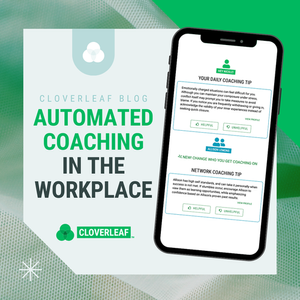
With Cloverleaf, coachees can rate every piece of coaching content. With each coaching tip, we ask simple questions like, was this coaching helpful? This immediate feedback is a starting point for users to provide even more context concerning the effectiveness and relevance of the coaching they receive.

Coachees can rate coaching content to provide immediate feedback
Gain a pulse on team culture and how applicable the coaching can be

Next, team members can respond to additional contextual questions concerning why that coaching was helpful or unhelpful.

All of these data points are significant because they offer insight that correlates with the team and organizational sentiment, relevance to their role, and the ROI of Automated Coaching™. 

The Big Question

The most important question is, how do we know that Automated Coaching™ improves emotional intelligence, team effectiveness, or belonging? 

Cloverleaf’s Chief Research Officer, Scott Dust, runs regressions against the data to isolate the impact of Cloverleaf on outcomes, and here are some of the results.

Our monster pilot data essentially says that as the number of coaching moments increases, so does the increase in (a) team effectiveness, (b) feeling recognized by team members, and (c) feeling as if one’s strengths are valued by others.

These are great results, and we plan to further extend this analysis. We believe that Cloverleaf (an Automated Coaching™ solution) when used in conjunction with a human coach, can take employee and organizational development to even greater heights.

Cloverleaf is helping People Strategy Leaders change how they develop their leaders. Scaling coaching opportunities for leaders and managers is possible with access to popular validated assessments, personalized dashboards, and in-the-moment coaching tips.

Discover why Cloverleaf is the all-in-one tool for boosting emotional intelligence in the workplace. Schedule a demo to learn more about Cloverleaf ‘s impact on leadership development, managerial effectiveness, and driving behavioral change.