
You’ve probably sat through three or four AI coaching demos in the past six months. Maybe more. And if you have, you’ve noticed something: they all sound nearly identical.
Every platform is proactive. Every platform is personalized. Every platform is “in the flow of work.” The language has converged so completely that you could swap the vendor names in most demos and the pitch would still hold together.
This is genuinely confusing — not because the vendors are lying, but because those descriptors are all technically true. The differences live underneath the marketing language, in the architectural choices and philosophical convictions that determine how a platform actually works. And those differences matter a lot, especially if you’re trying to make a decision that will touch your entire manager population.
The most useful question to ask before your next evaluation isn’t “does this platform have roleplay?” or “does it integrate with Slack?” It’s: what does this platform believe about how behavior change happens at work?
Why the Foundation Matters More Than the Feature Parity To AI Coaching
Behavior change is hard. That’s not a novel insight for anyone working in talent development — it’s the defining frustration of the function.
You can design a great performance review process. You can run a compelling manager training. You can commission a CliftonStrengths rollout and watch people read their reports, feel seen, and then not change much about how they actually work.
The problem isn’t the content. Most leadership development content is solid. The problem is that insight and behavior change are separated by a gap that good intentions don’t reliably cross.
The challenge isn’t just generating better insight. It’s getting that insight to show up in the moments where behavior actually happens.
Most development efforts still operate inside structured programs — performance reviews, training sessions, workshops. But those moments represent a tiny fraction of the interactions that actually shape how people work day to day.
The real question isn’t whether a platform can produce good coaching. It’s whether that coaching reaches someone in the 10 minutes before a 1:1, in the middle of a Slack conversation, or right after a difficult interaction — when there’s actually something to change.
So what does close that gap? That’s where the philosophies diverge.
Get the 2026 AI coaching playbook to see how organizations are implementing AI coaching at scale.
Two Competing Models of Behavior Change in AI Coaching
Most organizations evaluating AI coaching platforms have already invested significantly in behavioral assessments. DISC, CliftonStrengths, Enneagram, 16 Types, Hogan — the list varies by company, but the investment is real. Assessment licenses, rollout time, facilitation, and the slow cultural work of building a shared language around how people think and work together.
What happens to all of that when you bring in an AI coaching platform?
If the platform requires a proprietary assessment — or asks users to manually upload their existing scores — you’re effectively starting over. The investment becomes a sunk cost, the shared language has to compete with a new vocabulary, and every employee who’s already done the work has to do something new before they can start getting coached. That’s friction at the front door, before the coaching has even begun.
A platform built on the philosophy that validated behavioral science is foundational — not supplemental — takes a different approach: it integrates with the assessments organizations have already adopted.
If your people have CliftonStrengths profiles, those become the behavioral foundation. If they have DISC scores, those inform every coaching moment. Nothing your organization has already built gets abandoned. In practice, this often means AI coaching ends up consolidating spend that was previously split across multiple assessment vendors — organizations frequently save more than 30% compared to paying for assessments and coaching separately.
This isn’t just a budget argument. It’s a behavior change argument. Coaching grounded in the assessments someone already took, already reflected on, and already has a shared language around with their team lands faster than coaching asking them to start fresh.
See How Cloverleaf’s AI Coach Works
The 1.5% Problem: Why Most AI Coaching Misses Where Behavior Is Actually Influenced
Here’s a number worth sitting with: HR, L&D, and talent functions have, on average, about 220 meaningful touchpoints per employee per year. That covers everything from benefits enrollment to performance reviews to manager enablement programs.
Meanwhile, Microsoft’s research on workplace tool usage shows employees have roughly 14,640 interactions with other people per year — through calendar, messaging, email, and meetings. Do the math and HR is touching about 1.5% of the interactions that actually shape an employee’s experience of work.
The real promise of AI coaching isn’t making that 1.5% more efficient. It’s reaching the other 98.5% — the manager-to-employee Slack message, the 10 minutes before a 1:1, the moment someone’s walking out of a difficult conversation and trying to figure out what just happened.
That only works if the coaching lives where those interactions live. Not behind a separate login. Not in a dashboard someone has to seek out. In the notification that fires before the meeting. In the three sentences that show up in Slack without requiring the manager to go anywhere.
“In the flow of work” is one of those phrases every vendor uses but means different things by. It’s worth asking specifically: does coaching proactively appear by integrating in the tools employees are already in — email, calendar, Slack, Teams — without requiring a separate visit? Or does “in the flow of work” mean available in the vendor’s platform at lifecycle moments like performance reviews? Both are useful. Only one reaches the 98.5%.
There’s also the question of what happens when the coaching arrives. Coaching that has a designed ending — three sentences, an actionable insight, the option to go deeper if time allows — treats a manager’s attention as the scarce resource it is. Coaching that opens into an indefinite conversation, however rich, competes with everything else on their screen. The most common feedback on AI coaching that actually gets used consistently is that people love it because it’s fast. Not because it’s long.
A Word on AI Personas and Organizational Trust
One more distinction worth naming, because it rarely comes up in demos: what it means, organizationally, to have a named and personified AI coach.
The bet on personification is that employees engage more deeply with an AI that feels like a coaching relationship than one that feels like software. There’s probably some truth to that — at least in the short term. Nametags and personas lower the activation energy for a first conversation.
But organizations navigating AI governance requirements are increasingly asking different questions.
🤔 What does it mean when employees form an ongoing relationship with a named AI system?
🤔 What are the disclosure requirements?
🤔 What happens when the vendor updates the product significantly?
🤔 Who owns the continuity of that relationship?
The International Coaching Federation’s 2025 AI coaching framework requires explicit AI disclosure on every interaction — not buried in an onboarding modal, but present at the point of engagement. For organizations with global privacy requirements, enterprise governance standards, or simply a cultural commitment to transparency about AI use, how a vendor handles this architecture matters. It’s worth asking directly: where does the AI disclosure appear, and what does the employee see?
Three Questions That Cut Through the Marketing Language For Talent Leaders Evaluating AI Coaches
If this framing is useful, here are three questions to bring into your next evaluation — regardless of which vendor you’re evaluating:
1. Where does the coaching actually appear, and what does the employee have to do to receive it? The answer reveals whether “in the flow of work” means native to their existing tools or native to the vendor’s platform.
2. What happens to the behavioral assessments we’ve already invested in? The answer reveals whether this platform compounds your existing infrastructure or asks you to rebuild it.
3. What is the platform’s published stance on AI disclosure, bias mitigation, and coaching ethics standards? The answer reveals how the vendor thinks about organizational trust — not just user satisfaction scores.
Both architectural approaches to AI coaching represent serious bets on how behavior change happens. The question isn’t which bet is winning in the market. It’s which bet is built on the same belief about development that you hold — and which one is designed to reach not just the 1.5% of interactions your team already owns, but the 98.5% where managers and employees actually work.
If the philosophy of validated behavioral science, compounding over time, delivered in the tools people are already in — that resonates, Cloverleaf’s AI coaching approach is worth a closer look. Or if you want to bring these questions into your next evaluation, the Talent Leader’s Guide to Vetting AI Coaching breaks down exactly what to look for.
I manage 10 direct reports. We do quarterly feedback, bidirectional, which means I start by asking them what they’d like me to continue, start, stop, or do differently. Then we flip it.
I’ve run this cadence for a while. Before my last round, I was better prepared than usual. I’d been syncing Granola meeting transcripts and 1:1 notes into Claude, so I could pull themes across months of conversations, not just whatever I happened to remember from the past two weeks. I had the patterns. I knew what I needed to say to each person.
I had already said most of it before.
One in Three Feedback Conversations Makes Performance Worse, Not Better
That’s not a rhetorical point. A landmark meta-analysis by Kluger and DeNisi examined 607 studies and found that over one in three feedback interventions actually decreased performance after they were delivered. Not neutral. Worse. Their explanation: feedback becomes less effective, and sometimes actively counterproductive, the closer it gets to the person’s sense of self. When feedback touches something someone considers core to who they are, the brain stops processing it as information and starts processing it as threat.
When that happens, people don’t change. They cope. They dispute the feedback, reinterpret it favorably, lower their goals, or agree in the moment and move on. The feedback is accurate. It doesn’t matter.
I had been watching this play out with one of my direct reports.
Get the 2026 AI coaching playbook to see how organizations are implementing AI coaching at scale.
The Same Feedback Didn’t Land — Until Managers Can Change How They Frame It
One of my direct reports is genuinely one of the most helpful people I work with. When someone asks if something is possible, they’ll say yes, enthusiastically, warmly, and then go on to explain everything they’re going to do and how. It comes from a real place.
But in a startup where context switches fast, that pattern creates noise. Someone asks a quick question and gets a five-minute answer. The feedback I needed to give was simple: just say yes and move on. Not every question needs a full response.
I’d said something like this before. They understood it, nodded, and seemed to take it in. It came up again anyway.
This time, I prepared differently.
I was using Cloverleaf’s MCP integration alongside my meeting notes, pulling together patterns from past 1:1s and layering in behavioral data from assessments into the same context. Not just what had been happening, but additional signals about how this person tends to operate and how feedback like this might land with them.
The output didn’t just give me talking points. It added guidance on how to frame the feedback for this specific person.
It surfaced the same theme, and then added more helpful nuance and insight:
“This is the single most personality-driven behavior. This person is very people-centered in nature, and helpfulness feels like an identity to them — not just a habit. Be careful here. If they hear ‘stop being helpful,’ that will land as a rejection of who they are. Instead, frame it as how they channel their helpfulness.”
See How Cloverleaf’s AI Coach Works
When Feedback Touches Identity, It Stops Being Processed as Information
I stopped when I read that. Because I realized what I had been doing, even without using those exact words, was telling someone to stop doing the thing that feels most like them. For someone whose helpfulness is core to their identity, that isn’t a coaching note. It’s an identity threat.
The research on this is clear. Studies on how people respond to identity-threatening feedback consistently show the same pattern: people cope rather than change. They dispute it, misremember it more favorably, or reduce their commitment to improving, none of which is visible in the moment. They nod, they move on, and nothing shifts. The feedback wasn’t wrong. The frame was.
The reframe the system suggested: “Your helpfulness is one of your superpowers. The change is about being strategically helpful, directing it where it can have the most impact, not diffusing it across every moment.”
Same observation. Completely different frame. Their response when I used it: “Yeah, that’s spot on.” And then the conversation actually opened, they had thoughts about specific situations, ideas for what strategically helpful would look like day-to-day. It became a real exchange instead of something they were getting through.
What Behavioral Data Does That Performance Data Can’t
Most of what gets written about AI and feedback is focused on improving the data collection side: surfacing patterns across performance reviews, reducing recency bias, generating first drafts of assessments. That’s genuinely useful. Gallup research shows that employees who receive frequent, specific feedback are nearly four times as likely to be engaged, and better preparation helps managers get there.
But performance data tells you what happened. It doesn’t tell you how to talk about it in a way this specific person can actually receive.
That’s a different problem. The information about the helpfulness pattern was solid. What I was missing was context on how that pattern connects to this person’s identity, and therefore how I needed to frame the conversation for them to actually hear it.
That’s what the assessment data surfaced. Not a profile to study before a review cycle, but a specific note in the preparation flow: here’s how this person will likely receive what you’re about to say. Before the conversation, not after.
Giving Effective Feedback Gets Harder the More People You Manage
I know my team. I spend real time with each person. But managing 10 people at a startup — across product, customers, recruiting, and everything else — means the nuanced detail of how each individual thinks doesn’t stay in active memory. Some of it slips. Some of it I never had clearly to begin with.
This isn’t unique to me. Research on continuous feedback finds that feedback quality, specifically how well it accounts for the individual, is one of the strongest predictors of whether it changes behavior. The bottleneck isn’t manager effort or intent. It’s the cognitive load of holding detailed individual context across many people simultaneously.
Cloverleaf’s insight doesn’t replace knowing your team. What it does is resurface the context that matters at the moment you need it, in a way that changes not just what you say but how you say it for this person.
One Data Point Can Entirely Change How People Give & Receive Feedback
The feedback I’d been trying to give for months finally landed. Not because I said something new, because I said it in a way this person could actually hear.
That’s the part that’s been missing from most of what I’ve seen in this space. Not better data collection or more frequent check-ins. The translation layer between what you know about someone’s performance and how to communicate it in a way that reaches them, that fits how they think, what they value, and what they’re most likely to act on.
When that behavioral context, the translation between performance and how to communicate it, is present, feedback stops being something people sit through and becomes something they understand, engage with, and actually change because of it.
In a given year, the average employee has about 220 interactions with HR. This includes everything—onboarding, benefits administration, compensation changes, performance reviews, training courses, talent reviews. The full spectrum of what HR touches across an employee’s year adds up to roughly 220 touchpoints.
Microsoft’s research into Office 365 calendar data and Teams messaging reveals something else: the average employee has approximately 14,640 people interactions per year. Meetings, group messages, email threads, collaborative projects. The actual work of collaboration happens 14,640 times annually.
Which means HR touches 1.5% of the interactions where development actually needs to happen.
This is a buyer’s guide. AI coaching promises to bridge that gap—but the market is filling with tools that vary wildly in what they actually do. Some are chatbots with framework databases. Some are role-play simulators. Some frustrate employees who expect answers. Here’s how to tell which tools can actually activate your talent investments in the moments that matter.
Get the 2026 AI coaching playbook to see how organizations are implementing AI coaching at scale.
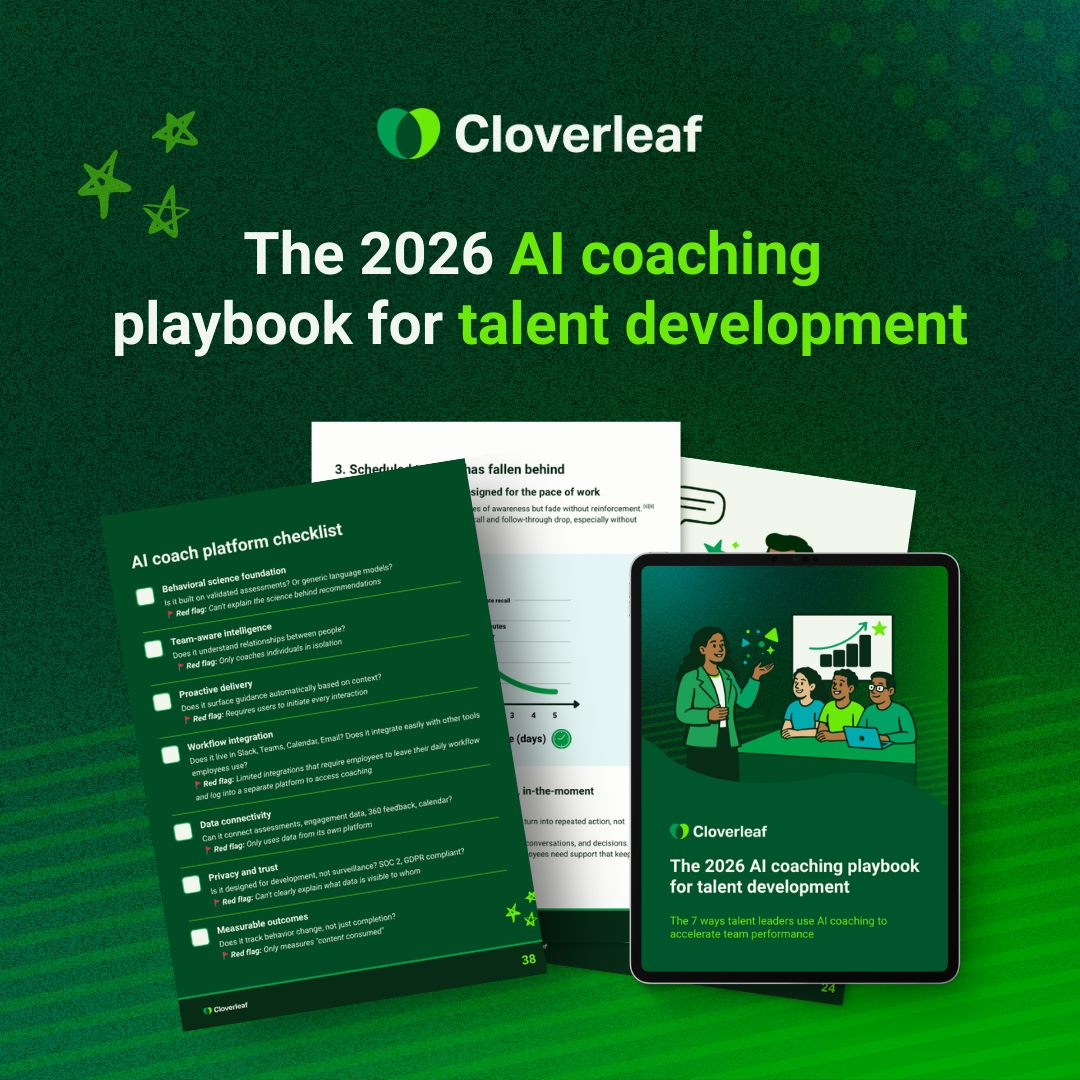
The two promises of AI coaching—and which one delivers ROI for talent leaders
Promise 1: An AI coach can help teams do more faster with less.
Generate performance review drafts. Summarize feedback. Create development plans. This is the efficiency promise, and most talent leaders are already experimenting with it.
Talent leaders are willing to try things like using Gemini or other tools in their performance reviews because leaders are too busy. It can help write the reviews for them. However, most times they are not confident if it is a good idea or not and often feels like a gamble.
That’s the efficiency use case. It streamlines admin work. It saves time on documentation. It’s valuable—but it’s not transformative.
Promise 2: AI coaching can ensure ROI from the talent programs you’ve already paid for
You’ve invested in performance management systems, leadership development programs, feedback processes, 360s, culture initiatives. Those investments create valuable moments—the performance review conversation, the workshop debrief, the 360 results session.
Unfortunately, those critical insights are easily forgotten in the busyness and demands of work.
The manager and employee have a productive performance review. They identify a development goal. They both agree. They’re both clear on it. Three weeks later, the manager is preparing for their next one-on-one. The development goal doesn’t cross their mind. They’re thinking about project status, deadline pressure, what needs to get done this week. The goal that felt so important in the performance review? It’s in a system that hasn’t been opened since that conversation ended.
The workshop creates a breakthrough. The manager finally understands why they keep steamrolling their team in meetings. They leave energized to change. Two weeks later, in a tense project meeting, they do it again. They didn’t forget the workshop insight. They just didn’t remember it in the moment when their stress response took over and they needed it most.
The 360 feedback reveals a growth area. The employee reads it, reflects on it, commits to working on it. The PDF sits in their downloads folder. It doesn’t come up again until the next 360, six months later, when they realize they haven’t actually changed anything.
Your 220 HR moments create real insight. But that insight is not surfacing in the 14,640 interactions where it would actually change behavior.
AI coaching can layer on top of everything you’ve already built and activate it. It takes the goals, the insights, the feedback from those 220 HR moments and surfaces them in the 14,640 interactions where managers and employees actually work together.
Consider this common scenario:
Manager preparing for their weekly one-on-one.
Slack notification appears ten minutes before the meeting: “You and this employee agreed to work on delegation in their performance review two weeks ago. Here’s a way you can coach them on it today.”
Right there in the notification, the manager can launch a role play to practice the conversation. Or they can open a chat with the AI coach: “I’m worried about bringing this up. I think they’re going to get defensive because they’re already stressed about the project deadline.”
The AI coach responds based on that employee’s behavioral data—how they receive feedback, what motivates them, how they handle stress. The manager gets specific guidance for this specific person in this specific situation. Not a framework. Not a reminder to “use your training.” Actual coaching on how to have this conversation with this employee today.
The manager walks into the one-on-one equipped. The performance review goal doesn’t get buried under project updates—it surfaces in the exact moment when the manager can actually coach on it.
That’s the promise worth building a business case for: your 220 HR moments start working in the 14,640 interactions where development actually needs to happen. The investments you’ve already made—they start delivering ROI every single day, not just in the moments you can directly be present or available for.
See How Cloverleaf’s AI Coach Works
What your AI coach should automate—and what it should never touch
Before evaluating specific AI coaching tools, you need a framework for thinking about where AI should and shouldn’t be used. Because if AI coaching is replacing human judgment or relationships, you’re solving the wrong problem.
Where AI wins: Speed, accuracy, and pattern recognition
AI is never biased—if the data it’s trained on is clean.
That’s a big if. But when the data is good, AI performs consistently no matter what time of day it is, no matter how many meetings happened before, no matter what’s going on in the background.
Humans don’t work that way. What you had for breakfast changes how fast your brain works. If you’ve been in back-to-back meetings all day, you’re tired by 4pm. We all carry unconscious biases we don’t even realize are shaping our decisions.
AI doesn’t have recency bias. January performance and November performance are weighted the same—assuming it’s been trained that way.
AI also processes massive amounts of data instantly and spots patterns humans would never catch. You want to look at 500 employees’ development goals and identify common themes? AI does that in seconds. A human would spend hours manually reviewing and still miss half the connections.
Where human intervention wins: Transferable knowledge, creativity, leadership
You might not be an accountant, but you can generally understand competing departmental goals. You can figure out how finance thinks about risk differently than sales thinks about revenue opportunity. You can navigate cross-functional dynamics because you understand organizational context.
AI trained on finance data has to start from ground zero when you ask it about sales. The race toward AGI—artificial general intelligence—is real. But we’re not there yet. Right now, humans significantly outshine AI in cross-functional understanding.
Creativity is another area where humans win. AI can seem creative. It generates novel combinations of existing ideas. But all it can do is imitate. It recombines what it’s been given.
True innovation comes from humans who look at market conditions, competitive dynamics, available tools, economic constraints and say: “Here’s a completely new approach nobody’s tried.”
Leadership is where humans are irreplaceable. Trust, culture, loyalty, inspiration—these don’t come from bots.
One of the biggest barriers to AI adoption isn’t the technology. It’s lack of trust in leadership. Employees worry: “If I use this tool, what data does my employer see about me? If I train AI to do my job really well, am I just going to lose my job?”
Those fears aren’t solved by better AI. They’re solved by better leadership. Trust, vulnerability, courage—that’s how organizations actually win with AI. And that’s work only humans can do.
What this means for talent leaders evaluating AI coaching tools
AI should handle speed and pattern recognition. It should surface insights from your siloed systems—performance reviews, engagement surveys, skills data, learning history, calendar data. It should deliver personalized nudges based on patterns humans can’t track manually across hundreds of employees.
But the AI coach should be pushing people back toward human intelligence. Toward cross-functional collaboration. Toward creative problem-solving. Toward relationships.
If the AI coaching tool you’re evaluating is designed to replace manager conversations or reduce human connection, you’re looking at the wrong tool. It’s solving the wrong problem.
For more on why development infrastructure needs to support human relationships, see why 2026 is the year talent development becomes business infrastructure.
Five features that separate AI coaching systems from glorified chatbots
We’ve been getting a specific type of sales call lately. Talent leader says: “We tried an AI coach last quarter. People used it for two weeks and then stopped. It felt like a glorified chatbot with a framework database. We’re disappointed.”
When you dig into what went wrong, a pattern emerges. The tools that fail share common gaps. The tools that succeed share five specific features.
Feature 1: Proactively shows up in the flow of work before you remember you need it
Even on your best days, you don’t wake up thinking: “You know what I’m going to do? Spend my first 15 minutes reviewing that training I took and figuring out how to apply it today.”
You wake up thinking: “Do I have time to prep for that meeting? I didn’t even pack lunch for my kid yet.” You’re busy. You’re stressed. Development goals don’t surface naturally when you’re focused on immediate work demands.
Nobody wants another login. Nobody wants to remember to find another tool. Your AI coach needs to exist where people already work—Workday, LLMs, Microsoft Teams, Slack, email, wherever the 14,640 people interactions are actually happening.
But it’s not enough for AI coaching to just be available there. The differentiator is whether the AI coach understands what’s happening in your day and proactively surfaces guidance before you think to ask for it.
“I see you’re walking into this meeting with the product team. Remember you wanted to work on not dominating the conversation. Here’s one thing to try: Ask a question and count to five before you speak again.”
Not a five-minute video.
Not a long article.
Three sentences.
That’s all people have time for between meetings. Just a nudge. Just a reminder. Right in the flow of work where it can actually get applied.
Feature 2: Remembers your past conversations
If someone starts from ground zero every time they interact with the AI coach, it doesn’t feel like the coach actually knows them.
The AI coach should remember: “You’ve really struggled with defensiveness when your manager gives you feedback. Let’s keep working on that.” Or: “I’ve noticed you keep asking questions about delegation. What’s making this so hard right now?” Or: “In your last 360, your peers said you need to create more space for others to speak in meetings. How’s that going?”
If your organization has 360 capabilities or lightweight feedback tools integrated with your AI coach, can the coach know what feedback you’re getting from peers and coach you on those specific themes?
Memory creates the experience of working with someone who actually understands you—not just accessing a database that forgets everything the moment you close the window.
Without memory, every interaction starts from scratch. The AI coach asks you the same diagnostic questions every time. You answer the same background information over and over. You stop engaging because it feels like you’re training the tool instead of the tool helping you.
Feature 3: Coaches you on your specific situation, not generic advice for your role
Many tools claim “personalization” but what they actually mean is: “We know your title, so we’ll send you content for people at your level.”
Here’s what false personalization in AI coaching often looks like:
Manager gets a notification about a “personalized learning opportunity”—it’s a seven-minute video on delegation. The subject line says “Based on your role as Manager Level 3.” The manager already knows how to delegate. They’ve been managing people for five years. The video is noise. After the third generic “personalized” notification, they stop opening messages from that system.
True personalization means the coaching addresses what you’re stressed about right now, what you’re excited about, what’s in front of you today. Not generic advice for people with your job title.
You need AI coaching that understands: This person is stressed about an upcoming difficult conversation scheduled for tomorrow. This person is excited about a new project but doesn’t know how to structure the kickoff meeting happening this afternoon. This person just got promoted last week and is overwhelmed by suddenly managing people who used to be peers.
If your AI coach is only trained on frameworks, it will feel generic. If it’s trained on your behavioral data, your performance history, your current projects, your team dynamics—it can deliver coaching that’s actually relevant to what you’re dealing with today.
Feature 4: Connects data across your talent systems
How much data can your AI coach actually access? If it only knows what happens inside its own platform, it can’t connect the dots that make coaching useful.
Can it pull from your performance management system? Your engagement surveys? Your skills taxonomy? Your learning history? Your HRIS data—who reports to whom, when someone got promoted, when teams restructured?
Can it know behavioral assessment data—DISC profiles, Enneagram types, CliftonStrengths, communication preferences?
Can it understand calendar context—who you’re meeting with, when you have one-on-ones scheduled?
Consider what’s possible when data actually connects:
Manager preparing for one-on-one with Jordan. Gets notification ten minutes before the meeting: “You’re meeting with Jordan in 10 minutes. Jordan’s top CliftonStrength is Responsibility, but their current project isn’t utilizing that strength. That might explain the disengagement you mentioned in last week’s skip-level. Consider asking: ‘Does this project feel aligned with what you’re best at?'”
That single notification required three data sources working together: performance system (disengagement observation from skip-level), assessment data (CliftonStrengths profile), calendar (meeting in 10 minutes). If your AI coach can’t connect across those systems, it can’t deliver that kind of insight.
The more data sources your AI coach can integrate, the more useful it becomes. If your AI coach lives in a silo, it’s just another tool with partial information.
Feature 5: Knows when to ask questions and when to give answers
Most AI coaching tools try to be pure coaches. They try to ask the right questions. They attempt to help you reflect. They guide you to discover your own insights.
However, there is an interesting dynamic that occurs when people use tools like this:
Manager opens the AI coach. “I have a difficult conversation with an employee tomorrow. They’re underperforming and I need to address it.”
AI coach: “What specifically is making this conversation feel difficult for you?”
Manager: “I don’t know how to bring it up without them getting defensive.”
AI coach: “What do you think defensiveness might signal for this person?”
Manager closes the tool. Thinks: “I came here for help and it’s just asking me more questions. I already have questions. I need answers.”
People expect AI to give answers, not just facilitate their thinking.
When the AI keeps asking “How do you feel about that?” or “What do you think you could try?” without ever providing concrete guidance, people get frustrated and stop using it.
Your AI coach needs to be versatile.
Sometimes it should coach—help you process your thinking, ask questions that surface your own wisdom. Sometimes it should mentor—surface the right information from your talent systems and give you specific guidance for this specific situation.
Example of coaching mode: “You seem frustrated about this conversation. What specifically made it frustrating? When have you felt this way before? What helped then?”
Example of mentoring mode: “You’re about to give feedback to someone with High S on DISC—they need softer delivery and time to process. Try starting with what they’ve done well, then frame the feedback as an observation, not a criticism. Give them space to respond without filling the silence.”
For more on how AI coaching activates specific assessment data at moment of need, see how AI coaching can activate assessment data for for manager development.
Four types of AI coaching in the market (and what each one actually does)
When you start looking at AI coaching tools, you’ll notice they’re all pretty different. They’re not trying to solve the same problem. The market breaks into four categories, each with distinct use cases.
Type 1: Q&A functionality
This is the most basic form. It’s essentially a chat interface trained on frameworks, best practices, or your organization’s existing content. You ask it a question—”How do I give feedback in this situation?”—and it retrieves relevant information from its training data.
Some platforms have added this type of AI coach. It’s trained on coaching and leadership frameworks. You can ask whatever question you want and it pulls from what it knows.
Some tools let you customize the training. If you’ve already invested in specific frameworks through your leadership development programs—CCL, Blanchard’s Situational Leadership, others—you can train the AI on those models your organization already uses.
Quick access to frameworks without digging through your LMS. But knowing a framework doesn’t mean you’ll use it in a stressful moment.
Type 2: Role play
Almost every AI coaching tool offers role play. The most common use case is practicing difficult conversations before they happen. Most tools let you customize the role play to frameworks your organization already uses.
One differentiated example: some tools focus specifically on sales and customer support. You can upload past sales calls or customer service interactions, and their AI role-plays based on those actual scenarios. It’s highly specific to sales enablement and frontline support training—not general leadership development.
Managers can practice high-stakes conversations in a low-stakes environment. But knowing you should practice doesn’t mean you will.
Type 3: Human-like coaching experience
A smaller segment of AI coaches aims to make executive-level coaching accessible to everyone in the organization. Their goal is to make the experience feel like talking to a human coach. Some include video simulations of a person. Others use voice chat. You can talk with it as if it were an actual coach—someone who asks thoughtful questions, helps you process your thinking, guides you to insights.
Some tools offer cohort-based leadership development training where the AI coach follows up on what you learned in the program. These are focused on data within their own platform, which makes them a specific use case rather than a broad organizational tool.
A critical feature to look for in this category: memory (see Feature 2 above).
Makes coaching accessible to everyone, not just senior leaders. But people expect AI to give answers, not just ask questions.
Type 4: Full talent lifecycle integration
This is where AI coaching becomes genuinely differentiated. Can your AI coach pull together data from segmented systems—performance reviews, engagement surveys, skills inventories, learning history, career pathing, behavioral assessments, calendar data—and deliver personalized support based on all of that context?
Can it surface a performance review goal three months later when that goal is actually relevant to today’s one-on-one? Can it know who’s attending a meeting and flag: “You’re the only introvert presenting to a room of extroverts—here’s how to structure your message so it lands”? Can it understand that this employee’s top CliftonStrength is Responsibility and their current project isn’t utilizing that strength, which might explain their recent disengagement?
Some HRIS platforms like Workday have opened up their systems for custom integrations, making it possible for AI coaches to connect across the talent lifecycle. If your HRIS doesn’t have that level of openness, there are still ways to connect data—but it requires intentional integration work.
This type activates your existing talent investments in the moments where they’re actually needed. It makes your siloed data useful. The tradeoff: it requires significant integration work and data connectivity. It’s not plug-and-play for most organizations.
Most organizations exploring AI coaching will encounter tools in categories 1-3. Very few tools are attempting category 4. When you’re evaluating, ask explicitly: “Which category does this tool fall into, and does that match what we’re trying to accomplish?”
Your evaluation checklist: Five features and four questions
The infrastructure to bridge that gap—to activate your performance reviews, your 360s, your engagement insights, your behavioral assessments, your leadership programs in the 98.5% of interactions you can’t directly reach—that infrastructure can exist now.
But not all AI coaching tools are solving that problem. Some are chatbots with framework databases. Some are role-play simulators. Some are question-asking tools that frustrate people who expect answers.
The tools that work deliver five things:
- Proactive nudging in the flow of work
- Memory that creates continuity
- True personalization beyond role-based templating
- Data breadth across your talent lifecycle
- Versatility between coaching and mentoring
For guidance on measuring ROI and building your business case, see how to calculate AI coaching ROI. For details on data security and integration requirements, see AI coaching integrations and security.
When you’re evaluating AI coaching tools, ask explicitly about those five features. Ask for examples of how the tool delivers each one. Ask to see the data integrations. Ask how it handles privacy and trust.
The market is noisy. The solutions vary wildly. But the organizations that get this right—that choose AI coaching systems instead of glorified chatbots—they’re the ones who’ll activate talent development in the moments that actually matter.
We’ve been getting requests lately for team diagnostics. Organizations want to understand why their teams aren’t performing, why collaboration feels difficult, why certain dynamics keep creating friction.
Team diagnostics serve a purpose. They identify patterns. They give you data about where trust is lacking, where conflict is being avoided, where accountability breaks down. That baseline understanding matters.
But diagnostics are a starting point, not a solution. And they’re often misused as if identifying the problem is the same as solving it.
A team diagnostic tells you “your team avoids conflict” in March. It doesn’t tell you what to do in May when you’re sitting in a room with two teammates—one who communicates directly and pushes for fast decisions, another who goes quiet when tension rises—trying to make a decision about the product roadmap, and you can feel the unspoken disagreement building.
The diagnostic gave you the pattern. It didn’t give you the guidance for this specific moment with these specific people and their different communication styles.
That’s not a flaw in diagnostics. It’s a structural limitation of point-in-time team assessments. Understanding this limitation helps you know what infrastructure to build next.
Get the 2026 AI coaching playbook to see how organizations are implementing AI coaching at scale.
Five gaps between team diagnostic insights and actual team behavior change
1. Single-framework diagnostics force every team problem into the same model
Most team diagnostics are built on a single framework. You’re measuring trust, conflict, commitment, accountability, and results. Or you’re assessing psychological safety and cohesion. Or you’re evaluating communication patterns.
The framework determines what gets measured. What gets measured determines what gets addressed.
But teams don’t fail for the exact same reasons. A product development team struggling with decision speed has different problems than a client service team struggling with handoffs. A newly formed team trying to build trust faces different challenges than a long-tenured team dealing with stagnation.
When you force every team’s problems into the same diagnostic model, you miss the specific dynamics actually creating friction. The framework becomes the lens—not the team’s reality.
See How Cloverleaf’s AI Coach Works
2. Team-specific problems don’t always fit into diagnostic frameworks
Even when a framework is relevant, it’s often too broad to guide specific team interactions.
“Your team lacks trust.” Okay. What does that mean when you’re managing Jordan and Alex? Is it that Jordan doesn’t believe Alex has the technical competence to execute? Is it that Alex doesn’t feel psychologically safe disagreeing with Jordan? Is it that neither of them trust the priorities because decisions keep changing?
“Your team avoids conflict.” Sure. But what does that mean for tomorrow’s product roadmap meeting? Does Jordan need permission to be more direct? Does Alex need structured turn-taking so they don’t get talked over? Do you need to model productive disagreement yourself so the team sees it’s safe?
The diagnostic label tells you there’s a problem. It doesn’t tell you how to manage the relational dynamic between these two specific people in this specific meeting.
Consider this example:
Sales team at a SaaS company. Diagnostic said “team avoids accountability.”
Recommended solution: institute peer accountability practices. Have team members hold each other accountable, not just the manager.
Sounds great. Here’s what the diagnostic didn’t know: This team was 100% commission-based. Highly competitive. Low trust because everyone was protecting their deals. When they tried to introduce “peer accountability,” it got weaponized. People used it to undermine each other, point out mistakes, protect their own numbers.
The diagnostic recommendation assumed moderate trust and collaboration as a baseline. This team had neither. The “solution” made things worse because it didn’t account for the specific relational context and incentive structure.
3. Team dynamics change faster than diagnostic cycles can capture
You run the diagnostic in March. Results say the team struggles with psychological safety. You do the debrief. Two people admit they don’t feel safe disagreeing with the manager. Manager says “I want you to push back on me.” Everyone feels good.
April: Manager is under pressure from their VP. Someone pushes back on a decision in a meeting. Manager gets defensive. Shuts it down. The person who pushed back thinks “See? It’s not actually safe.” They stop engaging.
May: New person joins the team. They don’t know the diagnostic happened. They don’t know the “team struggles with psych safety” context. They observe the quiet team and adapt to that norm.
June: You’re still operating off March data that said “psychological safety is the issue.” But now the issue is “new team member doesn’t have context,” “manager’s behavior under pressure contradicts stated values,” and “team has adapted to silence as the norm.”
The diagnostic can’t see any of that. It’s frozen in March. Teams aren’t static. They’re living systems that adapt constantly to new members, pressure shifts, reorganizations, and changing priorities.
4. Generic team recommendations ignore the context that determines whether they’ll work
Ideal team behavior depends on context. What works for a team that’s been together for three years doesn’t work for a team that formed last month. What works for a high-trust environment where people can be direct doesn’t work in a low-trust environment where directness gets misread as aggression.
Team diagnostics measure general patterns. They don’t account for:
- Whether this team is new or long-tenured
- Whether they’re under intense deadline pressure or in a planning phase
- Whether they’re co-located or distributed across time zones
- Whether their work requires deep collaboration or parallel execution
- Whether the leader has credibility or is still building it
- Whether compensation structures create competition or collaboration
- Whether team members have existing relationships or are strangers
Generic recommendations applied to specific contexts don’t land. The advice makes sense in theory. It doesn’t fit the actual situation this specific team is navigating right now.
This is part of a broader shift happening in talent development—away from episodic interventions and toward continuous infrastructure that adapts to real-time context. For more on this structural change, see why 2026 is the year talent development becomes business infrastructure.
5. Diagnostic insights don’t translate into what to say in in the moment
This is the biggest gap.
The diagnostic tells you “your team avoids accountability.” Great. Now what?
It’s Tuesday morning. You’re about to meet with your team. Jamie missed a deadline on the client deliverable. Everyone knows it. No one has said anything. You need to address it.
What do you actually say? How do you say it in a way that doesn’t create defensiveness? How do you adapt your approach based on whether Jamie is someone who’s motivated by achievement and will be hard on themselves, or someone who needs external accountability and clearer expectations?
The diagnostic gave you the pattern. It didn’t give you the script for this specific moment with this specific person in this specific team context.
Frameworks are helpful for understanding patterns. But frameworks alone don’t create behavior change—they need infrastructure to make them actionable. For more on this gap between frameworks and execution, see why talent development frameworks need behavioral infrastructure.
How continuous AI coaching makes discoveries from team diagnostics actionable
Let me be clear — this isn’t about replacing diagnostics. Team diagnostics serve a real purpose. They surface patterns you can’t see when you’re inside the system — where trust is breaking down, where conflict is being avoided, where accountability has quietly disappeared.
The problem is what happens after.
You run the diagnostic. You get the debrief. The team talks about it — maybe even has a breakthrough conversation where people admit things they’ve been holding back. And for a couple of weeks, it sticks. People reference the findings. The manager tries to create more space for disagreement. Someone speaks up in a meeting who normally wouldn’t.
Then the quarter gets busy. Two people rotate off the team. A reorg shifts priorities. And that diagnostic is sitting in someone’s Google Drive while the team navigates completely different dynamics than the ones that were measured.
The insight was real. The reinforcement wasn’t there.
So instead of treating the diagnostic as the destination, what if it became the starting input — the foundation that continuous coaching builds on every day?
Coaching adapts to each team member’s behavioral preferences
One of the five gaps with team diagnostics is that they typically force every team’s problems into a single model. You’re measuring trust, conflict, commitment, accountability, and results — and that framework becomes the lens for everything.
AI coaching works differently. It can pull from multiple data sources simultaneously — the team diagnostic findings and individual behavioral assessment data. DISC for how people communicate. Enneagram for how they respond under stress. CliftonStrengths for what energizes them. Values assessments for what actually motivates them.
So when a manager is preparing for a team meeting, the coaching isn’t just working from “this team avoids conflict.” It’s accounting for the fact that one person on this team shuts down when they feel rushed, another gets energized by debate, and a third needs to see data before they’ll commit to anything. The diagnostic told you conflict avoidance is the pattern. The coaching tells you what that pattern actually looks like with these specific people — and what to do about it.
Proactive coaching before team interactions for more insight
Think about when team dynamics actually get tested. It’s not during the debrief when everyone’s on their best behavior. It’s the Tuesday afternoon meeting where there’s tension about a missed deadline and half the team is frustrated.
The diagnostic told you “this team avoids accountability.” But that doesn’t help you at 2 PM when Jamie missed the client deliverable and no one’s saying anything.
Continuous AI coaching can proactively surface guidance before those moments. Something like: “This teammate values achievement and is likely already frustrated with themselves about the missed deadline. Lead with acknowledgment of the challenge, ask what support they need, then clarify expectations going forward. Avoid framing it as a competence issue — frame it as a resource or priority issue.”
That’s not a diagnostic label you have to translate on the fly. That’s what to say, how to say it, adapted to how this specific person is wired — delivered before the conversation where you need it.
When team composition changes, the coaching can keep up
You ran the assessment in March. By June, two people have joined, one has left, the manager is under new pressure from their VP, and the team is operating under completely different conditions than when the diagnostic was run.
Remember the gap about dynamics changing faster than diagnostic cycles can capture? The manager who said “I want you to push back on me” in March gets defensive when someone actually does it in April under pressure. The new person who joined in May doesn’t know the diagnostic happened. They observe a quiet team and adapt to that norm.
AI coaching doesn’t freeze in March. New member joins — the coaching adapts to that shift in composition. Organizational pressure spikes — the coaching adjusts. A manager who’s normally collaborative starts micromanaging under stress — the coaching can surface that pattern and offer guidance before the next high-pressure interaction.
It’s working from who’s actually on this team right now, what’s happening around them, and how they’re showing up today.
Context-aware guidance instead of generic team recommendations
The fourth gap we talked about is that generic recommendations ignore the context that determines whether they’ll actually work. The sales team that was told to “institute peer accountability” when they were 100% commission-based and already low-trust — the recommendation made things worse because it didn’t account for the actual relational dynamics.
AI coaching knows the context that diagnostics can’t capture. It knows if this is a new team still figuring out how to work together or a long-tenured team stuck in patterns they can’t see anymore. It knows if they’re co-located or spread across time zones. It knows if they’re in the middle of a product launch or a planning phase. It knows the compensation structure, the leader’s tenure, the pressure level.
So when a manager asks for help with delegation, they’re not getting a generic delegation framework that sounds right in theory. They’re getting guidance that accounts for this team’s specific composition, the pressure they’re under right now, and the actual people who’ll be doing the work.
Coaching to give you solutions to the patterns the team diagnostic uncovered
The biggest gap — gap five — is that diagnostic insights don’t translate into what to say in the moment. You know the pattern. You don’t know the play.
Continuous coaching closes that translation gap. Before the meeting where you need to address the product roadmap disagreement, it might surface: “One teammate on this call prefers direct communication and will push for decisions quickly. Another processes more slowly and needs time to think before responding. Try this: state the decision that needs to be made, give everyone 2 minutes to think individually, then go around and ask each person for their perspective.”
That’s not a theoretical framework about conflict styles. That’s “here’s what to do in this meeting, with these people, in the next 30 minutes” — informed by the diagnostic findings and each person’s behavioral profile.
The diagnostic gave you the map. Continuous coaching gives you turn-by-turn directions — updated in real time, adapted to who’s actually in the car.
Making diagnostic findings part of how your team works every day
If you invested in team diagnostics, that data has value. You know which teams struggle with what patterns. But that’s a starting point, not an endpoint.
- Turn diagnostic insights into team-specific coaching guidance.
- Integrate coaching where team work happens.
- Make it continuous, not episodic.
- Update as the team changes.
That’s what separates organizations that get value from diagnostics and organizations that don’t. It’s whether you built the infrastructure to activate it—every day, in the moments that matter, for the specific people who make up this team right now.
You’re the one who made the case. You went to leadership, justified the budget, rolled out DISC or CliftonStrengths or Enneagram — maybe all three. People took the assessments. Some teams had great debrief sessions.
And then the data just… sat there.
Not because anyone decided it was no longer valuable. It happens because there’s no system that puts it in front of people when they actually need it. The manager preparing for a 1:1 doesn’t pull up a PDF. The person writing feedback at 4pm on a Friday doesn’t pause to look up their direct report’s Enneagram type.
However, if the assessment data remains structurally disconnected from the moments where it would actually change behavior, managers are left trying to remember and apply complex insights on their own—which rarely happens consistently under the pressure of daily work.
Get the 2026 AI coaching playbook for talent development to accelerate team performance.
How assessment data gets scattered across organizations — and what it costs
The scale of this disconnect is often bigger than talent development leaders realize when they’re evaluating individual tools.
Cloverleaf’s 2025 survey of 155 talent leaders found that organizations with over 1,000 employees use an average of 20 different assessment tools. Companies with more than 5,000 employees average 35 different tools. But only about nine of those assessments are purchased centrally by talent management or L&D. The rest get acquired independently by business lines—different vendors, different platforms, no shared view of who took what or where the results live.
Even among companies that have a talent assessment strategy, only 34% have a formalized procurement process and only 31% ensure assessments are administered by certified practitioners or validated tools.
So the data exists. It’s scattered across vendor portals, PDFs, email attachments, and slide decks from debriefs that happened months ago. There’s no single place where a manager can access it and no mechanism to surface it when a coaching moment arrives.
The cost isn’t just operational inefficiency. One of the primary benefits of investing in assessments—maybe the primary benefit—is creating a shared language and behavioral understanding across an organization. That benefit gets significantly undermined when teams independently select different tools and nobody connects the results to daily work. Organizations end up paying for insight that never reaches the person who needs it, at the moment when it would actually change their decision.
See How Cloverleaf’s AI Coach Works
How multiple assessments create more precise coaching than any single tool can deliver
People are more complex than a single assessment can capture. That’s not a criticism of any assessment—it’s the reason validated tools exist across different categories in the first place. Each one is designed to answer a different question about how people work.
DISC tells you how someone responds to challenges and collaborative environments — their behavioral tendencies when working with others. Enneagram reveals why they react the way they do under stress — the core motivation and emotional trigger underneath the visible behavior. A strengths assessment like CliftonStrengths shows where someone naturally contributes the most — the work that energizes them versus the work that drains them. 16 Types shows how they process information and make decisions.
If an AI coach does not have any or limited access to only one of those inputs, it can only coach on one dimension. With DISC alone, the coaching might say “this person prefers a slower pace and softer delivery.” That’s accurate. It’s also incomplete.
When you layer a second assessment, the coaching gets meaningfully more specific. Add a third, and something qualitatively different happens: the AI can now connect how someone communicates, why they’re reacting the way they are, and what kind of work is or isn’t utilizing their strengths. The coaching shifts from general guidance to insight that accounts for the whole person in a specific relational context.
In practice, this difference shows up clearly in the quality of the coaching output. When a manager asks an AI coach “How should I give feedback to this person on the marketing team?” and the system has access to one assessment’s data, the answer might be decent but one-dimensional.
When that same AI coach has data from CliftonStrengths, Insights Discovery, motivating values, and 16 Types for that individual, the coaching output can point to specific insights that informed each recommendation—this person’s humor shows up as a natural strength in their profile, they tend to respond better to warmth and connection before directness, and their motivating values are likely shaping how they’ll interpret critical feedback.
Each additional assessment adds another layer of precision that the coaching can draw from when generating recommendations.
That’s the practical difference between coaching that sounds generally reasonable and coaching that might actually change how the manager prepares for and enters that specific conversation.
What insight do managers get when AI coaching can pull from multiple assessments
Layering assessments isn’t about collecting data for the sake of having more data. It’s about understanding the person, the people they work with, and their work context well enough that an AI coach can deliver the right guidance at the right moment.
Here’s what that can look like in four scenarios talent development leaders deal with constantly:
Preparing for a difficult 1:1 with a disengaged employee
With DISC data alone, the manager might get communication style guidance—adjust your pace, soften your delivery. Add Enneagram data, and the coaching can surface that this person’s core motivation is feeling competent and correct (Type 1)—which means their withdrawal probably isn’t disengagement, it’s more likely a stress response to feeling like they’ve failed at something. Add CliftonStrengths data, and the AI coach might flag that their top strength is Responsibility and that strength hasn’t been utilized in their current project assignments.
The coaching can shift from “adjust your delivery” to something far more specific and actionable: consider opening with what they’ve done well this quarter before raising the performance concern, then ask directly whether their current work is actually utilizing what they do best. That’s a fundamentally different conversation than the one the manager was planning to have.
Supporting a first-time manager through their first 90 days
A newly promoted manager inherits a team they’ve never led before. With layered assessment data across the team, AI coaching can surface—before their first 1:1 with each person—how that individual tends to process information, what typically motivates them, how they usually handle stress, and what management style they tend to respond to most effectively.
The manager doesn’t need to memorize any of this information or study profiles before each meeting. The relevant context shows up 10 minutes before the meeting in their Slack or Teams notification, tailored to who they’re about to meet with.
Sustaining development after a performance review
The performance review conversation identified that a manager needs to improve their delegation skills. Without ongoing reinforcement, that feedback typically lives in the HRIS system until the next review cycle rolls around.
With layered assessment data, AI coaching can deliver ongoing nudges tied to how each specific direct report actually tends to respond to delegation—one person might need detailed parameters and structured check-ins (High C on DISC), while another person might work better with autonomy and periodic touchpoints (High D). The coaching isn’t offering generic advice about delegation principles. It’s providing specific guidance about the actual humans this manager is trying to delegate to.
Navigating a cross-functional team that’s generating friction
A project pulls people from three departments. No one has worked together before. The team dashboard shows 100% judging preference on 16 Types—which suggests this group will likely move quickly toward spreadsheets and project plans but may skip the brainstorming phase where better ideas often surface.
That’s not an insight most would typically generate on their own just by looking at a roster of names and titles. With that insight surfaced, the team lead can intentionally build in a time-boxed brainstorm session before the team jumps to action items—and potentially avoid the friction that often comes from a team that plans efficiently but innovates poorly.
Teams don’t need every assessment on day one—but relying on just one means the AI coach can only understand part of each person
There’s a common hesitation when discussing multiple assessments: “We can’t ask people to take that many assessments—it’s too much to expect.” It’s worth reframing what “too much” actually means in practice.
Taking three to five assessments might total about 40 minutes of someone’s time, and those assessments don’t have to happen in one sitting or even in the same week. The return on that 40 minutes can compound every single day when an AI coaching engine has access to that data and can use it to deliver more precise, more contextually relevant guidance.
For most teams, a practical starting point is the combination of DISC, Enneagram, and 16 Types—which together can cover behavioral tendencies, core motivations, and thinking/decision-making style.
Add a strengths assessment like CliftonStrengths, Strengthscope, or VIA Character Strengths and you start to see what kind of work energizes each person versus what drains them.
Add something like Culture Pulse or Organizational Culture Assessment and you can begin to understand the norms and expectations that are shaping how the team actually interacts day-to-day.
That assessment stack—five tools, under an hour of total time investment per person—can give an AI coaching platform enough multi-dimensional data to provide coaching on communication style, underlying motivation, performance dynamics, conflict patterns, and cultural context.
One assessment gives you one lens on the person. Multiple assessments can start to give you something closer to the full picture.
The data your organization already owns—the DISC results, the CliftonStrengths reports, the Enneagram types—isn’t sitting unused because people don’t value it. It’s sitting unused because there’s no system that puts it in front of the right person at the right moment in a form they can actually act on.
When that data gets connected to an AI coaching layer and delivered inside the tools your managers already use—before the 1:1, during the feedback draft, while they’re staffing the project—it can stop being something people took once and mostly forgot about. It can become the foundation for coaching that actually knows who your people are, how they tend to work together, and what they might need from each other in specific situations.
That’s what becomes possible when assessment data stops being a report that sits in a folder and starts functioning as infrastructure that supports daily work.
Get the 2026 AI coaching playbook for talent development to see how organizations are activating assessment insights at scale.
A Type 8 manager gets feedback that they’re “too intense” with their team. They don’t understand it. They’re being direct and efficient—that’s how they show respect. What they don’t see: their Type 9 employee experiences that same directness as aggression. The Type 9 goes quiet in meetings, which the Type 8 reads as agreement. The Type 9 feels steamrolled. Both people think the other is the problem.
Understanding someone’s Enneagram type is different from adapting to it in the moment—10 minutes before the 1:1, in the Slack thread that’s getting tense, when you’re writing feedback at 4pm on a Friday.
The Enneagram promises something most workplace assessments don’t: access to why people do what they do.
Motivation—what someone is trying to protect or achieve, often without realizing it.
Two managers can push equally hard for results. One because they desire to feel valuable and successful (Type 3). The other because they want to feel responsible and correct (Type 1).
Same behavior. Different drivers. And the difference changes everything about how you coach them, give them feedback, and help them grow.
That depth is why talent development leaders keep choosing the Enneagram. It reveals motivation behind behavior. It builds self-awareness deeper than most tools can reach. It explains why teams misinterpret each other. It shows each type a specific growth path. It makes emotional intelligence practical—not abstract, but something people can actually see in themselves and in others.
Those are five specific things the Enneagram is best positioned to do. And each aspect can reach further and grow stronger if it can show up in real interactions, for every employee, every day.
Get the 2026 AI coaching playbook for talent development to accelerate team performance.
How AI coaching keeps Enneagram insight accessible when managers need it most
The Enneagram can help managers understand what drives behavior amongst their team—why the Type 8 needs autonomy, why the Type 6 asks so many questions, why the Type 9 goes quiet when there’s conflict.
An AI coach equipped with a team’s Enneagram results delivers that understanding ten minutes before the 1:1 starts, before the manager writes the feedback, before the Slack thread escalates. So that all of the valuable insight does not sit dormant in a report from the workshop three weeks ago. Instead it surfaces exactly when the manager needs it—right before the interaction where understanding turns potential friction into productive conversation.
Before 1:1s: Manager gets coaching on what the employee needs to hear
Manager preparing for quarterly review with Type 2 employee who missed targets for the first time. Employee has already sent three apologetic emails.
Ten minutes before the meeting, Slack notification appears: “You’re meeting with Jordan in 10 minutes. Jordan is Type 2—driven by need for connection and appreciation. If feedback doesn’t start with how much you value their contributions, they’ll hear rejection, not guidance. Try: ‘I value your work on this team, and I want to understand what’s creating these challenges so I can support you.'”
Manager adjusts their approach. Feedback lands without triggering the “I’m failing everyone” shame spiral Type 2s fall into. Conversation stays productive.
Without AI coaching: Manager remembers Jordan is Type 2 after the meeting—when Jordan seems crushed and withdraws for the rest of the week.
During conflict: Manager sees the mismatch before tension escalates
Cross-functional project. Type 8 product manager needs decision today. Type 6 engineering lead keeps asking questions, stress-testing the plan. Type 8 reads this as stalling. Type 6 reads the push for speed as recklessness. Slack thread getting tense.
Manager preparing to step in gets coaching: “These two process authority differently. Type 8 needs autonomy and decisive action. Type 6 needs to trust the plan before committing—questions are how they build that trust, not resistance. In your conversation, validate both: ‘We need decisiveness AND a solid plan. How do we build confidence fast enough to move today?'”
Manager reframes the conflict as complementary tension, not personality clash. Both feel heard. Decision moves forward.
Without AI coaching: Manager assumes Type 6 is being difficult, sides with Type 8’s urgency. Type 6 disengages from future collaboration.
When staffing projects: Dashboard shows team composition patterns before friction starts
Manager planning project team opens dashboard showing triad distribution: 60% Gut types (8, 9, 1), 30% Heart types (2, 3, 4), 10% Head types (5, 6, 7).
The AI coaching flags a possible outcome: “Under pressure, most of this team will react with instinct and intensity. Build in space to acknowledge what’s wrong before pivoting to solutions. If you skip acknowledgment, Gut types will escalate until they feel heard, and Heart types will feel like their concerns are being dismissed.”
Manager structures communication to prevent predictable friction. Team navigates pressure without fracturing.
Now, imagine without the timeliness and proactive nature of the AI coach: Manager staffs the team. Pressure hits. Gut types spiral, Heart types withdraw. Manager doesn’t understand why collaboration collapsed.
For more on how AI coaching activates assessment insights in manager workflows, see AI for leadership development.
See How Cloverleaf’s AI Coach Works
How AI coaching prevents the Enneagram from degrading into labels among team members
Shortly after after the workshop or program, the depth of the Enneagram starts to collapse into stereotypes among the team:
- “She’s just a Type 8” (dismissive)
- “He’s such a Type 6” (frustrated)
- “Typical Type 3” (eye roll)
The team stops asking why someone behaves a certain way and starts using their Type as a shorthand explanation — or a dismissal.
An AI coach equipped with Enneagram data can help teams prevent this reduction by keeping the WHY behind each Type’s behavior pattern present whenever teammates are interacting with one another.
Consider a manager frustrated with Type 6 teammate asking endless questions in project meetings. Their internal monologue might sound like: “So negative. Always seeing problems. Can’t he just trust the plan?”
Before next project kickoff, the AI coach provides the manager with a tip: “This person is Type 6—they build confidence by stress-testing the plan. Questions aren’t resistance. They’re how this person moves from caution to commitment. Create space for questions. Show how you’ve addressed risks. That’s how they get on board.”
The manager’s interpretation can more readily shift from “He’s blocking progress” to “He needs to see risks addressed before he can commit.” Frustration becomes understanding. Questions get space instead of dismissal. Type 6 moves from caution to advocacy.
If this consistently happens, curiosity replaces judgment. The depth and value of the investment in the assessment and training drastically compounds to deliver real value to the organization through more collaboration and higher performance.
An AI coach can help managers practice self awareness using the Enneagram
Consider the workshop moment: Type 3 leader realizes they tend to skip relational connection and dive straight into deliverables. The recognition feels powerful in the moment. “I’m going to remember this and apply it.”
Next 1:1 comes around: They don’t remember. While preparing the agenda, they’re focused on project status updates and task progress. Relational connection doesn’t cross their mind because their Type 3 drive for achievement is pulling their attention to results.
An AI coach doesn’t rely on the manager’s memory or willpower to change ingrained patterns. Ten minutes before the 1:1, a notification can appear in their workflow: “Your Type 3 drive for results is a strength, but this employee may need relational connection before diving into problem-solving. Consider starting with: ‘How are you doing? What’s feeling hard right now?’ If you move straight to deliverables without this connection, you might solve the immediate task while unintentionally creating distance in the relationship.”
The Type 3 manager pauses. Adjusts their agenda. Opens the meeting with a genuine check-in instead of the status update they’d planned. The employee shares what’s actually been difficult. The conversation becomes real instead of purely transactional.
If this kind of contextual reminder surfaces consistently over time—before 1:1s, before feedback conversations, before team meetings—the repetition can help rewire the behavior pattern. The Type 3 manager may start naturally asking “How are you?” before diving into status updates—not because they consciously remembered the workshop insight each time, but because the repeated prompting helped establish a new habit.
This same dynamic can support other Types in recognizing their patterns before acting on them: Type 1 catching when their standards are tightening beyond what’s helpful. Type 6 noticing when healthy caution is tipping into analysis paralysis. Type 9 recognizing conflict avoidance early enough to address issues before resentment builds.
When this works well, self-awareness can gradually become self-management. Workshop insight becomes part of daily practice instead of remaining a powerful memory that fades over time.
AI coaching can help managers notice their stress arrows to adjust behavior before problems arise
Each Type has a predictable stress response. Type 1 standards may tighten beyond what’s helpful. Type 7 might avoid addressing present challenges. Type 6 could slide into worst-case thinking. Type 3 may over-index on achievement while losing relational connection.
Managers might not recognize their own stress pattern until after they’ve already acted on it—after the email is sent, after the meeting went poorly, after team morale took a hit.
Consider a Type 1 manager facing deadline pressure. Their internal critic amplifies. They start rewriting their team’s work. At 11pm, they send detailed feedback with 14 corrections. By morning, the team feels demoralized—the message they received wasn’t “here’s how to improve” but “nothing you do is good enough.”
An AI coach can role play with the employee. A Type 1 manager might consider sending late-night feedback — before they do, they could interact with the coach to decide how to make sure it lands how the other will best receive it.
Manager: “I need to send my team feedback on this deliverable. There are at least 14 things that need correcting.”
Coach (playing the recipient): “Reading this, I’d feel like nothing I did was good enough. The volume of corrections would overshadow any useful guidance. Can we sort through which corrections address genuine quality issues versus which ones reflect the higher bar you set when you’re under pressure?”
Manager: “I guess some of these are more about how I would have done it, not actual errors.”
Coach: “That’s your Type 1 stress pattern showing up — standards tightening beyond what’s helpful. What if you save this as a draft, revisit it tomorrow, and send only the corrections that address real impact?”
After the role play, the manager re-reads their feedback with new perspective. They recognize that roughly half the corrections came from stress-fueled perfectionism rather than actual quality concerns. They save the draft, revisit it the next morning, and send a version that addresses real issues — without the rigidity that pressure had introduced. The team receives feedback they can act on rather than a message that leaves them feeling like nothing they do is good enough.
If this kind of interaction happens consistently — before late-night emails, before tense meetings, before standards become unreachable — the manager starts recognizing their stress pattern earlier. Not after the damage is done, but while there’s still time to choose a different response.
Over time, the AI coach becomes a development partner — helping managers recognize their patterns early enough to lead with intention rather than react under pressure.
How to activate the Enneagram investment your organization has already made
If your organization completed Enneagram training, you don’t need to start over. Here’s how AI coaching activates existing insights:
Step 1: Team members enter their Enneagram types
Team members enter their type (1-9) into Cloverleaf. Takes two minutes per person.
If someone hasn’t identified their type yet, they can take Cloverleaf’s free, validated Enneagram assessment—built on the RHETI model and trusted by 970,000+ people. Takes 12 minutes. Results include core type, wings, triads, and growth/stress arrows with workplace-ready insights.
Step 2: Admins enable AI coaching
Single activation for entire organization. Managers automatically receive Enneagram-informed coaching before scheduled 1:1s in Slack, Teams, or email—based on who they’re meeting with and that person’s type.
Step 3: Managers access team dashboards
Dashboards show team Enneagram distribution across triads: Gut types (8, 9, 1) lead with instinct and action. Heart types (2, 3, 4) focus on relationships and recognition. Head types (5, 6, 7) lead with planning and possibility. Managers see where friction patterns are likely when staffing projects or navigating high-stress periods.
Step 4: Track behavior change, not workshop completion
Measure whether managers are adapting communication based on type. Track feedback quality improvements, conflict resolution effectiveness, 1:1 conversation depth.
Existing Enneagram investment becomes foundation for continuous coaching that reinforces insight at moment of need.
For organizations exploring how AI coaching creates sustained behavior change beyond training, see how to turn performance reviews into behavior change.
Common questions from talent development leaders
How is this different from managers reviewing Enneagram reports before 1:1s?
Static reports put the entire burden on the manager to remember what they read, interpret it correctly, and apply it in the moment. Most won’t — not because they don’t care, but because they’re moving between six meetings and a full inbox. The shift with AI coaching is that the relevant insight arrives at the point of need: before the conversation, inside the tool they’re already using, tailored to the specific person they’re about to meet with. The manager doesn’t have to go looking for it — it meets them where they are.
We already use multiple assessments. Does this only work with Enneagram?
No single assessment captures a complete picture of how someone communicates, what motivates them, and where their strengths sit. The more useful question is whether an AI coaching tool can synthesize across assessments rather than treating each one in isolation. When a manager is preparing for a 1:1, they shouldn’t need to cross-reference three different reports. The coaching should pull from all available data — communication style, strengths, core motivation — and deliver a unified picture that’s actionable for that specific conversation.
What does implementation look like without adding training burden to managers?
Cloverleaf scales Enneagram-informed coaching across entire organizations—whether 50 managers or 5,000. AI coaching integrates with Slack, Microsoft Teams, Google Workspace, and Workday, so coaching appears where managers already work. Each manager receives personalized guidance based on who they’re working with and that person’s Enneagram type—no individual manager setup or training required.
Most Enneagram investments peak after assessment or training is completed. The insight is real — managers see their patterns, understand their teams differently, and leave with genuine intention to change. But intention without infrastructure fades. Within weeks, Type descriptions become shorthand labels, stress patterns go unnoticed until after the damage is done, and the depth that made the Enneagram valuable in the first place collapses into stereotypes.
AI coaching changes what happens after the results are received or the training wraps up. It keeps the why behind each Type’s behavior present in the moments where understanding actually matters — before the 1:1, during the tense Slack thread, while writing Friday afternoon feedback. Not as a report the manager has to remember to consult, but as context that arrives when it’s needed and disappears when it’s not.
When that happens consistently, the shifts compound. The Type 3 manager starts checking in relationally before diving into deliverables. The Type 1 catches when pressure is tightening their standards beyond what’s helpful. The Type 6’s questions get treated as commitment-building rather than resistance. The Type 9 names a concern early instead of letting it build into quiet resentment.
That’s the difference between an assessment that holds value and a development investment that’s still working six months later. The Enneagram provides the insight. AI coaching makes it operational.