
AI Coaching embedded where work happens
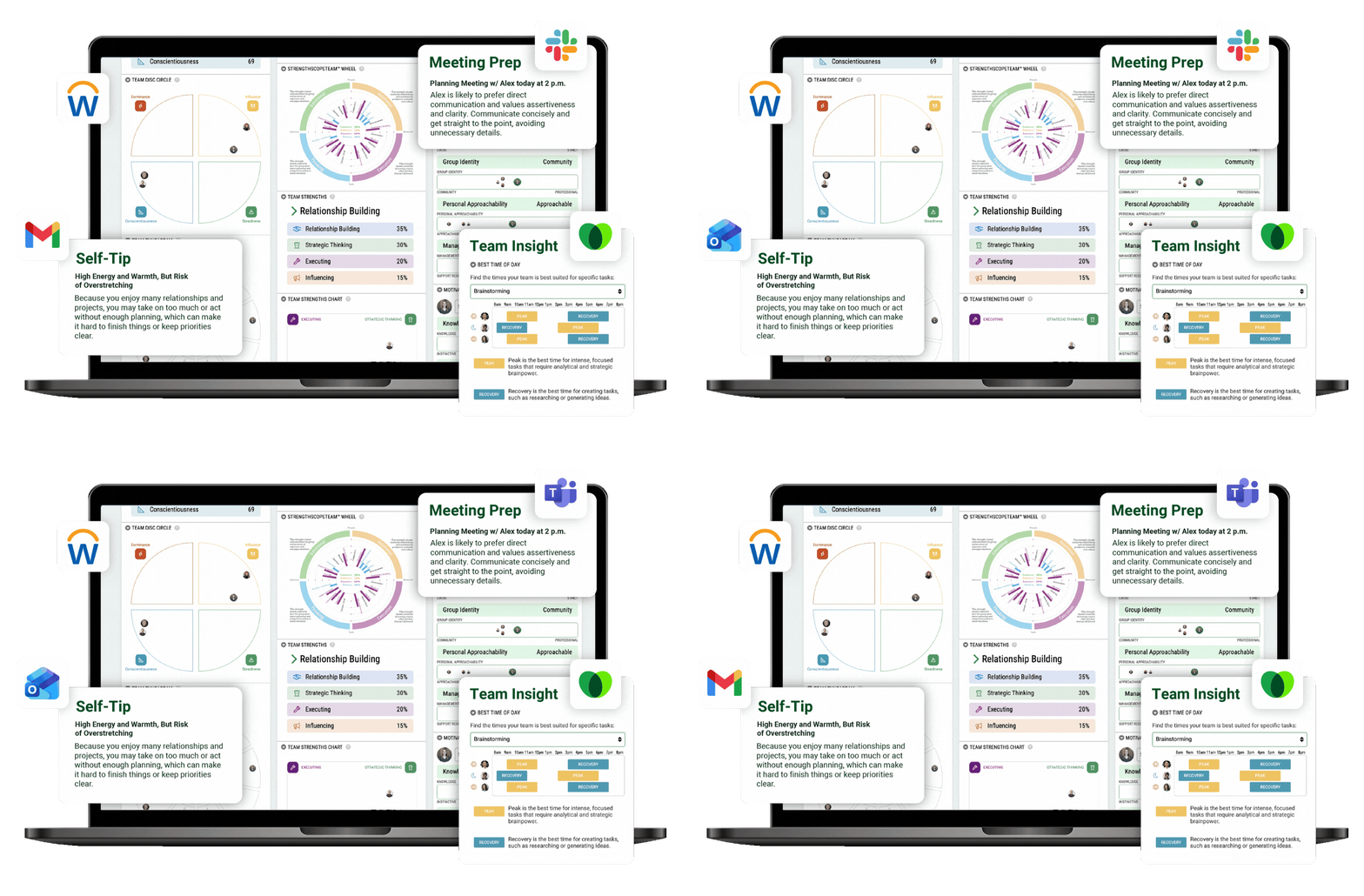
Science-backed coaching inside the tools your teams already use (Slack, Microsoft Teams, Workday, Outlook, Google Workspace, and AI assistants like Claude, ChatGPT, and Microsoft Copilot) to help with the meetings, decisions, and transitions your people are actually navigating.
Learn more about our integrations



Slack & Microsoft Teams
Coaching inside your collaboration hub
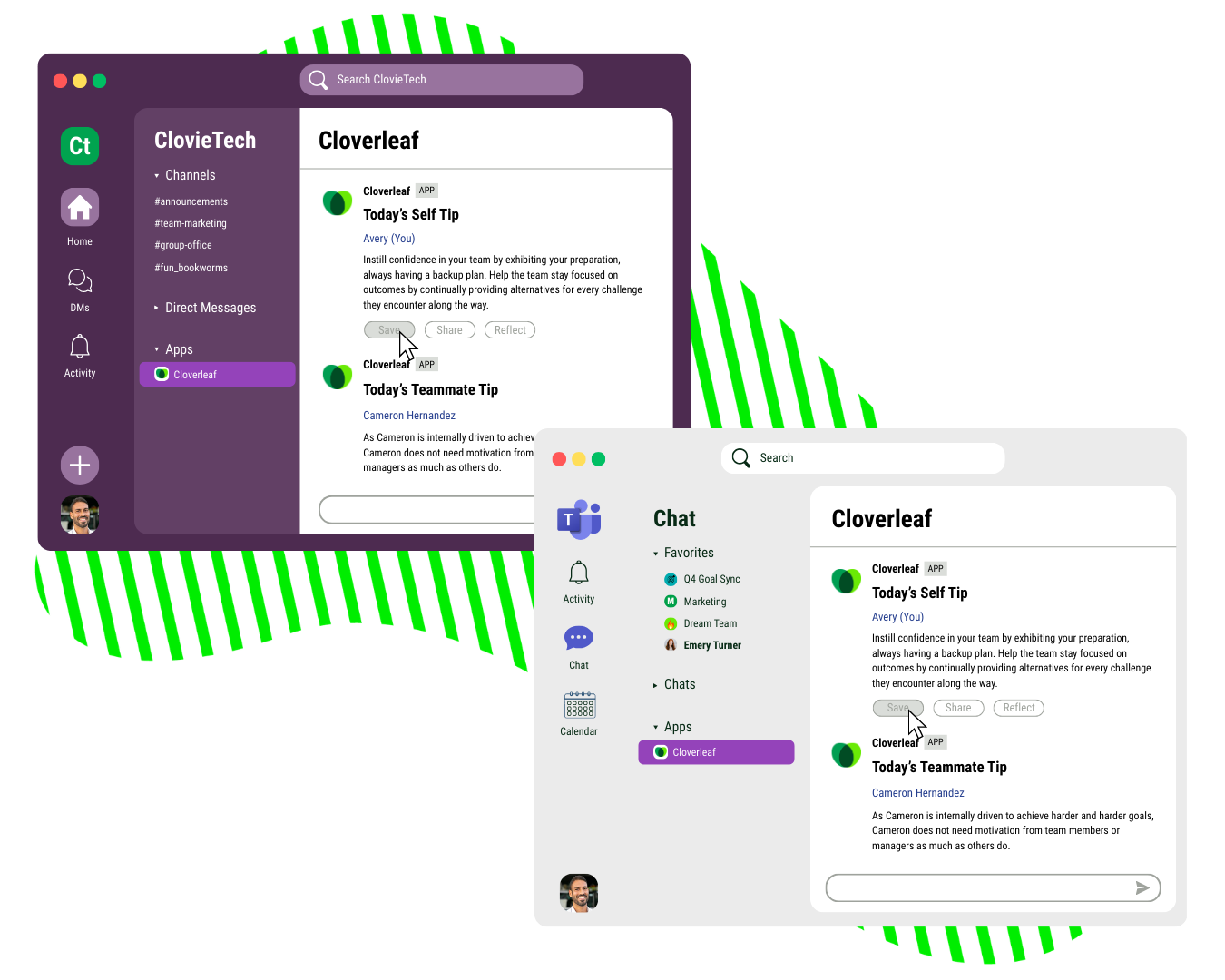
Whether your organization runs on Slack or Microsoft Teams, Cloverleaf’s AI Coach delivers personalized, science-backed coaching directly inside your team’s daily conversations.
Employees receive proactive coaching nudges in chats, helping them prepare for meetings, navigate difficult conversations, adapt to teammates’ communication styles, and lead more effectively.
No separate logins. No new workflows to adopt. Just coaching embedded seamlessly into the collaboration platform your teams already use every day.
Email & Calendar
Coaching that understands the workday
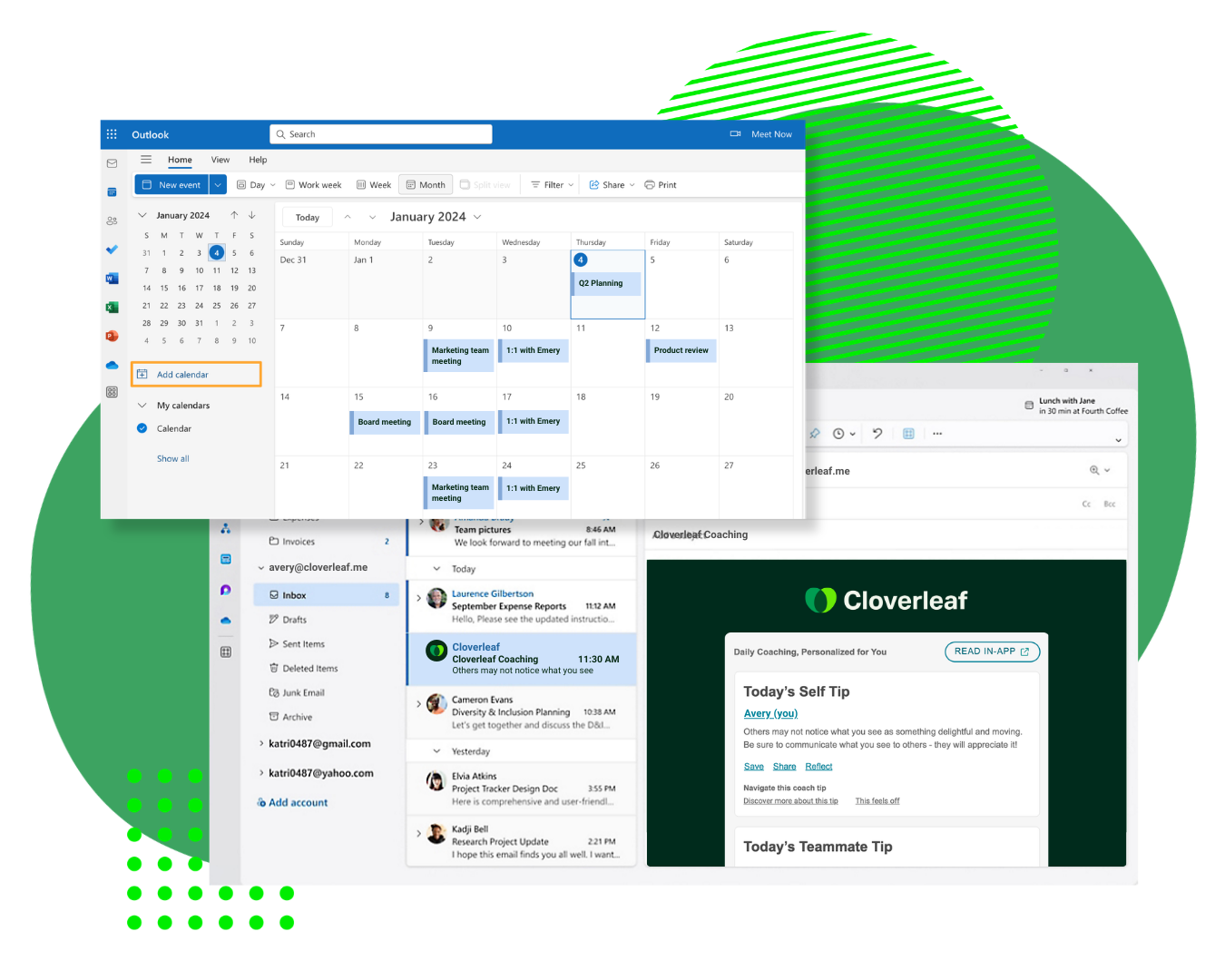
Cloverleaf’s AI Coach connects to employees’ calendars to understand what’s actually happening in their day so coaching shows up when it matters most.
By analyzing upcoming meetings and the people involved, the AI Coach delivers personalized, science-backed guidance to help employees prepare for conversations, collaborate more effectively, and lead well in the moments that matter. It’s one of the only AI coaching experiences that uses real calendar context to provide timely, relevant support.
Those insights are delivered directly through email, meeting employees where they already work every day, no new platforms or workflows required.
Workday & HRIS
Coaching aligned to talent lifecycle moments
Cloverleaf integrates with Workday and other leading HRIS platforms to connect coaching directly to your people data and talent processes.
By syncing organizational structure, role changes, and lifecycle events, our AI Coach proactively delivers personalized insights at critical moments, after performance reviews, during promotions, when engagement signals shift, or as new managers step into leadership roles.
Instead of development living in a disconnected system, coaching becomes part of your existing HR ecosystem: embedded, contextual, and automatically delivered when it matters most.
MCP & AI Assistants
Coaching inside Claude, ChatGPT, and Copilot
Cloverleaf connects to AI assistants like Claude, ChatGPT, and Microsoft Copilot through the Model Context Protocol (MCP) — an open standard for linking AI tools to outside data. When an employee asks their AI assistant to prepare for a meeting or draft feedback, Cloverleaf delivers each teammate’s communication style and coaching insights directly into that conversation, without switching tools.
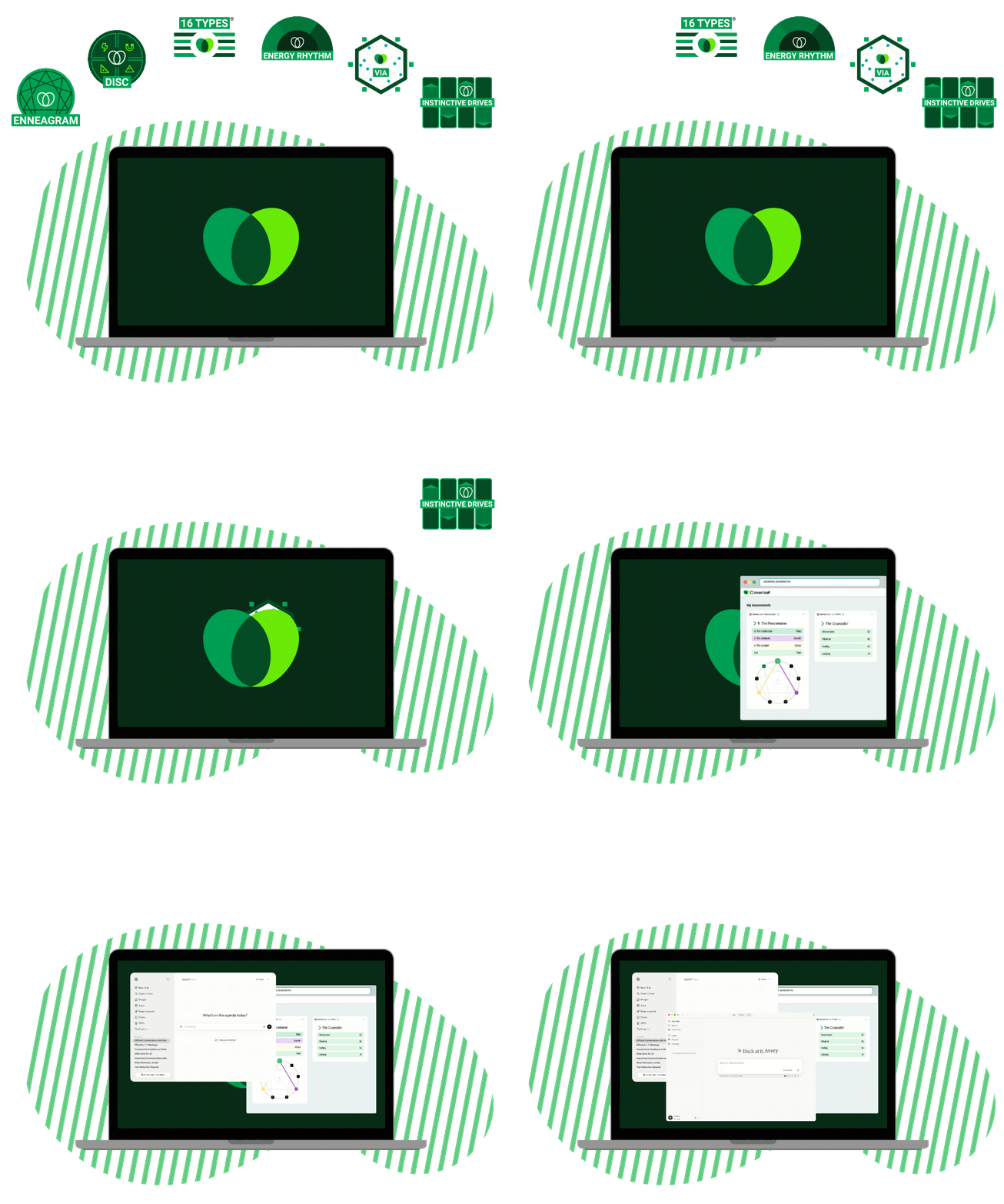
Proactive, context-rich AI Coaching embedded across your tech stack
Most AI coaching tools rely on employees to seek out guidance. Cloverleaf proactively delivers coaching so employees get the right insight, in the right moment, wherever they work.

Proactive delivery, not pull-based coaching
Other AI Coach integrations require employees to ask for coaching in the flow of work, Cloverleaf has the data to know what coaching they need and deliver it to them in the tools they already work in.

Deep and flexible integrations
From robust Workday connections to MCP-enabled integrations with existing Microsoft Copilots or custom LLMs, Cloverleaf embeds coaching across your full ecosystem, not just one collaboration tool.

Richer context, more personalized coaching
By integrating with the systems that reflect roles, reporting structures, performance milestones, and organizational changes, coaching is uniquely tailored to each individual and what’s happening in their day.
Frequently asked questions
How is Cloverleaf's approach to integrations different from other AI coaching tools?
Most AI coaching tools integrate with workplace platforms to make coaching available — meaning employees can access coaching if they remember to seek it out. Cloverleaf’s integrations work differently. Cloverleaf connects to your HRIS, collaboration tools, and AI assistants to deliver coaching proactively — triggered by what’s actually happening in your organization, not by whether someone remembers to log in.
The integration isn’t just a delivery mechanism. It’s what makes coaching contextual — personalized to the individual, informed by your organizational frameworks and people data, and timed to the moments where leadership behavior is actually being formed.
What integrations does Cloverleaf currently support?
Cloverleaf integrates with the systems where your people data lives and where your people work:
HRIS / HCM: Workday (certified Marketplace partner), plus additional HRIS platforms used by enterprise HR and IT teams. HRIS integration ensures coaching stays aligned with organizational context — roles, teams, transitions, and performance milestones.
Collaboration platforms: Slack and Microsoft Teams. Coaching is delivered proactively inside these tools as direct messages, channel posts, or pre-meeting reminders — depending on your configuration.
AI assistants: Claude, ChatGPT, and any MCP-compatible AI assistant through Cloverleaf’s native Model Context Protocol integration. Managers can search for teammates and pull personality insights and coaching profiles directly into the AI conversations where they’re already preparing for meetings, drafting feedback, and planning development conversations.
Does coaching trigger automatically, or do employees have to seek it out?
Cloverleaf delivers coaching proactively. When your HRIS records an organizational event — a promotion, a manager reassignment, a performance review completion, a team restructuring — Cloverleaf detects that change and delivers personalized coaching automatically in the tools your people already use.
This is what separates event-driven coaching from tools that simply make coaching searchable. Cloverleaf’s integrations don’t just keep employee data in sync — they turn organizational events into coaching moments.
Employees can also engage with Cloverleaf’s AI Coach directly when they want to through conversation simulation, coaching on demand, or by pulling insights into their AI assistant via MCP. But the default is proactive: coaching comes to people, not the other way around.
How do integrations make coaching more personalized?
People data from your HRIS: Roles, reporting relationships, team composition, tenure, and organizational changes like promotions and transitions. This ensures coaching reflects what’s actually happening in someone’s work life — not a static profile.
Behavioral assessment data: Communication styles, working preferences, and strengths from validated assessments like DISC, Insights Discovery, CliftonStrengths®, and others your organization uses. This ensures coaching is tailored to how each individual actually operates.
Your organizational frameworks: Competency models, leadership frameworks, values, and performance expectations that your organization has defined. This ensures coaching reinforces the specific standards your Talent Development team has set — not generic best practices.
The result: two managers promoted on the same day receive different coaching based on their individual style, the specific people they now lead, and the leadership expectations your organization has established.
Can Cloverleaf's coaching align to our organization's leadership frameworks and competency models?
Yes. This is a core part of how Cloverleaf works, not an add-on.
Cloverleaf can ingest your organization’s competency models, leadership frameworks, values, and performance expectations — and use them to inform what coaching is delivered. Your frameworks define the standard. Cloverleaf operationalizes it into daily behavior.
This means coaching doesn’t just tell a manager to “give better feedback.” It helps them practice feedback delivery in a way that reflects how your organization defines effective feedback, personalized to the specific direct report’s communication style and development priorities.
Coaching focuses can also target the specific capabilities your organization needs to develop — delegation, executive presence, cross-functional collaboration, or whatever your talent strategy prioritizes. Development becomes continuous and aligned to organizational priorities, not episodic and generic.
HRIS integration strengthens this further: as roles change, teams shift, and performance milestones are reached, coaching stays aligned with the organizational context rather than relying on outdated information.