
The DISC workshop goes well. The facilitator is good. People recognize themselves in the profiles, laugh at the right moments, and leave with a new vocabulary for why certain relationships have always felt like friction. There is genuine energy in the debrief.
Then the quarter moves on. The report ends up on a shared drive. And six months later, the same team dynamics are back — the same conflict patterns, the same communication breakdowns, the same people getting read as difficult.
This is not a DISC problem. It is a program design problem. Research consistently shows that the vast majority of organizations with 100 or more employees use behavioral assessments. Most of them do not see lasting change in how their teams actually operate. The gap is not between good assessments and bad ones. It is between teams that treat DISC as a data point and teams that build it into how they work.
The five differences below are not theoretical. They are the structural distinctions that separate teams where DISC created a moment of recognition from teams where it changed how they actually function.
Get the 2026 AI coaching playbook for talent development to accelerate team performance.
5 things teams understand that make DISC more effective
1. They treat self-awareness as a team output, not an individual exercise
Teams that know DISC: everyone understands their own profile. Teams that use DISC: everyone has a working model of each other.
Most DISC programs are designed to help individuals understand themselves better. That is a legitimate goal — and the research on self-awareness validates the stakes. Dr. Tasha Eurich’s decade of research found that while 95% of people believe they are self-aware, the actual figure is closer to 10–15%. Working alongside colleagues who lack self-awareness can cut a team’s chances of success in half, with measurable effects on stress, motivation, and retention.
But the research finding most directly relevant to program design is this: individual self-awareness compounds when it becomes shared. A team where one person understands their own operating tendencies is marginally better off. A team where everyone has a working model of how the people around them think — and a common language to name those differences in the moment — operates at a categorically different level.
A Korn Ferry study of 6,977 professionals across 486 publicly traded companies found that organizations with self-aware leaders consistently outperformed peers on financial measures. A separate simulation with 300+ leaders found high self-awareness predicted better decision-making, coordination, and conflict resolution at the team level.
The unit of change is not the individual profile. It is the shared map.
Teams that use DISC design their programs with this in mind. The goal is not for each person to know their own type. It is for the team to know each other well enough to use their differences as information rather than evidence of incompatibility.
2. They depersonalize conflict in real time, not in retrospect
Teams that know DISC: they understand style differences in theory. Teams that use DISC: they name them in the room before the story hardens.
Here is how team conflict typically unfolds without a shared behavioral language. A high-Dominance team member sets an aggressive deadline — not to create pressure, but because forward motion is how they are wired. A high-Conscientiousness team member pushes back with detailed questions — not to obstruct, but because rigor is how they protect quality. A high-Steadiness team member absorbs the tension in silence — not because they agree, but because preserving group harmony is what their instincts prioritize.
Without shared language, all of this registers as interpersonal friction. The D reads the C as obstructionist. The C reads the D as reckless. The S gets read by both as passive. And the team develops a story about each other that has almost nothing to do with intent and everything to do with operating from different defaults — which is exactly what Carl Jung meant when he said that what we leave unconscious will direct our lives, and we will call it fate.
Teams that use DISC have a name for what is happening in that room. Not “why are you being difficult” but “you’re coming at this from a different angle — what’s the risk you’re trying to account for?” The friction does not disappear. But it depersonalizes. And depersonalized friction is something a team can actually work with.
This only happens if the shared language is present at the moment of conflict — not recalled from a workshop six months later. Which is what makes the program design question so consequential.
See How Cloverleaf’s AI Coach Works
3. They understand the lens each style sees through — not just the label it carries
Teams that know DISC: they can name the four styles. Teams that use DISC: they can predict the question each style brings into any situation.
Most DISC training delivers the taxonomy well. People leave knowing what each letter stands for and which descriptors fit their profile. What it less often conveys is the operational framing that makes DISC usable in real time: each style is, at its core, asking a fundamentally different question whenever it enters a new situation.
A Dominance tendency asks: where are we going, and when do we get there? This is the engine of momentum. It keeps teams from over-processing decisions that need to be made and drives accountability to outcomes. Its risk is urgency that creates pressure without realizing it — an internal deadline that the rest of the team treats as a hard commitment.
An Influence tendency asks: who is involved, and are they energized? This style builds the coalition that gets work done across boundaries. It keeps teams from becoming insular and sustains the engagement that long initiatives require. Its risk is a preference for being liked that can soften necessary clarity.
A Steadiness tendency asks: how does this work, and will it hold up over time? This is the style that builds the systems and processes that make teams scalable. It creates the psychological safety that comes from consistency and reliability. Its risk is absorbing dysfunction to protect harmony rather than naming the conflict that needs to happen.
A Conscientiousness tendency asks: what exactly are we trying to accomplish, and are we doing it right? This style surfaces the assumptions everyone else skipped and holds the standard that the team will eventually be glad someone held. Its risk is that the pursuit of precision can outlast the point where speed matters more.
When a TD leader helps a team internalize this framing — not just the labels but the questions — what changes is how team members interpret each other. The C is no longer being difficult. They are asking a question the team needs answered. The I is not just creating noise. They are managing something the team would lose without them. The shared map goes from a static profile to a live operating model.
4. They use DISC to design roles and work — not just to improve communication
Teams that know DISC: they adjust how they talk to each other. Teams that use DISC: they adjust what they ask each person to do.
The most common application of DISC in the workplace is communication coaching. Know your colleagues’ styles, adapt your message accordingly. This is useful. It is also the smallest available return on the assessment investment.
The more consequential application is role and work design: using behavioral data to understand where each person on a team is most likely to produce excellent work — and where they are structurally likely to struggle regardless of effort or intention.
A high-C team member placed permanently in an execution role against someone else’s broad-brush strategy is not a performance problem. They are a retention risk created by a role design that systematically requires them to operate outside their zone. A high-I team member given a primarily individual-contributor scope with no collaborative surface area will disengage at a rate that has nothing to do with their manager’s intentions.
Teams that use DISC ask a different set of questions when work gets assigned. Not just “who has capacity” but “whose behavioral tendencies make this assignment likely to produce the outcome we need?” Not just “who should present this?” but “who is energized by visibility and who will perform better with a supporting role?”
This does not require treating DISC as deterministic — profiles are tendencies, not ceilings. But a team that uses its behavioral data to design work around where people are most likely to thrive gets materially different outcomes from one that uses it only to soften the edges of communication.
5. They build DISC insight into the workflow — not just into the training event
Teams that know DISC: they had a great workshop. Teams that use DISC: the insight shows up before the conversation that matters.
Cloverleaf’s DISC assessment is built on independent validity research across 48,158 users with test-retest reliability confirmed. The data is stable. The insight is accurate. The structural problem is that even accurate, stable assessment data has a shelf life when it lives in a report.
Three months after a workshop, most team members cannot recall their colleagues’ profiles with enough specificity to use them under pressure. Six months after, the shared language has faded back into informal shorthand or disappeared entirely. This is not a failure of engagement. It reflects a well-documented principle in behavior change research: insight that is not reinforced at the moment of application does not change behavior.
A manager who completes a DISC workshop in January is not reliably better at navigating a conflict in March. The January insight is simply not present in the March moment. The gap is not commitment. It is proximity.
Teams that use DISC build for this reality. They connect the assessment data to the manager’s workflow before the 1:1, before the performance review conversation, when a team is forming around a new initiative. They treat DISC not as a report that gets read once but as a live data layer that informs how people develop each other in the ordinary conditions of work.
This is the design question that most DISC programs leave unanswered: not how to deliver a better workshop, but how to keep the insight active in the moments when behavior actually gets expressed. For a look at what that activation layer looks like in practice, see how Cloverleaf connects DISC results to in-the-flow coaching for managers.
The teams that see lasting change decided the goal was behavior change, not workshop completion
The five differences above share a common root: teams that use DISC have made a design decision that teams that know DISC have not. They decided that the goal of a behavioral assessment program is behavior change — not assessment completion.
That decision changes what gets built. It changes how work gets designed. It changes what managers are equipped to do before the conversations that shape how their teams develop. And it changes what TD leaders measure to know whether the program is working.
Most organizations have the assessment. What they’re missing is the layer that keeps it alive in daily work. That is what Cloverleaf does — surfacing DISC insight before the 1:1, before the feedback conversation, before work gets assigned. Not something to engineer. Something that shows up where managers already are.
Research shows only 24% of senior executives believe their leadership development programs actually work (Corporate Executive Board). Your DISC workshop got great satisfaction scores. Managers left understanding the four behavioral styles. They know their team members are High D, High S, High I, or High C.
Three weeks later, your High D manager is still giving direct, results-focused feedback to their High S employee who needs processing time and softer delivery. The DISC awareness is there. The application isn’t.
The problem isn’t that managers forgot DISC. It’s that they’re not using it when it actually matters—before giving feedback, during conflict, when preparing for difficult conversations.
Get the 2026 AI coaching playbook for talent development to accelerate team performance.
Why managers can remember DISC profiles but still struggle to change how they communicate
The DISC assessment creates awareness to help managers understand the four behavioral dimensions:
Dominance (direct, results-oriented),
Influence (persuasive, social),
Steadiness (patient, collaborative),
Conscientiousness (analytical, detail-focused).
They can almost immediately start mapping their team. They understand this individual is High S. They know this other person is High D.
Yet, when they return to work and continue giving feedback and intereacting with each other the same way they always have.
This isn’t because the training or insights are not relevant or true. It’s a reinforcement problem.
Managers can remember the four profiles. What they don’t have is a system that surfaces DISC insights at the moment they actually need them—before giving feedback, during conflict, when preparing for difficult conversations.
Unfortunately, managers and tesms reduce the impact of DISC to explaining behavior after the fact (“Of course she didn’t respond well to my feedback—she’s High S”) instead of using it to adapt their approach before conversations happen.
Mark Flanigan, a former Analyst Manager accurately describes the gap: “I had just come back from a management training where we learned all about DISC. First thing I asked my manager was what about my employees, are they going to get DISC training? The answer was no, we don’t have the budget for that.”
His organization invested in DISC awareness for managers, but had not yet invested in a system that helps scale DISC insights so entire teams of people can actually apply its insights.
See How Cloverleaf’s AI Coach Works
The critical gap between knowing someone’s DISC style and applying the insight
When managers know their employee’s DISC style but don’t have support applying it, they face a choice every time they give feedback or prepare for a difficult conversation:
Option 1: Stop what they’re doing, look up DISC guidance for that behavioral style, remember how to adapt their approach, then return to writing feedback.
Option 2: Give feedback the same way they always do.
Most choose option 2. Not because they don’t care. Because in the moment—writing performance feedback at 4pm on a Friday, preparing for tomorrow’s difficult conversation, responding to a tense Slack thread—remembering to look up and apply DISC guidance adds friction they don’t have bandwidth for.
AI coaching solves this by putting DISC insights in front of managers when they’re actually most valuable.
For example, imagine the following scenarios that happen on a daily basis for your leaders:
Manager writing feedback to High S employee gets a Slack notification: ‘This employee needs softer delivery and time to process. Try adding specific examples and framing feedback as conversation, not critique.’
Manager preparing for 1:1 with High D employee sees: ‘This person values directness and efficiency. Get to the point quickly, focus on results.’ The manager doesn’t remember to look this up. It appears automatically when they need it.
What DISC insight can actually show up in manager workflows
Here’s what happens when DISC insights surface at the moment managers need them:
Before giving feedback: Manager gets coaching while writing the review
Manager writing performance feedback to High S employee (patient, collaborative, prefers stability) types: “Your project deliverables have been consistently late. This needs to improve immediately.”
Before the manager hits send, Slack notification appears: “This employee has High S behavioral style—they need time to process feedback and prefer softer delivery. Try: ‘I’ve noticed some delays in project timelines. Can we talk through what’s creating those delays and how I can support you in meeting deadlines?'”
Manager revises. Feedback gets delivered in a way the High S employee can actually receive.
The manager didn’t remember to “use DISC.” AI coaching prevented the communication mismatch in real-time using DISC data the organization already has.
During team conflict: Manager gets context before addressing friction
Two team members clash repeatedly. High D team member (direct, fast-paced, results-driven) sees High S team member (methodical, needs processing time) as indecisive. High S sees High D as aggressive and pushy.
Manager preparing to address the conflict gets coaching before the meeting: “This friction is pace mismatch, not personality clash. High D style prioritizes speed and directness. High S style needs time to consider options and build consensus. Help them see how these complementary styles create better decisions when both are respected.”
Manager enters the conversation prepared to reframe the conflict as style difference instead of letting “He’s just a High D” become the explanation.
When staffing projects: Dashboard shows team DISC gaps before friction happens
Manager planning project team opens dashboard showing DISC distribution: 65% High I/High D (fast-paced, social, results-oriented), 20% High C (detail-focused, analytical), 15% High S (steady, collaborative).
Coaching flags the gap: “This team will generate ideas and momentum quickly but may skip planning and miss details. High C team members will feel rushed. Build in time for detailed planning before execution. Assign High C team member to review work for accuracy before deadlines.”
Manager staffs the project knowing where friction will occur and how to prevent it. Not because they remembered to analyze DISC distribution manually—because the dashboard surfaced the insight when they needed it.
For more on how AI coaching supports managers in specific workflows, see AI for leadership development.
How to activate your DISC data with AI Coaching
Your organization may have already completed DISC assessments. If so, you don’t need to re-assess. Here’s how to activate that data with AI coaching:
Step 1: Team members enter their existing DISC styles
If your team already completed DISC assessments through another provider, team members can enter their behavioral styles (Dominance, Influence, Steadiness, Conscientiousness) into Cloverleaf. Takes two minutes per person.
If team members haven’t taken DISC yet, they can take Cloverleaf’s free, validated DISC assessment in 10 minutes. Built on Marston’s theory and verified with 48,000+ users, it provides instant results showing their blend of all four styles—not just a single category.
Step 2: Admins enable AI coaching
Single activation for entire organization. Managers automatically receive DISC-informed guidance before scheduled 1:1s in Slack, Teams, or email—based on who they’re meeting with and that person’s DISC style.
Step 3: Managers access team dashboards
Dashboards show team DISC distribution. Managers see whether their team is heavy on High D/I (direct, fast-paced, results-oriented) or High S/C (steady, analytical, process-focused) when staffing projects and diagnosing team friction.
Step 4: Track behavior change, not completion rates
Measure whether managers are adapting communication. Track feedback quality improvements, conflict resolution effectiveness, team collaboration scores—not just “managers completed DISC training.”
Your existing DISC investment, or Cloverleaf’s free DISC assessment, becomes the foundation for continuous AI coaching that can also support future trainings and workshops.
FAQ’s about DISC assessment and AI coaching
Don’t managers just need to remember to use DISC?
In theory, yes. In practice, managers preparing for difficult conversations, writing feedback under deadline, or responding to team conflict don’t have bandwidth to stop, look up DISC guidance, and apply it. AI coaching removes that friction by surfacing guidance automatically when managers need it—not when they remember to seek it out.
How is this different from sharing DISC reports on a shared drive?
Three differences: Automatic notifications before 1:1s (managers see DISC insights without remembering to look them up). Team dashboards show DISC distribution patterns managers can’t calculate from individual reports. AI coaching provides situation-specific guidance on how to adapt communication, not just raw DISC data.
Can DISC with AI coaching scale in large enterprises?
Cloverleaf scales DISC-informed coaching across entire organizations—whether you have 50 managers or 5,000. AI coaching integrates with Slack, Microsoft Teams, Google Workspace, and Workday, so DISC-informed guidance appears where your managers already work. Each manager receives personalized coaching before their 1:1s based on who they’re meeting with and that person’s DISC style—without adding administrative overhead or requiring individual manager setup.
We use other assessments too. Does this only work with DISC?
Cloverleaf integrates multiple assessments (DISC, CliftonStrengths®, Enneagram, 16-Types, Insights Discovery). When managers have multiple assessment data points, AI coaching pulls from all sources to provide richer behavioral context. For more on how CliftonStrengths® activates with AI coaching, see CliftonStrengths® with AI coaching.
DISC assessments and training can create awareness. Roughly 76% of organizations with more than 100 employees use behavioral assessments. Most of that DISC data sits unused after the initial workshop because managers don’t have a system that surfaces insights when they actually need them.
AI coaching can proactively deliver DISC insights in front of managers before they write feedback, before they address conflict, before they staff projects. A workshop or coach can help teach managers what DISC is. AI coaching can continuously show them when and how to use it in their unique situations and interactions with team members. Assessment data that has sat in reports long after the assessment occurred can become personalized, proactive coaching that appears automatically before every conversation that matters to a team’s performance.
Receiving feedback in the workplace is often perceived as walking on eggshells. This process demands high emotional intelligence, communication skills, and an open mind.
Feedback in the workplace is an essential component of professional development and performance management. However, the art of giving and receiving feedback is often misunderstood and can cause tension if not done in the right way.
Here’s where the DISC profile can be highly beneficial. Using DISC when giving or receiving feedback could transform this entire process. Understanding the nuances of DISC can help leaders turn the process from a source of dread into a powerful catalyst for personal and professional growth.
Key Takeaways:
- Understanding an individual’s DISC type can transform the feedback process from a stressful task into a catalyst for growth.
- Feedback strategies can be personalized based on the DISC type of each team member.
- Using DISC profiles in feedback enhances communication, builds empathy, strengthens team unity, and promotes professional growth.
- Leaders are pivotal in integrating DISC profiles into their team’s feedback culture.
DISC Can Simplify Feedback With Behavioral Insights
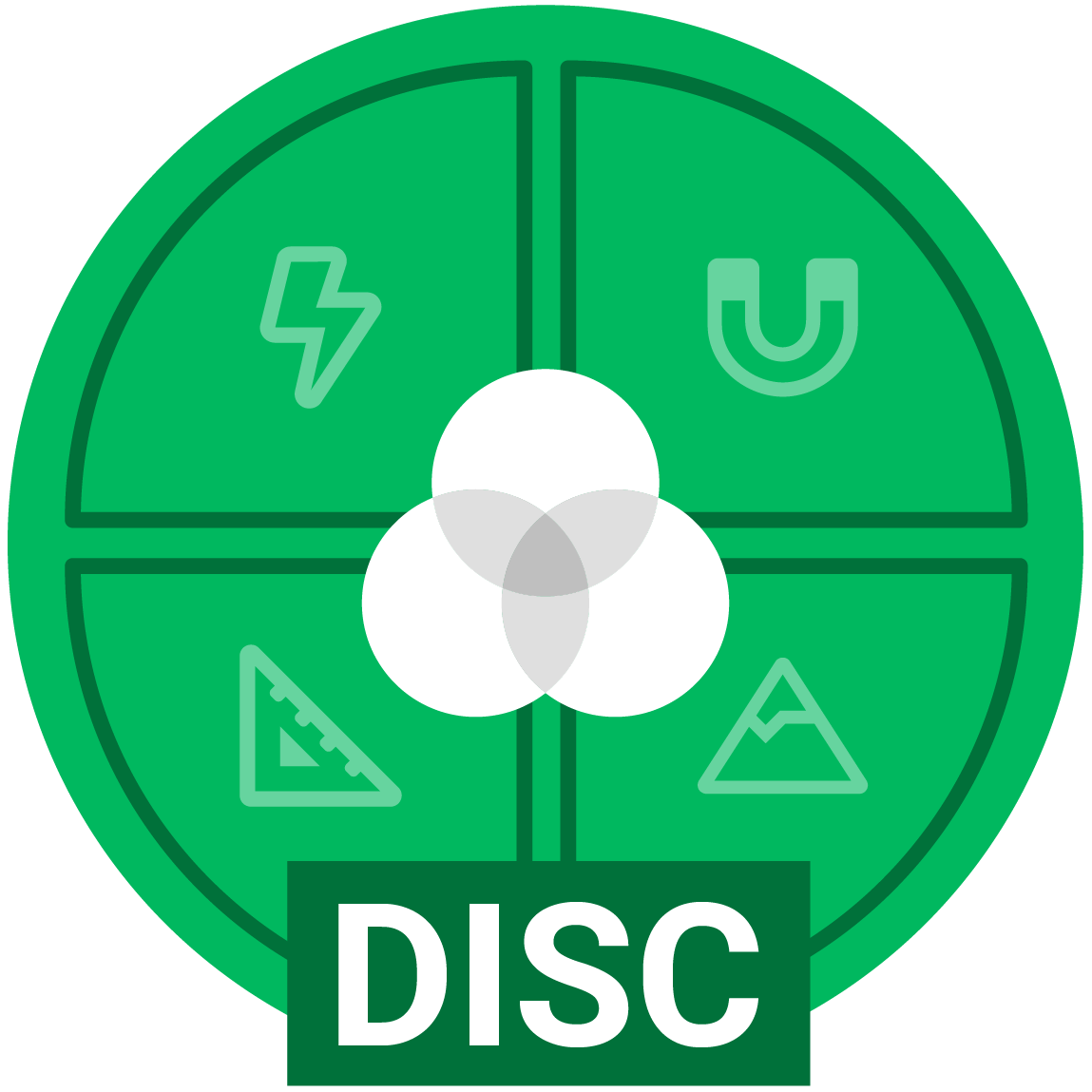
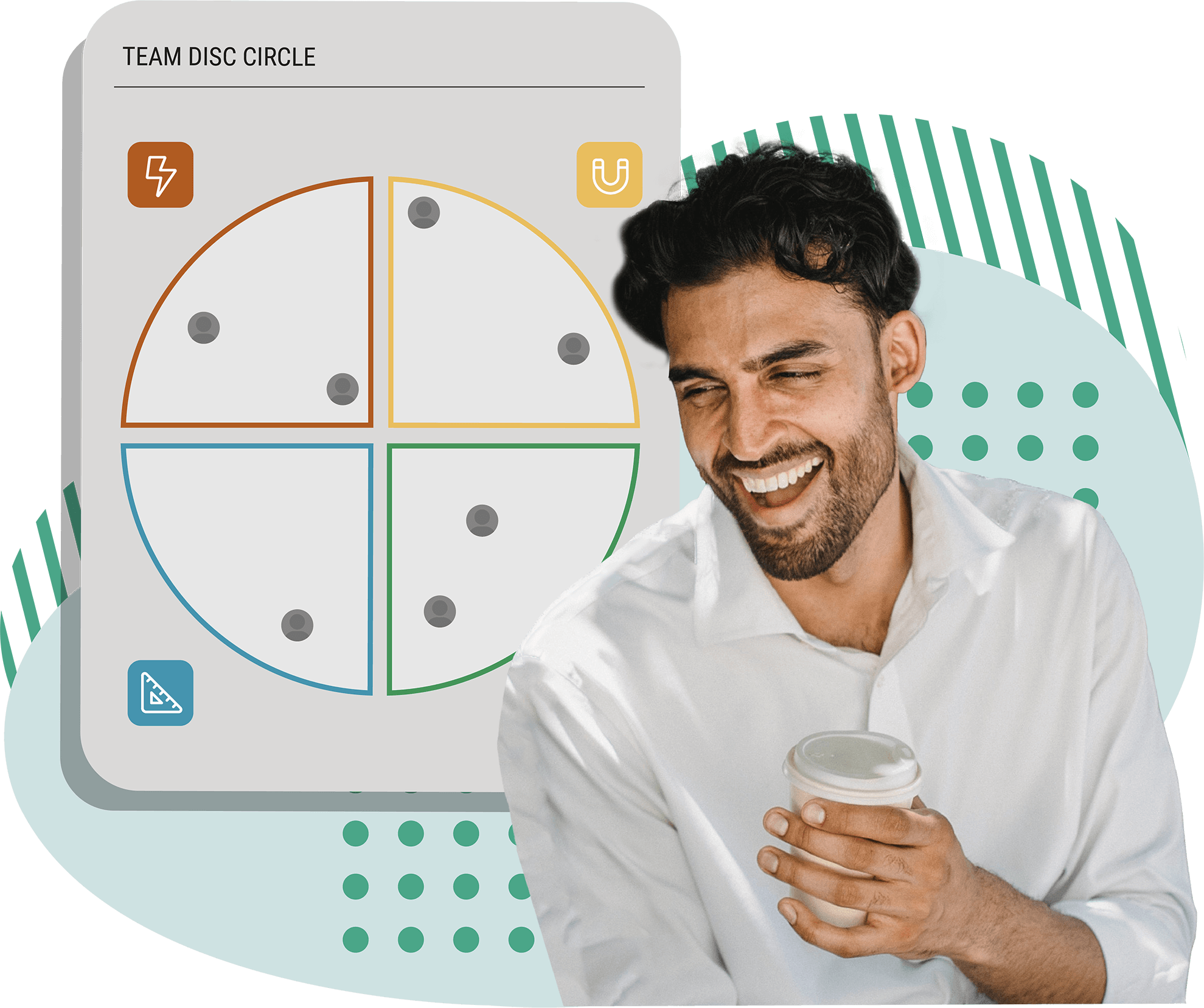
The DISC profile is a behavioral assessment tool that helps individuals identify their blind spots in communication. It categorizes individuals into four types:
- Dominance (D)
- Influence (I)
- Steadiness (S)
- Conscientiousness (C)
Each type responds differently to feedback, making it a key point in giving effective feedback.
Understanding DISC is one thing, but applying it in a team setting is another ball game. As Learning and Development Leaders, it’s crucial that you not only understand the DISC profile yourself but also effectively train your team members in it.
Start with a clear, simple introduction to DISC and its benefits. Make sure to articulate how understanding one’s DISC profile can help individual teammates enhance their communication skills and excel in their roles. Emphasize the relevance of DISC to real-life situations within your team’s specific workplace context.
To help you get started, visit our post: A Leaders Guide To Using DISC In The Workplace!
Once your team is familiar with the basic concept of DISC, move on to conducting DISC assessments. This process should be framed as a positive opportunity for self-awareness and professional development rather than a test or evaluation.
Take our free DISC assessment to gain actionable insights concerning your results and start receiving Automated Coaching™ to help your team perform more effectively.
Properly introducing DISC to your team and guiding them in its application can lead to more effective feedback sessions and foster an environment conducive to growth and learning. The art of giving and receiving feedback becomes a collaborative effort, raising the level of communication and understanding within the team.
HUMAN SKILL PROGRAMS ARE HITTING LIMITATIONS...
5 THINGS THIS FREE RESOURCE WILL TEACH YOU
- Close the widening gap between learning and on-the-job application
- Overcome the tension of pausing productivity for development opportunities
- Integrate learning so it is actually in the flow of work
- The evolution of human skill development
- What Automated Coaching™ is and how it works.

How DISC Can Transform Your Teams Feedback Processes
The DISC profile is not just a personality test; it’s a critical tool for enhancing communication skills and improving the feedback process. By tailoring your feedback to an individual’s DISC type, you align your communication style with their preferences, leading to more useful feedback and performance improvement.
For example, consider a scenario where a manager gives lengthy, detail-oriented feedback to an ‘I’ type employee, unaware of DISC principles. This type of feedback, incompatible with their enthusiastic and big-picture communication style, may make the feedback session unproductive, a pitfall that could be avoided using DISC profile insights.
The Pivotal Role of Leadership in Shaping a DISC-Enhanced Feedback Culture
Within this context, the role of people development becomes critical. Leaders need to understand and apply DISC principles and cultivate a feedback culture within their teams where DISC becomes integral.
4 Ways To Use DISC To Support A Feeback Culture
1. Strategize Feedback Sessions with Mixed-DISC-Type Teams
This involves leaders becoming adept at identifying the DISC profile of each person and tailoring their feedback accordingly. For example, if a leader is providing feedback to an individual who falls under the ‘D’ category (Dominance), they may opt for a more direct, concise approach focusing on solutions rather than dwelling on problems.
In contrast, when dealing with an ‘S’ type (Steadiness), the leader might need to be more patient and supportive, providing feedback with more warmth. This approach makes feedback a personalized tool that resonates more effectively with each person, promoting meaningful performance conversations.
2. Navigate Conflict Resolution Using DISC
Leaders can leverage DISC insights to navigate and mediate conflicts among teammates more effectively. For example, if a conflict arises between a ‘D’ type (who tends to be competitive and assertive) and an ‘I’ type (who prefers a more collaborative and harmonious environment), the leader can use their understanding of these profiles to guide the conversation.
They can respect the ‘D’ type’s need for directness and results while emphasizing the ‘I’ type’s importance of positivity and cooperation. By doing so, leaders can ensure that conflicts become opportunities for learning and growth rather than sources of division.
3. Promote DISC Understanding for Professional Development
Encouraging your team to understand their DISC profiles is integral to fostering a healthy feedback culture. By hosting DISC workshops or sharing resources for self-study, leaders can ensure that everyone understands their communication styles and how they interact with others.
This understanding not only fosters empathy and strengthens team cohesion but also aids in personal development in the workplace by highlighting areas for improvement.
For example, an ‘I’ type individual might realize they need to focus more on details, or a ‘C’ type might work on becoming more open to change. As each person strives for improvement, the team as a whole becomes stronger and more efficient.
This transition requires an open mind and a commitment to using DISC regularly, but the rewards for team performance and cohesion are well worth the effort.
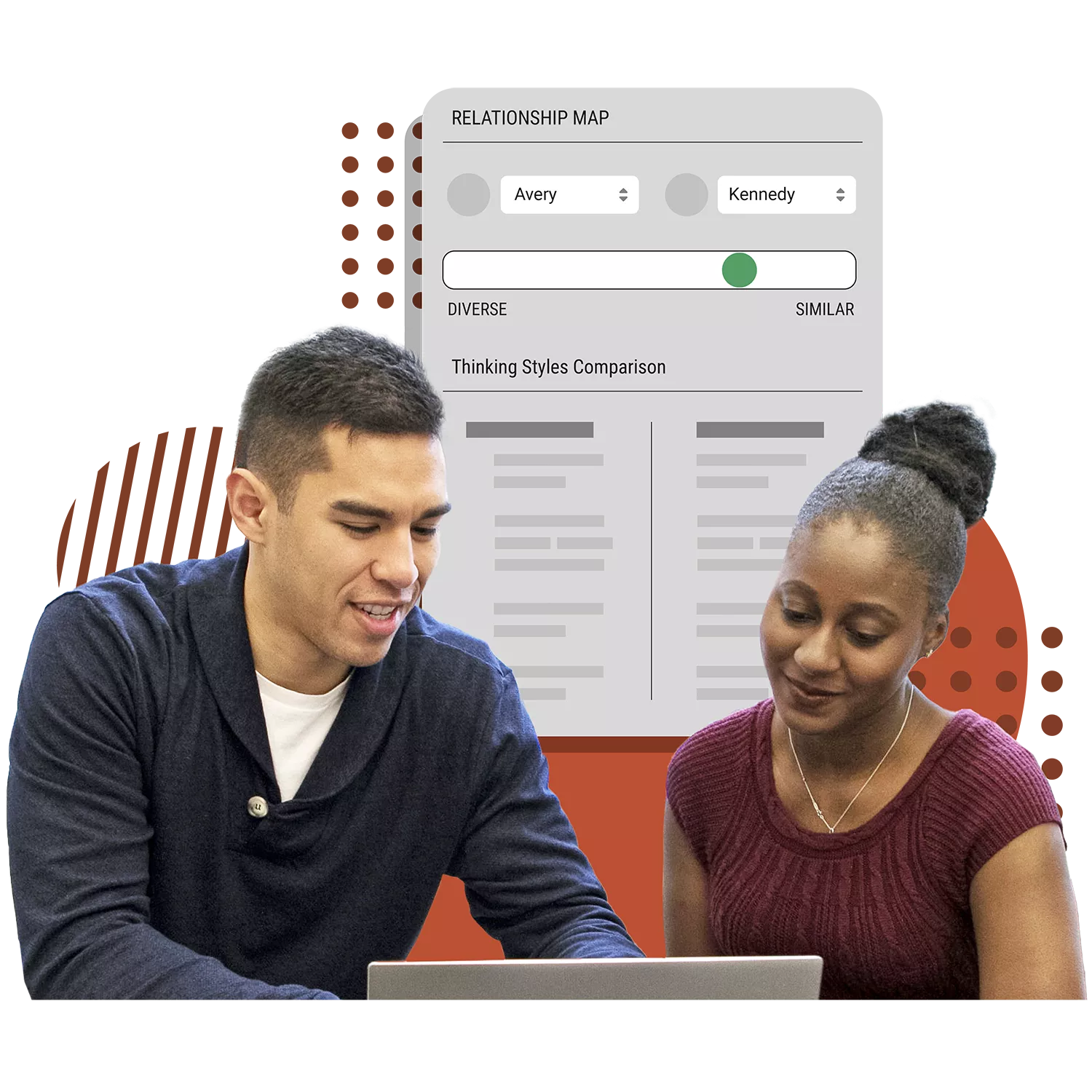
4. Leverage Cloverleaf’s Side-By-Side Thinking Comparison Tool
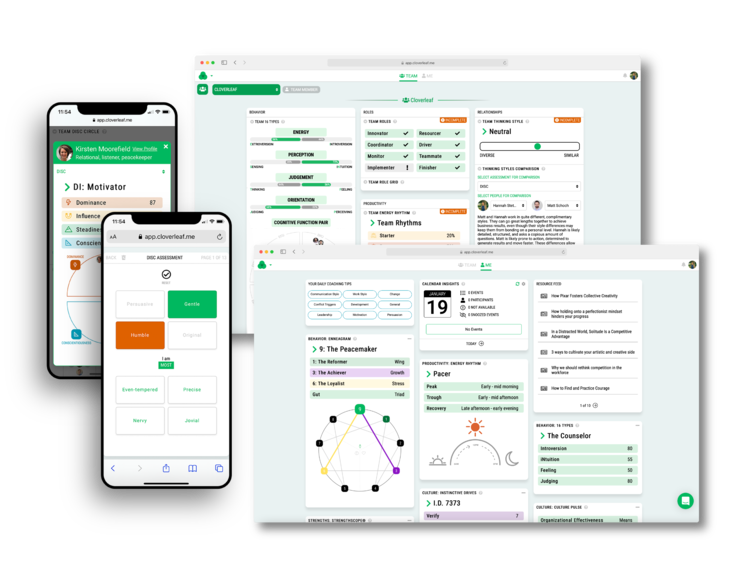
Utilizing the power of Cloverleaf’s Thinking Comparison tool gives teammates unique insight into their colleagues’ diverse thinking styles and motivational drivers, all through the lens of DISC profiles.
Practical Tips and Strategies for Each DISC Type
Explore our comprehensive guide filled with nuanced strategies for each DISC profile. Each section, illustrated with practical scenarios, provides valuable insight on how to optimize feedback delivery and reception to foster growth and efficient communication.
D Types: The Power of Directness and Efficiency
D types value directness, efficiency, and tangible results, which can feel challenging when giving feedback. However, understanding their communication style and preferences can transform this process into a productive, stress-free experience.
Below are several ways leaders can adapt their approach to communicate with D types effectively:
- Adopt a Direct Approach: D types appreciate straight talk. Discuss the current situation, desired outcomes, and actionable steps to achieve these goals. For instance, if you’re giving feedback to a ‘D’ type salesperson falling behind their quota, emphasize the key points succinctly and directly.
Emphasize Results: D types are results-oriented. When discussing their performance, focus on concrete data and facts rather than emotions or personal opinions. This helps them understand their standing and motivates them to improve.
Promote Independence: Give D types as much independence as possible to achieve their desired outcomes. Respect their abilities and encourage them to devise an action plan, harnessing their pioneering spirit.
Maintain Clarity: D types appreciate clearly defined boundaries, time limits, and resources. Clarity helps them operate efficiently and productively.
Prepare for Energy: It’s common for D types to respond with high energy. Don’t be overwhelmed. Stay strong, clear, and calm, offering respectful feedback that empowers them towards improvement.
I Types: Engaging with Enthusiasm and Creativity
Individuals with an ‘I’ profile are known for their enthusiasm, creativity, and sociability. They thrive when feedback is positive and engaging. Understanding how to navigate their preferences can lead to highly productive interactions. Let’s dive into strategies that make feedback more effective for I types:
- Express Positivity: I types appreciate an optimistic approach. When discussing performance issues, highlight the benefits of the desired outcomes and demonstrate confidence in their abilities to meet these goals. For instance, if an ‘I’ type graphic designer’s creations don’t align with the company’s brand image, offer constructive feedback with an emphasis on positivity.
Focus on the Big Picture: I types are big-picture thinkers who appreciate understanding the broader impact of their work. Make sure to connect individual tasks and performance outcomes to the larger team or organizational goals.
Encourage Creativity: Acknowledge their creative abilities and interpersonal skills. I types tend to be innovative and social, so recognizing these traits can help in fostering a positive feedback environment.
Maintain Engagement: Keep the conversation lively and engaging, as I types prefer interactive discussions. However, be prepared to steer the conversation back on track if they start to wander off-topic.
Ensure a Positive Tone: I types respond better to a firm, measured, and positive tone. They’re likely to be more receptive to your feedback if you can deliver it in an upbeat manner.
Set a Clear Timeline: To ensure understanding and accountability, close by agreeing on a timeline for implementing the suggested improvements. This will help ‘I’ types focus their energy and creativity on meeting their performance goals.
S TYPES: Emphasizing Support and Collaboration
- Embrace Patience and Reassurance: S types thrive in situations where they feel reassured and supported. While discussing areas of improvement, do so patiently, ensuring they understand you are critiquing the performance, not the person.
Highlight Their Strengths and Progress: Along with pointing out areas for improvement, acknowledge their strengths and progress, no matter how small. This balanced approach encourages S types and reinforces their sense of value.
Clarity on Expectations: Be clear about your expectations from S types. Ambiguity can create stress for them, so maintain clear, direct communication about goals and performance standards.
Create a Step-by-Step Plan: Guidance can greatly aid S types. Construct a step-by-step improvement plan together, providing them with a clear path to enhancing their performance.
Regular Check-Ins: Conducting regular feedback sessions helps S types feel secure and valued. Regular check-ins demonstrate your commitment to their development and allow for timely recognition of gradual improvements in their performance.
C TYPES: Precision, Accuracy, and Logical Thinking
Engaging in feedback sessions with C types, known for their conscientiousness, logical thinking, and accuracy, can be greatly enhanced by understanding their preferences. Below are some key strategies that will make your feedback sessions with C types more effective and productive:
- Precision is Key: C types value precise, specific feedback. If you’re discussing a ‘C’ type accountant’s errors in financial reports, make sure your feedback pinpoints the exact mistakes, elucidates their impact, and provides clear guidelines for correction.
Emphasize Facts and Details: Stick to a factual discussion focusing on the current results and the necessary improvements. Provide evidence or examples when necessary, as C types appreciate the meticulous analysis of situations.
Allow Time for Planning: After providing your feedback, give them time to process the information and develop a plan for achieving the desired outcomes. They prefer to take time to think things through.
Establish Clear Deadlines: Agree on a specific time frame for performance improvement, including a final deadline and milestones for reviewing progress. Firm deadlines give them a clear goal to work towards and ensure accountability.
Recognize their Competence: Whether in private or through email, recognize their hard work, precision, or competence. Positive reinforcement goes a long way in motivating C types to continuously improve.
Mastering the Art of Receiving Feedback Using DISC
Receiving feedback constructively requires self-awareness of your own DISC type. Understanding your communication preferences can help you interpret feedback from a new perspective and take action accordingly. This understanding fosters an environment of regular and real-time feedback, aiding in personal development.
Conclusion
Understanding and applying DISC profiles in the workplace can revolutionize the feedback process, transforming it from a potential point of conflict to a tool for growth and improvement. Remember to share feedback regularly and always maintain the right way of communication according to the DISC type.
Leveraging platforms like Cloverleaf can help you foster better understanding and synergy in your team’s interactions, accelerating conflict resolution and fostering a stronger, more cohesive unit.
Visibility into the communication styles, work approaches, and intentions of colleagues can significantly bolster team cohesion, and improve collaboration, impacting organizational effectiveness.
Schedule a meeting today to learn how Cloverleaf can help you develop the leaders who manage teams.

Introduction
The theory underlying DISC comes from William Marston’s work (Marston, 1928/2013), which proposes that individuals’ tendencies can be traced to their emotional responses to environmental stressors. The DISC assessment focuses on (a) how individuals view their environment, and (b) how individuals prefer to influence others within that environment. Along these lines, the DISC is particularly helpful in explaining why individuals react and behave in certain ways when interacting with others at work. Cloverleaf uses Cleaver Company’s version of the DISC, which is based on the original theory and assessment of DISC (Merenda & Clarke, 1965). This version entails four dimensions: Dominance (D), Influence (I), Steadiness (S), and Conscientiousness (C). To verify the validity and reliability of the DISC assessment, Cloverleaf conducted an independent analysis with its existing user base (sample size = 48,158).
Description of the DISC Assessment
The DISC assessment offers 24 questions (also called a question block), each with four adjectives (or phrases). For each of the 24 questions, users must select which of the four adjectives is most like them and which of the four adjectives is least like them. Example adjectives include “persuasive,” “even-tempered,” “self-reliant,” and “generous.” Each of the adjectives within each question block either: (a) contributes to the D, I, S, or C score; (b) detracts from the D, I, S, or C score; or (c) neither contributes nor detracts from the D, I, S, or C score. Scores for D, I, S, and C are generated based on Cleaver Company’s proprietary algorithm. The range of scores for each dimension is between 0 and 100.
Reliability Analysis
Within each of the 24 question blocks, the four items are not independent. Thus, the forced-choice question approach of the assessment does not allow for the traditional reliability analyses applied to Likert-style assessments. Nonetheless, it is possible to approximate this approach using re-coded scores. Note that this approach does not illustrate the degree to which the questions are representative of the dimensions. Instead, it allows for an investigation of individual items to evaluate whether specific items are potentially problematic.
I first created 96 variable scores that represented each of the four dimensions within each of the 24 question blocks. Within the question block, if the user rated a specific adjective that aligned with D, I, S or C as most like them, that specific dimension received a score of 2. Within the same question block, if the user rated a specific adjective aligned with D, I, S, or C as least like them, that specific dimension received a score of 0. The remaining dimensions received a score of 1. Thus, across each of the four dimensions (D, I, S, and C) there are 24 variables (e.g., D_1, D_2…D_24) with scores of 0, 1, or 2, with higher scores representing responses more representative of its dimension.
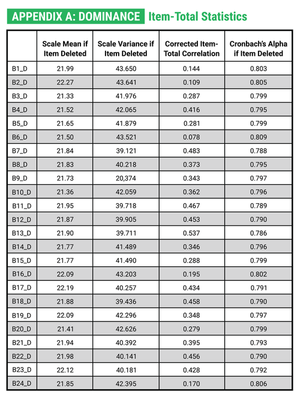
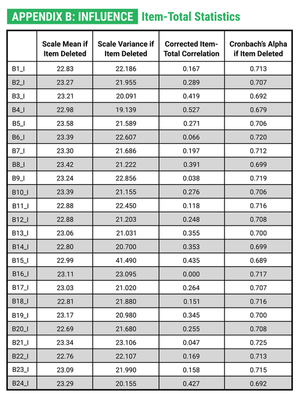
I first conducted a reliability analysis using the 24 variables for each dimension. The alpha reliabilities were .80 for Dominance, .72 for Influence, .72 for Steadiness, and .60 for Conscientiousness. I then investigated whether the alpha reliability would change when deleting any of the 24 items. For all four dimensions, there was no single item that could be deleted that would increase the alpha reliability by .1 or more (see Appendices A-D). I also evaluated the bi-variate correlation between each item and the overall dimension score (see Appendices E-H). All of the correlations were positive and statistically significant (p < .001). The average item-dimension correlation included .40 (range: .17, .60) for Dominance, .35 (range: .04, .63) for Influence, .36 (range: .10, .55) for Steadiness, and .30 (range: .09, .52) for Conscientiousness. In total, these analyses suggest that none of the variables are particularly problematic in their association with the dimension score.
Dimensionality of the DISC Assessment
The DISC is theorized as a circumplex along two continuums. The first is whether individuals view themselves as more powerful or less powerful than their environment (i.e., akin to internal versus external locus of control). The second is whether individuals view their environment as favorable or unfavorable. Dominance entails feeling more powerful than one’s environment and operating within an unfavorable environment. Influence entails feeling more powerful than one’s environment and operating within a favorable environment. Steadiness entails feeling less powerful than one’s environment and operating within a favorable environment. Conscientiousness entails feeling less powerful than one’s environment and operating within an unfavorable environment. Given this dimensionality, we would expect that each dimension is related but relatively unique.
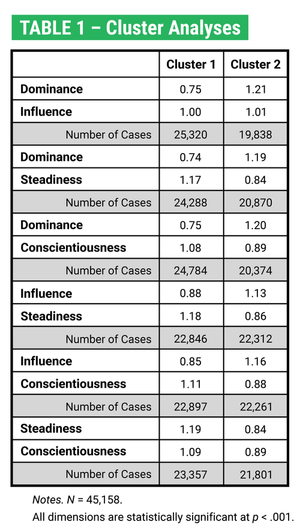
The forced-choice question approach of the assessment does not allow for the traditional factor analysis approach applied to Likert-style assessments. I, therefore, employed a cluster analysis approach to approximate the factor structure. Cluster analyses allow for an investigation of the characteristics of a specified number of profiles (i.e., clusters) within the sample data based on a specified number of dimensions (Scott & Knott, 1974). In this case, I specified two profiles based on two dimensions at a time. I did this for each possible pair (i.e., D and I, D and S, D and C, I and S, I and C, S and C). The underlying theory of DISC would suggest that the two profiles should differ such that the first profile has a higher mean score on one dimension compared to an alternative dimension, and the second profile is the inverse.
I used the mean, dimension-level score for D, I, S, and C in the cluster analyses. The findings of the cluster analyses (see Table 1) generally support a priori expectations. For example, when comparing Dominance and Influence, cluster 1 Dominance (.75) is lower than cluster 1 Influence (1.00), and cluster 2 Dominance (1.21) is higher than cluster 1 Influence (1.01). This suggests that Dominance and Influence are divergent dimensions. This expected pattern does not hold for the Steadiness and Conscientiousness comparison where the cluster scores are similar. However, each of these dimensions shows appropriate differences between the Dominance and Influence dimensions. This suggests that when users feel that they are less powerful than their environment, they might find it challenging to differentiate between their environment being favorable (Steadiness) versus unfavorable (Conscientiousness).
Test-Retest Reliability
A total of 138 users within the sample completed the DISC assessment two or more times. This allowed for investigating whether there were significant differences between the dimension scores across time. Across the 138 users, I conducted a one-sample mean difference t-test. As expected, there were no statistically significant differences for any of the four dimensions (see Table 2 below). This offers support for test-retest reliability.
Conclusion
With respect to inflation bias and social desirability responding, forced-choice measures are considered superior to Likert-style assessments (Anderson et al., 1984). The challenge, however, is that forced-choice measures offer interdependent questions within each forced-choice question block. Thus, it is necessary to impose assumptions to approximate reliability and validity testing. In this case, I created continuous variables by re-scoring questions within each question block. Using this approach I was able to evaluate the general structure of the variables and dimensions. The findings suggest that there are no problematic items and that the four-dimension factor structure is appropriate. Further, findings from our test-retest analyses suggest that DISC scores are likely to remain the same when users take the measure across time.
References
Anderson, C. D., Warner, J. L., & Spencer, C. C. (1984). Inflation bias in self-assessment examinations: Implications for valid employee selection. Journal of Applied Psychology, 69(4), 574–580
Marston, W. M. (1928/2013). Emotions of normal people. Vol. 158. Routledge.
Merenda, P. F., & Clarke, W. V. (1965). Self-description and personality measurement. Journal of Clinical Psychology, 21, 52–56.
Scott, A. J., & Knott, M. (1974). A cluster analysis method for grouping means in the analysis of variance. Biometrics, 507-512.
Appendix A
Dominance – Item-Total Statistics
Appendix B
Influence – Item-Total Statistics
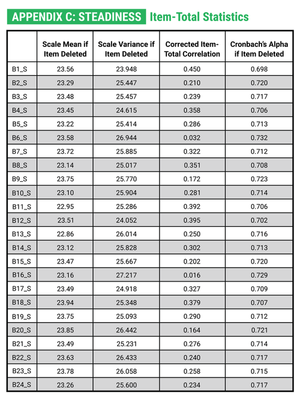
Appendix C
Steadiness – Item-Total Statistics
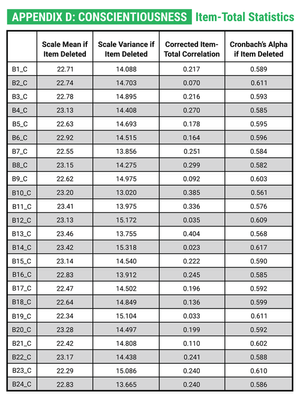
Appendix D
Conscientiousness – Item-Total Statistics
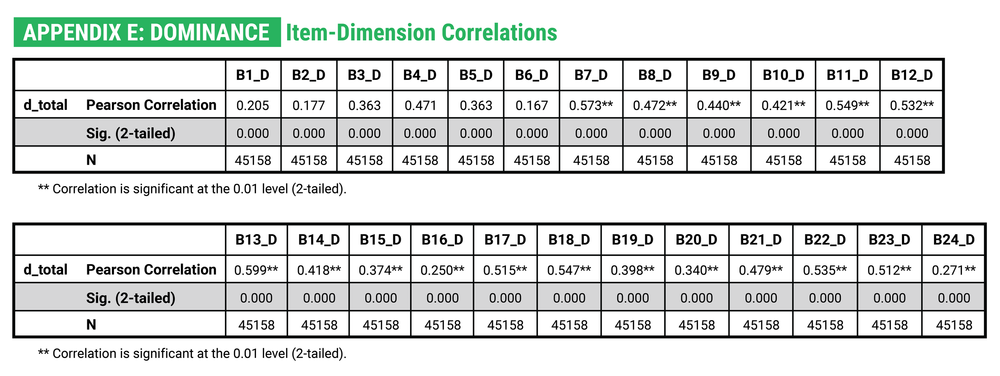
Appendix E
Dominance – Item-Dimension Correlations
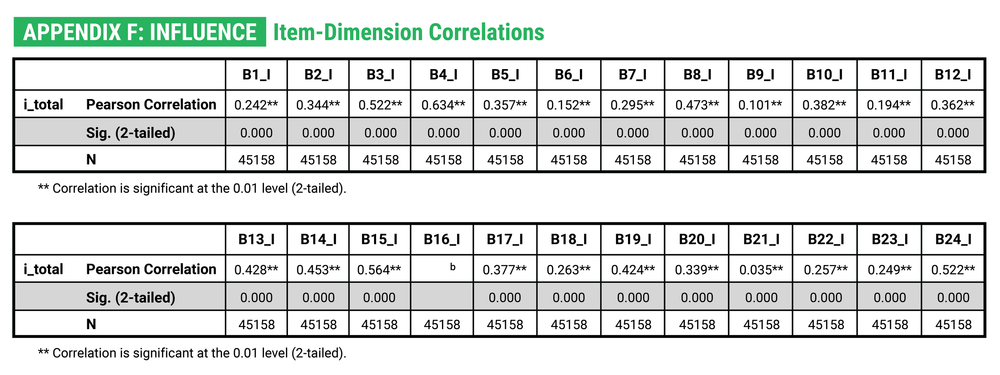
Appendix F
Influence – Item-Dimension Correlations
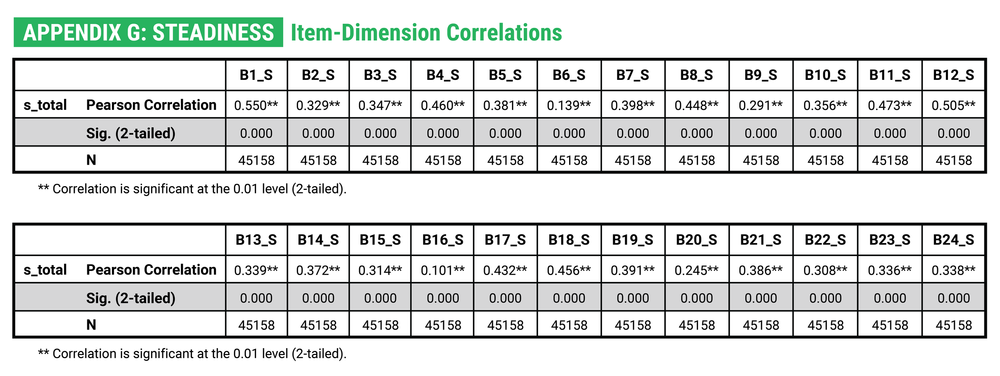
Appendix G
Influence – Item-Dimension Correlations
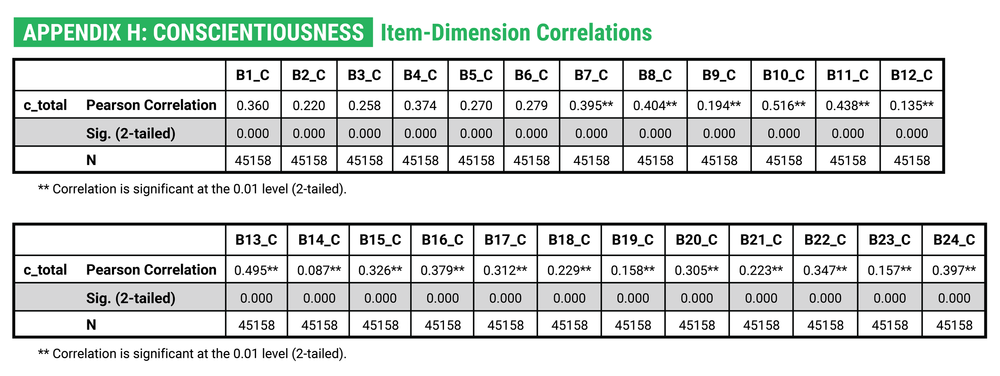
Appendix H
Conscientiousness – Item-Dimension Correlations