
Enneagram Type 2, The Helper: More Than a Caretaker
You don’t just help—you anticipate needs before they arise. You’re the one who remembers birthdays, checks in on a friend having a tough week, and notices when a teammate seems off. Your kindness isn’t just about being nice—it’s about creating deep connections and making others feel valued.
But constantly giving can come at a cost. You might push your own needs aside, struggle to say no, or feel unappreciated when your efforts aren’t acknowledged. At times, it can feel like the love you give isn’t always reciprocated.
You’re not just a helper—you’re a person with your own needs, dreams, and boundaries. And that’s what makes you a Giver. This guide will help you maximize your strengths, set healthy boundaries, and grow in ways that let you support others without losing yourself in the process.
The Enneagram Guide To Healthy Teams
See How High-Performing Teams Use the Enneagram to Strengthen Collaboration
Core Motivations & Fears of Type 2s
A common misconception about Twos is that they give simply because they enjoy helping. While that’s true to an extent, there’s something deeper at play—a core longing to be loved, appreciated, and truly seen.
You thrive on connection, and your generosity isn’t transactional—it’s how you express love. Whether it’s supporting a friend through a tough time, making sure no one feels left out, or anticipating needs before they arise, you instinctively create spaces where people feel valued and cared for.
But beneath these motivations lie some powerful fears:
- Fear of being unwanted—that if you stop giving, people might not stick around.
- Fear of being unworthy of love—that love has to be earned through selflessness.
- Fear of being overlooked—that your kindness might go unnoticed or unappreciated.
Twos are one of the most relationally driven Enneagram types, making up 14% of the 883,560+ Enneagram assessments taken on Cloverleaf. You’re the glue that holds teams, families, and friendships together.
But here’s the truth: You don’t have to earn love—you’re worthy of it just as you are. In this guide, we’ll explore how you can honor your generous spirit without overextending yourself or losing sight of your own needs.
Strengths of Enneagram 2: The Giver
As a Type 2, you have a gift for connection—you don’t just support people, you see them. You instinctively know what someone needs, often before they say a word. More than just kindness, your generosity creates belonging, strengthens relationships, and makes people feel truly valued.
Twos bring warmth, encouragement, and collaboration into every space they enter—whether it’s at work, in friendships, or in leadership. But these strengths, if unchecked, can also lead to exhaustion, unspoken expectations, or resentment (more on that in the next section).
Core Strengths of Enneagram 2
☘️ Deeply Empathetic & Emotionally Attuned – You don’t just listen; you feel what others feel. Your ability to recognize unspoken emotions makes people feel safe and understood.
☘️ Encouraging & Uplifting – You naturally bring warmth to any environment, making people feel valued and appreciated.
☘️ Collaborative & Relationship-Oriented – You thrive in team settings, building strong connections and ensuring that everyone feels included.
☘️ Generous & Supportive – You’re always ready to offer help, guidance, and reassurance, making you a trusted confidant and ally.
☘️ Persuasive & Inspirational – Your sincerity and passion allow you to rally people toward a shared mission, whether it’s a team goal or a personal cause.
What This Means in Work & Life
Your ability to bring people together and create harmony is unmatched. Whether leading a team, supporting a friend, or working behind the scenes, you make others feel important and valued. But this deep investment in people can become a double-edged sword—overextending yourself, giving more than you have, or struggling to say no.
💡 Coaching Insight: Helping doesn’t always mean doing. Before stepping in, ask yourself:
💬 How can I empower this person rather than doing it for them?
✔ New Habit: Shift from fixing to guiding, so you support others without overextending yourself.
Challenges & Growth Opportunities for Enneagram Type 2
Your ability to care for others is your superpower, but it can also become your greatest struggle. You give, support, and uplift—often without being asked. But when you pour all your energy into others without setting limits or asking for what you need, exhaustion and resentment can creep in.
So how do you continue being a source of encouragement and connection without losing yourself in the process?
⚠️ Common Challenges for Type 2s
👉 Difficulty Setting Boundaries – You feel responsible for others’ happiness, making it hard to say I can’t right now—even when you’re running on empty.
👉 Suppressing Personal Needs – You focus so much on what others need that you push your own desires aside—until frustration builds.
👉 Absorbing Others’ Emotions – You take on people’s stress, sadness, or struggles as if they were your own, leaving you emotionally drained.
👉 Seeking Validation Through Giving – You want to feel appreciated and loved, but this can lead to giving with unspoken expectations.
👉 Neglecting Self-Care – You’re so busy taking care of others that you forget to take care of yourself.
🌱 Growth Strategies for Type 2s
✅ Set Healthy Boundaries Without Guilt – Saying I can’t right now doesn’t mean you don’t care—it means you respect your own limits.
✅ Give Yourself Permission to Rest – You don’t need to “earn” self-care. Prioritizing your well-being helps you show up fully for others.
✅ Give Without Expecting – Care isn’t a transaction. Remind yourself: I give because I choose to, not because I need something in return.
✅ Communicate Your Needs Clearly – No one can read your mind. Practice saying: I need support right now. It’s not weakness—it’s healthy.
✅ Balance Giving & Receiving – Letting others support you, too, creates deeper, more reciprocal relationships.
💡 Coaching Insight: Twos thrive when they realize that their worth isn’t tied to how much they give—they are valuable just as they are.
✔ New Habit: Instead of asking How can I help? all the time, try:
💬 What do I need right now?
Type 2 at Work: Strengths & Strategies for Success
Enneagram Twos bring warmth, emotional intelligence, and deep care to their work. Whether leading a team, supporting colleagues, or creating a sense of belonging, they naturally foster connection. However, their desire to be helpful can sometimes lead to overextension, blurred boundaries, and hidden resentment.
How Twos Lead
- Lead with compassion, encouragement, and emotional intelligence.
- Build loyal, people-first teams where employees feel seen, heard, and valued.
- Can struggle with enforcing boundaries or holding others accountable, especially if they fear it may harm relationships.
How Twos Work on a Team
- Thrive in collaborative environments—they naturally foster trust, inclusivity, and connection.
- Often act as the emotional glue of a team, ensuring everyone feels supported.
- Can take on too much responsibility and struggle to say “no” even when their workload is already overwhelming.
Biggest Workplace Challenge:
🛠 Letting Go of the “I Need to Be Needed” Mindset
Twos feel most valuable when they’re helping others—but this can sometimes turn into over-functioning.
📍 Example: Instead of jumping in to fix a problem, Twos can pause and ask:
Would you like my help, or do you just need someone to listen?
This small shift helps Twos support others without overextending themselves.
Communication Style
✔ Warm, encouraging, and deeply personal—Twos communicate with care and connection.
✔ Focuses on relationship-building—they value trust and harmony in interactions.
✔ Struggles with direct conflict—may avoid tough conversations or sugarcoat difficult feedback.
✔ Grows by practicing clear, assertive communication—learning to state their own needs as clearly as they advocate for others.
Ideal Work Environments for Type 2s
Twos thrive in roles that involve people, connection, and support. They do best in:
✔ People-focused workplaces (education, healthcare, HR, nonprofits, counseling).
✔ Roles that require emotional intelligence, relationship-building, and mentorship.
✔ Work cultures that value empathy but also encourage healthy boundaries and self-care.
☘️ How Cloverleaf Can Help Twos Thrive at Work:
Personalized coaching insights remind Twos to:
✅ Set boundaries without guilt.
✅ Balance helping with personal well-being.
✅ Communicate needs directly while maintaining warmth.
📍 Take the Free Enneagram Test & Get Personalized Coaching →
Type 2 in Relationships: Communication & Emotional Growth
Enneagram Type 2s bring devotion, warmth, and an unwavering sense of care to their relationships. They believe love is shown through acts of service, deep emotional support, and always being there when someone needs them. Twos naturally sense the emotions of those around them, often anticipating needs before they’re expressed.
But this deep investment in others can sometimes come at a cost. When Twos feel unappreciated, taken for granted, or emotionally distant from others, they may experience resentment, exhaustion, or insecurity.
How Type 2s Express Care
✔ Acts of service and thoughtful gestures – Twos show love through helping, supporting, and anticipating the needs of their loved ones. They remember birthdays, bring coffee unasked, and notice when someone needs a comforting word.
✔ Being the emotional anchor – They are natural encouragers, always ready to listen, uplift, and provide a safe space for others to share their struggles.
✔ Checking in consistently – Twos reach out with messages like, How are you really doing? or I was thinking about you.
How Type 2s Receive Care Best
✔ Feeling appreciated and recognized for their kindness – They want to know their efforts matter, not just for what they do, but for who they are.
✔ Hearing affirmations like: I see how much you care, and I truly appreciate it.
✔ When others take the initiative to help them – Twos feel deeply loved when someone notices their needs and steps in without being asked.
⚠️ Potential Relationship Struggles
👉 Becoming over-involved – Their instinct to help and “fix” things can sometimes feel overbearing rather than supportive.
👉 Taking rejection personally – If someone doesn’t accept their help or reciprocate their care, Twos may internalize it as a sign they aren’t loved.
👉 Neglecting their own needs – Twos often prioritize others so much that they lose sight of their own well-being, leading to resentment, burnout, or emotional exhaustion.
Practical Relational Tip for Type 2s
Shifting from “Giving to Be Needed” to “Giving Freely”
When you care deeply about someone, you instinctively offer help—but not everyone needs or wants to be “fixed.”
Instead of assuming what someone needs, try asking first:
🚫 Here, let me handle that for you.
✅ Would you like support, or do you just need me to listen?
🚫 I know exactly what will help you.
✅ What would feel most helpful for you right now?
🚫 Why don’t you ever ask for my help?
✅ I love supporting you, but sometimes I need help too. Can we talk about that?
Learning to express their own needs clearly—rather than hoping others will automatically meet them—allows Twos to build healthier, more balanced connections.
💡 Coaching Insight: Twos thrive in relationships when they understand that love is not something they have to earn—it’s something freely given.
Stress & Growth Paths for Type 2s
Under Stress: When Giving Turns into Guilt & Control
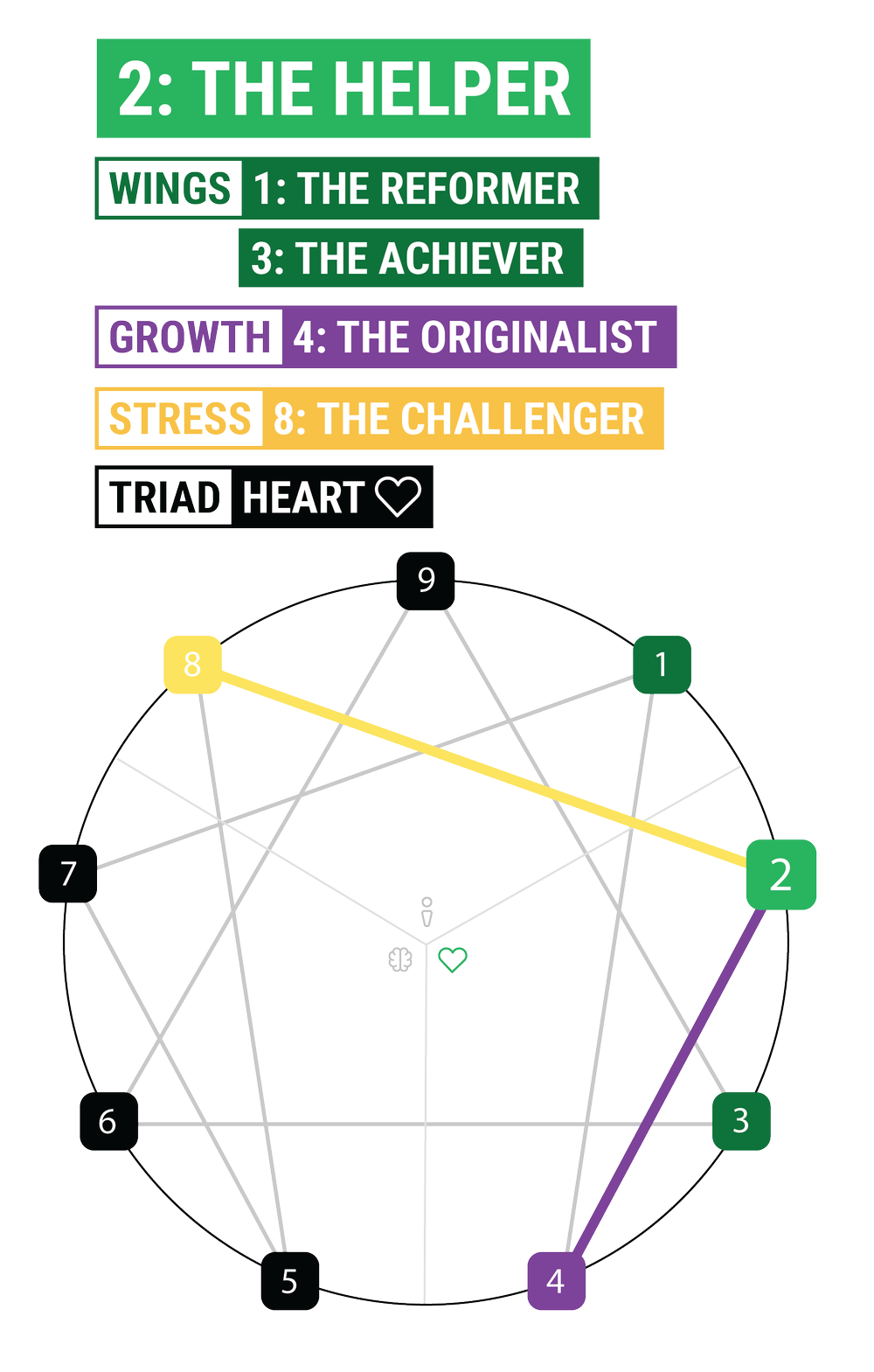
When overwhelmed, Type 2s take on the reactive traits of Type 8, shifting from warm and supportive to demanding, forceful, and emotionally intense.
What This Looks Like:
- Over-giving turns into keeping score → Twos may start to think, After everything I’ve done, why aren’t they showing up for me?
- Guilt and resentment build → When their kindness goes unnoticed, Twos may withdraw or lash out with passive-aggressive comments.
- Overstepping boundaries → May try to “fix” people who didn’t ask for help, then feel hurt if their support isn’t wanted.
- Struggle to ask for help → Instead of stating their needs clearly, they expect others to “just know” what they need and feel unloved when they don’t.
💡 Coaching Tip: Stress can make Twos believe that love must be earned through sacrifice—but real connection doesn’t work that way.
Instead of assuming others should notice and reciprocate your efforts, practice voicing what you need clearly. Try saying:
💬 “I love supporting you, but I also need [specific support]. Can we work on that together?”
In Growth: Embracing the Emotional Depth of Type 4
At their best, Type 2s integrate the healthy traits of Type 4, shifting from seeking external validation to finding deep fulfillment within themselves.
What This Looks Like:
- Giving without expectation → Learning that love doesn’t have to be earned allows Twos to help without resentment.
- Honoring their own emotions → Instead of only focusing on others, they create space for self-reflection and personal growth.
- Strengthening relationships through balance → Twos realize that healthy connections involve both giving and receiving, and that asking for help doesn’t make them a burden.
- Finding purpose outside of relationships → They embrace creativity, independence, and solitude, realizing their worth isn’t tied to how much they do for others.
💡 Coaching Tip: Practice self-care without guilt. Remind yourself:
💭 “I am worthy of love, even when I’m not helping someone.”
Key to Managing Stress: Prioritizing Your Own Needs
The real growth path for Twos isn’t about giving less love—it’s about learning to receive love freely, without feeling like they have to earn it.
- Shift from people-pleasing to self-honoring → Express what you need without guilt.
- Take time for yourself → Creativity, solitude, and personal passions matter just as much as relationships.
- Let go of the need to fix everything → Supporting someone doesn’t mean carrying their burdens for them.
💡 Coaching Insight: Twos thrive when they understand that love isn’t conditional. If you’re feeling drained, ask yourself:
❓ Am I giving from a place of joy, or am I hoping for something in return?
❓ What do I need right now, and how can I ask for it clearly?
Coaching Tips for Type 2s
Type 2s naturally bring warmth, connection, and care to every aspect of life. But sustaining that without burnout means learning to balance giving with receiving and ensuring they don’t lose themselves in others’ needs. Here’s how to grow while maintaining what makes you, you.
1. Shift from Over-Giving to Intentional Support
Try this: Before stepping in to help, pause and ask:
💬 Am I helping because they truly need it or because I need to feel needed?
💡 Coaching Insight: Twos thrive when they offer support without expectation. Instead of jumping in automatically, let others express what they actually need.
2. Set Boundaries Without Feeling Guilty
Try this: Before saying yes to something, ask yourself:
💬 If I say yes to this, what am I saying no to for myself?
💡 Coaching Insight: Twos often feel guilty for putting themselves first, but true connection happens when both people feel valued—including you. Healthy boundaries don’t push people away; they create space for mutual respect.
3. Communicate Your Own Needs Clearly
Try this: Instead of waiting for people to notice when you’re overwhelmed, say:
💬 I love being here for you, but I also need [specific support]. Can we work on that together?
💡 Coaching Insight: Twos often assume “If they really cared, they’d just know.” But real relationships aren’t built on assumptions—they’re built on communication.
4. Balance Giving with Receiving
Try this: The next time someone offers to help you, practice saying yes without deflecting or minimizing.
💬 Instead of Oh, I’m fine! try:
✅ Actually, that would mean a lot—thank you.
💡 Coaching Insight: Allowing others to care for you too strengthens relationships. Accepting help isn’t a weakness—it’s a sign of trust.
How Cloverleaf Helps Type 2s Thrive
You already know how to support others, but true fulfillment happens when you also support yourself. Sustaining success without burnout means building balance, boundaries, and trust.
☘️ Cloverleaf’s personalized coaching insights help Type 2s:
✅ Set boundaries with confidence—learning that no isn’t rejection.
✅ Balance connection with self-care—so giving doesn’t drain you.
✅ Communicate openly & clearly—ensuring relationships are built on mutual care.
✅ Recognize their worth beyond helping—so love isn’t something to be earned.
👉 And the best part? These insights show up exactly when you need them—whether before a meeting, in your inbox, or inside your daily tools.
Do you need more information about the other Enneagram Types? Discover more about each number: 1,3,4,5,6,7,8, and 9!
Enneagram Type 1, The Reformer: More Than a Perfectionist
You see what others miss—the inefficiencies, the broken systems, the unfairness. Where others accept things as they are, you can’t help but see what needs to be fixed.
But here’s the thing—your high standards aren’t just about perfectionism. They’re about making things right, ensuring fairness, and upholding integrity in everything you do.
Whether it’s fixing inefficiencies, championing ethical decisions, or simply making sure the details aren’t overlooked, you’re wired to create order and improvement.
But with that drive comes pressure. The weight of responsibility. The frustration when others don’t seem to care as much. The voice in your head that says, “If I don’t do it, who will?”
You’re not just about rules and structure—you’re about purpose. And that’s what makes you a Reformer. This guide will show you how to maximize your strengths, avoid burnout, and grow in ways that let you lead without carrying the world on your shoulders.
The Enneagram Guide To Healthy Teams
See How High-Performing Teams Use the Enneagram to Strengthen Collaboration
Core Motivations & Fears of Type 1s
A common misconception about Type 1s is that they’re just rigid perfectionists who can’t let things go. In reality, Ones aren’t obsessed with rules for the sake of rules. You’re motivated by a deep internal compass that pushes you to uphold fairness, justice, and improvement—whether that’s in your work, relationships, or personal growth.
Type 1s are one of the most common Enneagram types, making up 15% of over 883,560 Cloverleaf Enneagram respondents. You’re the people who keep teams and organizations running with integrity, helping to build systems that work not just efficiently but ethically.
But beneath these motivations lie some powerful fears:
- Fear of being morally flawed—that you might be “bad” or “not good enough.”
- Fear of making critical mistakes—especially those that could compromise your integrity or let others down.
- Fear of disorder or failure—when things feel out of control, it can trigger deep frustration and stress.
- Fear of unfairness or corruption—seeing people or systems operate dishonestly is especially painful for you.
In this guide, we’ll dive deep into what makes Type 1s tick—your strengths, challenges, and how you can grow without feeling like you have to carry the weight of the world alone.
Strengths of Enneagram Type 1: The Reformer
As a Type 1, your strengths don’t just make you a reliable person—they make you a force for good in the world. You’re not just about structure and order; you bring integrity, discipline, and a clear vision for how things should be.
Core Strengths of Enneagram 1
☘️ High Integrity – You hold yourself to high moral and ethical standards. If you say you’ll do something, you mean it.
☘️ Reliable & Responsible – People know they can count on you to follow through, meet deadlines, and do things the right way.
☘️ Driven by Purpose – You don’t just work hard for the sake of it. You believe in meaningful work and want to contribute to something bigger than yourself.
☘️ Sharp Attention to Detail – Whether it’s catching a small mistake or refining a process, you have an eye for accuracy that others appreciate.
☘️ Efficient & Organized – You thrive on structure and naturally create order out of chaos, making you an essential part of any team or project.
☘️ Passionate About Improvement – Whether it’s yourself, your work, or the systems around you, you’re always looking for ways to make things better.
What This Means in Work & Life
Your strengths make you a natural leader, even if you don’t see yourself that way. You set the bar for quality and help others operate at their best. But these same strengths can also turn into growth areas if taken too far—perfectionism, burnout, or being too critical (we’ll cover that in the next section).
💡 Coaching Insight: Your high standards set the bar for excellence—but they don’t have to be a solo effort. The best leaders create a culture of shared responsibility rather than carrying the weight alone. Instead of stepping in to ‘fix’ things, experiment with coaching:
- Instead of doing it yourself, Ask, ‘What support do you need to get this right?’
- Instead of correcting a mistake silently, Say, ‘Here’s one way to make this even better next time.’
Challenges & Growth Opportunities for Enneagram Type 1
Your drive for excellence makes you a powerful force—but it also makes you your own toughest critic. You hold yourself to a higher standard than anyone else, and that relentless pressure can leave you feeling frustrated, overworked, or even resentful. So how do you maintain your high standards without sacrificing your well-being?
⚠️ Common Challenges for Type 1s
👉 Perfectionism & Self-Criticism – You set high standards, but when things don’t go as planned, you can be hard on yourself and others.
👉 Struggles with Delegation – Because you like things done right, it’s hard to trust that others will meet your standards. This can lead to taking on too much and feeling resentful.
👉 Frustration with Imperfection – You see how things should be, and it can be exhausting when reality doesn’t match your ideals. Rigid thinking can make it difficult to adapt.
👉 Work-Life Balance Struggles – Your deep sense of responsibility makes it hard to “turn off” work mode. Relaxation can feel unproductive, but it’s essential for your well-being.
👉 Unexpressed Anger & Resentment – Type 1s often repress their frustration, leading to simmering resentment. Learning to express your emotions in a healthy way can improve relationships and reduce stress.
🌱 Growth Strategies for Type 1s
✅ Challenge Your Inner Critic – Instead of focusing on what’s wrong, practice acknowledging what’s working. Self-compassion helps you grow without burnout.
✅ Embrace “Good Enough” – Perfection isn’t always necessary. Ask yourself: Will this still be effective if it’s 90% done?
✅ Practice Letting Go – You don’t have to fix everything. Focus on what you can control, and release what you can’t.
✅ Delegate & Trust Others – Perfection isn’t a solo act. Letting go of control can actually make you more effective in the long run.
✅ Prioritize Self-Care – Rest, creativity, and play aren’t distractions—they make you sharper and more balanced. Schedule time for things that bring you joy.
✅ Express Frustration Before It Builds Up – Instead of repressing anger, find healthy ways to voice your concerns without criticism—it will strengthen your relationships.
💡 Coaching Insight: Type 1s thrive when they have clear expectations and high standards, but their inner critic and perfectionism can lead to burnout. Building in self-compassion and flexibility allows them to sustain long-term success without feeling constantly overburdened.
Type 1 at Work: Strengths & Strategies for Success
Enneagram Type 1s bring a structured, ethical, and disciplined approach to their work. Whether leading a team, managing projects, or driving change, they hold themselves (and others) to high standards and ensure things are done the right way.
How Ones Lead
- Lead by example—hardworking, ethical, and principled.
- Expect excellence but may struggle to delegate.
- Motivate teams by upholding fairness and integrity.
How Ones Work on a Team
- Ensure consistency, structure, and follow-through.
- Organize tasks, create efficient systems, and uphold accountability.
- Can become frustrated when others don’t match their work ethic.
Biggest Workplace Challenge:
🛠 Letting Go of the “If I Don’t Do It, It Won’t Be Done Right” Mindset
Type 1s are incredibly reliable leaders, but that can sometimes translate into taking on too much. If you’ve ever stayed late fixing someone else’s work instead of coaching them to improve, you know this struggle well.
📍 Example: Imagine you’re leading a project, and a teammate submits a draft that’s good but not perfect. Your instinct? Fix it yourself. But what if, instead, you gave clear, constructive feedback and let them refine it? This not only frees up your time but also develops a culture of shared excellence rather than solo perfectionism.
Communication Style
- Thoughtful and well-structured in their messaging.
- Focused on accuracy and clarity, but can come across as too direct or critical.
- Benefit from softening feedback and recognizing effort over just results.
Ideal Work Environments for Type 1s
You thrive in environments that value structure, integrity, and precision—where work is done thoroughly, not just quickly. Some of the best industries for Type 1s include:
✔️ Law & Compliance
✔️ Education & Academia
✔️ Research & Policy Development
✔️ Healthcare & Medicine
✔️ Nonprofits & Ethical Advocacy
☘️ How Cloverleaf’s Enneagram Tips Can Help You:
You don’t need another one-time personality report—you need daily coaching insights that show up right when you need them. Whether it’s learning to give feedback effectively, delegating with confidence, or balancing high standards with self-care, Cloverleaf helps you grow as a leader without sacrificing who you are.
📍 Take the Free Enneagram Test & Get Personalized Coaching →
💡 Coaching Insight: Ones can become resentful if they perceive others as less committed or disciplined at work. Managing expectations, focusing on progress over perfection, and recognizing different work styles help prevent burnout and frustration.
Type 1 in Relationships: Communication & Emotional Growth
Enneagram Type 1s bring steadfast commitment, responsibility, and deep care to their relationships. They believe love is shown through doing the right thing, showing up consistently, and helping others improve—sometimes without realizing how their high standards can come across.
How Type 1s Express Care
- Through acts of service, dependability, and unwavering loyalty.
- Helping their partner or loved ones stay organized, disciplined, and on track.
- Offering constructive feedback and problem-solving (though it may feel like criticism to others).
How Type 1s Receive Care Best
- Feeling appreciated for their efforts and high standards.
- Being told they are “good enough” just as they are—not just for what they do.
- Having their values and sense of integrity affirmed by those they care about.
⚠ Potential Relationship Struggles
- Unintentionally critical—because they care deeply, they may focus on how things can improve rather than celebrating what’s already good.
- Can become frustrated when partners or loved ones don’t share their level of discipline or attention to detail.
- May have a hard time relaxing and simply enjoying the moment.
Practical Relational Tip for Type 1s
Shifting from Criticism to Connection
When you care about someone, you want to help them improve—but your feedback can sometimes feel like a report card instead of encouragement.
Instead of focusing on what’s wrong, shift to what’s possible:
🚫 ‘That’s not the right way to do it.’
✅ ‘Want to see a trick I use to make this easier?’
🚫 ‘Why didn’t you just do it this way?’
✅ ‘I’d love to understand how you approached this—can you walk me through it?’
🚫 ‘You never listen to my advice.’
✅ ‘Hey, I noticed something that might help—want to hear it?’
By reframing correction as collaboration, you encourage change without making people feel judged.
💡 Coaching Insight: Ones prefer direct, constructive conversations but can struggle with receiving feedback that feels like criticism. Learning to see feedback as helpful, not personal, allows for deeper connection and growth in relationships.
Stress & Growth Paths for Type 1s
Under Stress: When the Inner Critic Takes Over
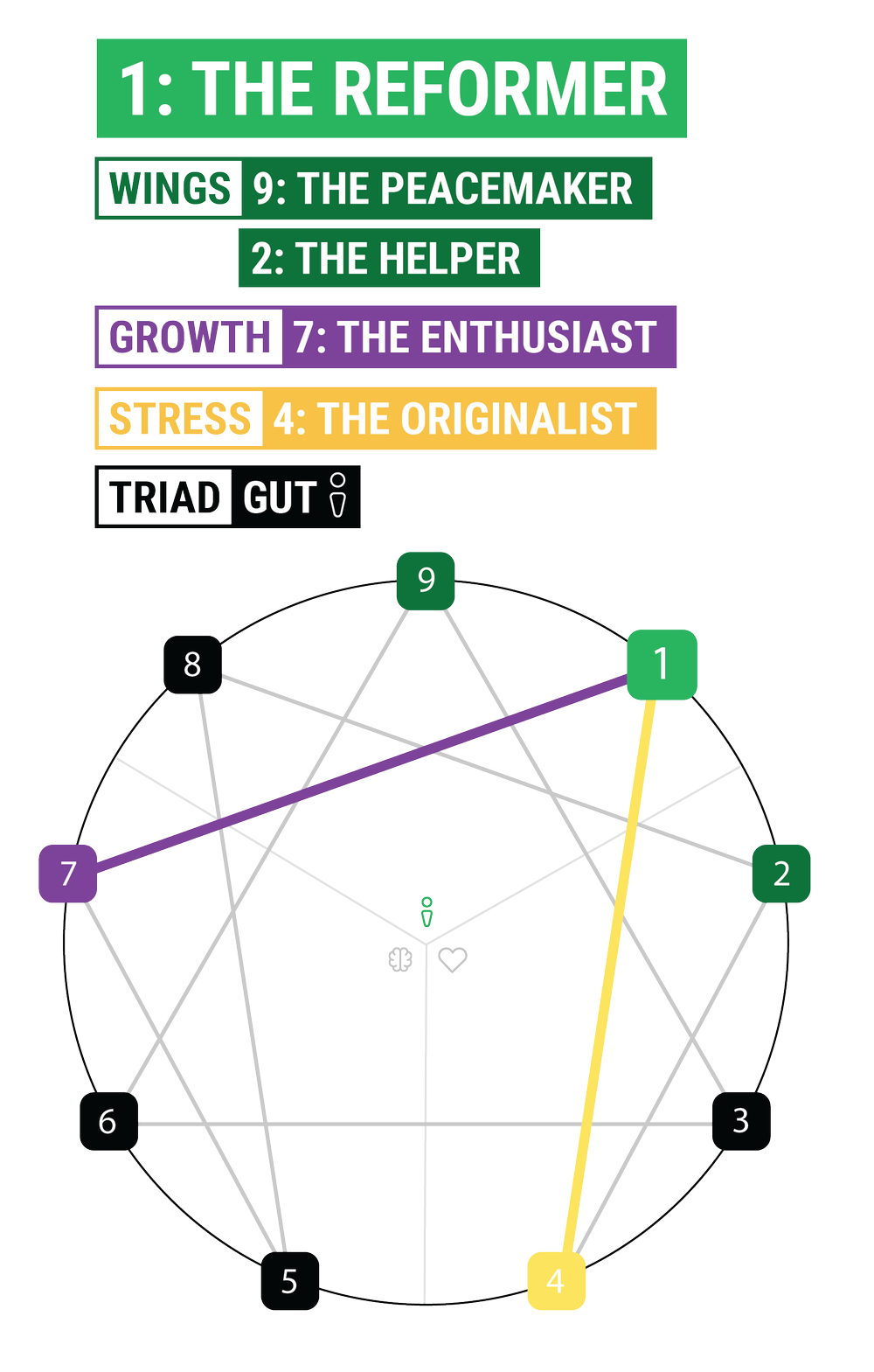
When overwhelmed, Type 1s move toward the reactive emotions of Type 4. This can look like:
- Feeling misunderstood → “No one else seems to care as much as I do.”
- Becoming overly self-critical → “I should be able to handle this better.”
- Withdrawing or isolating → “If I can’t do it right, I won’t do it at all.”
- Frustration turning inward → Instead of expressing anger, they may spiral into resentment, shame, or melancholy.
💡 Coaching Tip: Stress makes Type 1s hyper-aware of flaws—both their own and others’. When you catch yourself ruminating or feeling isolated, pause and ask:
❓ Am I being fair to myself? Would I say this to a friend?
❓ What is one thing I can let go of right now?
Progress happens when you allow yourself to be human, not just ‘right.’
In Growth: Embracing the Joy of Type 7
At their best, Type 1s integrate the lightness and adaptability of Type 7. Growth looks like:
- Letting go of rigid control and trusting the process.
- Finding joy in spontaneity instead of needing every step planned.
- Experimenting instead of perfecting—knowing failure is part of learning.
- Balancing responsibility with play—realizing rest fuels productivity.
💡 Coaching Tip: Try a “healthy risk” this week. Instead of over-preparing or over-editing, ask yourself:
❓ What’s one thing I can say ‘yes’ to without overanalyzing?
❓ How can I approach this with curiosity rather than pressure?
💭 Reminder: You don’t have to choose between high standards and joy—you can have both.
Key to Managing Stress: The Power of Imperfection
The real growth path for Type 1s isn’t about lowering standards—it’s about recognizing when ‘good enough’ is actually good enough.
- Shift from self-criticism to self-compassion → Talk to yourself the way you would mentor someone else.
- Schedule joy, not just work → Give yourself permission to enjoy the process, not just the outcome.
- Redefine ‘progress’ → Improvement isn’t about fixing everything—it’s about learning and adapting.
💡 Coaching Insight: Type 1s thrive when they balance discipline with self-kindness. If you’re feeling overwhelmed, ask yourself:
❓ Am I holding myself to an impossible standard?
❓ How would I handle this if I weren’t afraid of mistakes?
The fastest way to grow isn’t through more control—it’s through trust, adaptability, and giving yourself grace.
Coaching Tips for Type 1s
1. Shift from Overworking to Sustainable Impact
Try this: Instead of taking on everything yourself, identify one task per week that you can delegate—without rewriting or fixing it afterward.
💡 Coaching Insight: Type 1s excel at quality control, but burnout happens when they don’t let others contribute. Delegating isn’t about lowering standards—it’s about helping others step up.
2. Reframing Feedback: From Critique to Collaboration
Try this: Before giving feedback, ask yourself: Am I focusing on improvement, or does this sound like criticism? Then, start with a positive affirmation before offering guidance.
Coaching Insight: Ones often expect direct feedback but struggle when receiving it—practicing curiosity instead of defensiveness can help. Instead of jumping to correction, try asking: “Can you walk me through your thought process?”
3. Self-Compassion as a Tool for Growth
Try this: When your inner critic gets loud, pause and ask, Would I say this to a friend? Reframing self-talk builds resilience and prevents burnout.
💡 Coaching Insight: Ones’ harsh self-judgment leads to stress—building self-compassion helps them sustain high standards without the guilt. Try celebrating wins before moving to what needs fixing.
4. Building Trust in Teamwork: Learning to Let Go
Try this: Instead of correcting a teammate’s approach immediately, ask them about their thought process first. You might find their method is just different—not wrong.
💡 Coaching Insight: Ones feel most frustrated when others don’t share their level of discipline—but learning to appreciate different strengths makes them stronger leaders. Try noticing what’s working before pointing out what’s not.
How Cloverleaf Helps Type 1s Thrive
You already know how to set high standards and push for excellence. But sustaining success without burnout requires more than just hard work—it requires balance, adaptability, and trust.
☘️ Cloverleaf’s personalized coaching insights help Type 1s:
✅ Balance perfectionism with adaptability—learning when “good enough” is truly enough.
✅ Improve communication & feedback skills so guidance feels supportive, not critical.
✅ Develop leadership without micromanaging—trusting others while still upholding integrity.
✅ Reduce stress and embrace flexibility—so high standards don’t come at the cost of well-being.
👉 And the best part? These insights don’t sit in a report—you get them exactly when you need them. Whether it’s a reminder before a meeting, a coaching tip in your inbox, or a team insight inside your daily tools, Cloverleaf keeps you growing in real time.
Want to learn about the rest of the Enneagram Types? Read more about the Enneagram: 2, 3, 4, 5, 6, 7, 8, and 9!
The Enneagram is a useful tool for building stronger, more connected teams. By understanding each person’s core motivations, communication styles, and stress responses, teams can improve collaboration, resolve conflict more effectively, and create a culture where everyone thrives.
But knowing your type isn’t enough. The hard part — and the part most teams get wrong — is making Enneagram insight show up in the daily moments that actually shape how a team works together. According to a DDI webinar poll cited by Peggy Murriner in her piece on choosing the right personality assessment, 53% of HR and L&D professionals say the top reason personality assessments fail to drive development is “lots of data, but no clear next steps.” The data exists. Nobody knows what to do with it.
The four activities below are designed to close that gap. Each one is an action you can run with your team this month, paired with the underlying logic for why it works. They help your team:
- ✅ Understand each other’s work styles for better collaboration.
- ✅ Navigate conflict with more awareness and empathy.
- ✅ Run more productive meetings by leveraging different strengths.
- ✅ Reinforce Enneagram insight in the flow of work — not just at the workshop.
If you’re looking for a type-by-type reference (how each Enneagram type shows up at work — communication style, stress responses, strengths, growth patterns), see How to Use the Enneagram in the Workplace to Develop All Nine Types. This article focuses on what to do as a team. The companion article covers what each type is.
Creating space for these conversations might feel uncomfortable at first, but the long-term benefit of a more cohesive, engaged team makes the effort worth it.
Get the Enneagram Guide To Healthy Teams to see how high performing teams use the enneagram to improve teamwork.
4 Enneagram team building activities
1. Use a messaging channel to share what the team is learning about different types
Start a Slack channel, Microsoft Teams thread, or recurring email digest where teammates share what they’re learning about themselves and one another. Affirming and recognizing new insights is a low-effort, high-leverage way to celebrate and reinforce a healthy team culture.
Why this works:
A decade of research by organizational psychologist Tasha Eurich found that 95% of people believe they’re self-aware, but only about 10–15% actually are. That gap closes only when self-awareness becomes a shared team practice — not an individual exercise. A teammate who hears their colleagues describe what they’re learning about themselves gets calibration data they can’t generate alone. Over time, the team builds a shared language for behavioral differences.
Self-awareness has business consequences. A Korn Ferry study of 6,977 professionals across 486 publicly traded companies found that organizations with self-aware leaders consistently outperformed peers on financial measures. The “soft” stuff isn’t soft — it’s the foundation of how decisions get made under pressure.
How to run it:
- Create a dedicated channel — #enneagram-learnings, #what-i-noticed-this-week, whatever feels right for your culture.
- Seed it with three or four prompts from the team lead in the first two weeks: “This week I noticed my Type 6 default kicked in when [specific situation]. Here’s what I tried instead.”
- Invite — don’t require — participation. Vulnerability that’s mandated stops being vulnerable.
- Refresh prompts monthly so the channel doesn’t become stale.
The activity reinforces the Enneagram insight your team has already absorbed. The channel becomes the system that keeps the insight active and visible after the workshop ends.
2. Build an enneagram type map to indicate each team member’s number
Recognizing the makeup of your team illuminates strengths and growth areas, helps you anticipate how different team members will react in shared situations, and gives the team a quick reference when conflict surfaces.
Why this works:
Behavior change research consistently shows that insight which isn’t reinforced at the moment of application doesn’t change behavior. Within a week of a typical workshop, participants retain as little as 20% of what they learned. A team Enneagram map fights against learning decay by giving the team an artifact they can return to in real moments — before a 1:1, during a tense Slack thread, when staffing a project.
What makes learnings from the Enneagram stick is having the type-level insight available the moment someone needs it.
How to run it:
Path A: DIY (for teams not yet using a behavioral platform)
- Confirm each team member’s type (with their consent — Enneagram type is personal data, not org chart data).
- Build the map as a Notion page or shared doc that’s editable, not a static PDF.
- Add a one-line “what they typically need” note next to each name (e.g., “Type 5: needs context before commitment; appreciates async processing time”).
- Share it with the team and revisit it quarterly — types don’t change, but team composition does.
Path B: Activate Cloverleaf’s Team Enneagram dashboard
If your team is already using Cloverleaf — or you’re evaluating it — the Team Enneagram view does this work automatically. Each team member’s headshot appears placed on the Enneagram symbol at their type. The dashboard surfaces the team’s triad distribution at a glance: how much of your team sits in the Head Triad (Types 5, 6, 7 — analytical, planning-focused), the Gut Triad (Types 8, 9, 1 — instinct, action-oriented), and the Heart Triad (Types 2, 3, 4 — relational, image-aware).
That triad-level read often reveals patterns the team doesn’t consciously see. A team that’s 46% Head / 29% Gut / 26% Heart will spend more energy stress-testing plans than executing them. A team weighted toward Heart will spend more cycles managing how things land than what gets decided. Knowing the distribution explains friction patterns the team would otherwise misread as personality issues.
The dashboard is live — when team composition changes, the map updates. When new members take the assessment, they appear automatically. And because it lives inside the same platform that delivers coaching nudges in Slack, Teams, Outlook, and Workday, the type-level insight is available in the moments where behavior is forming — not stored in a doc someone has to remember to open.
👉 Learn more about how Cloverleaf’s AI Coach works →
3. Facilitate team discussions using questions that highlight strengths
Block time on the calendar for a focused team discussion using prepared conversation starters. The structure prevents the “we’ll discuss it sometime” pattern that kills good intentions, and the questions themselves should pull strengths forward rather than lead with gaps.
Why this works:
A landmark meta-analysis by Kluger and DeNisi examined 607 studies on feedback and found that roughly one in three feedback conversations actually decreases performance afterward — not because the feedback was wrong, but because the framing made it land as a threat to identity rather than as information. When Enneagram-themed discussions are framed around what’s wrong with each type (“Type 1 perfectionism is annoying,” “Type 8 directness is too much”), the framework becomes a vehicle for identity threat instead of self-awareness. The fix is structuring the conversation around strengths and contributions, not flaws.
How to run it:
Designate a 60-minute meeting. Pose two or three of these questions and rotate through team members:
- When you make decisions, how does your type’s natural lens show up? Where does it serve the team well?
- Share a specific moment when you noticed a teammate using their type’s strengths in a way that helped the work.
- What’s one positive example of how Enneagram awareness has helped you collaborate with someone on this team?
- Describe what conditions help you do your best work — and how your type explains those preferences.
- What unique contribution do you notice each teammate making? Be specific.
- What about your type’s motivation pattern affects how you show up under pressure?
- In what way is shared self-awareness changing how this team operates day-to-day?
Limit the conversation to two or three questions per session. Depth beats coverage.
4. Use technology to activate Enneagram insight in the flow of work
Most assessment platforms stop at the report — and that’s where most Enneagram team programs lose momentum. The activity instructions above all share a common dependency: they require team members to remember the insight at the moment that matters. That’s a lot to ask of someone preparing for a hard 1:1 at 9:50 on a Tuesday morning.
Why this works:
Modern AI coaching platforms can deliver Enneagram insight directly into the tools your team already uses. As Peggy Murriner’s analysis of how companies use the Enneagram and AI to develop leaders explains, the manager doesn’t need the insight at the workshop. They need it Tuesday at 9:50, before the 1:1 with the direct report whose work just got publicly questioned. They need it Thursday afternoon, before they reply to the cross-functional partner who has been pushing back.
Static reports put the entire burden on the team member to remember what they read, interpret it correctly, and apply it in the moment. Most won’t — not because they don’t care, but because they’re moving between six meetings and a full inbox. As Kirsten Moorefield’s piece on AI coaching with behavioral assessment integration makes clear: when validated assessments are integrated as a foundational data layer, AI coaching can move from pattern-based guidance to personalized, context-aware insight that helps people respond more effectively in real moments of stress, pressure, and teamwork.
How Cloverleaf brings Enneagram insight into the flow of work:
- A shared team dashboard so everyone can see how different types interact, communicate, and make decisions
- Coaching nudges in Slack, Microsoft Teams, Outlook, and Workday — arriving before 1:1s, during difficult conversations, and after team meetings
- Specific guidance on how each teammate handles stress and growth based on their type, surfaced when it’s relevant
- Integration with the validated assessments your organization already owns — DISC, 16 Types, CliftonStrengths, Insights Discovery — not just Enneagram in isolation
That’s the architecture of activation: the data your team already has becomes context that arrives at the moment it matters, instead of a report that get’s lost in a folder.
👉 Take the free Enneagram assessment on Cloverleaf to start, or see how Cloverleaf turns assessment results into daily coaching for your team.
How to ensure the impact of Enneagram activities influences your team
The four activities above can help change how your team talks about itself.
What it could be less effective at changing, on their own, is how your team behaves on Tuesday morning.
A lot of teams can run incredible Enneagram offsites — the kind where two people who’ve been quietly resenting each other for a year finally see what’s been happening between them. Real understanding. Real apologies. Real intent to do things differently.
A week later, they’re right back where they started.
That isn’t a problem with the framework. The Enneagram is doing exactly what it’s supposed to do. The problem is what team members are expected to do with it once the meeting ends — essentially, “remember this in the moments it matters, while you’re rushing between calendar blocks and Slack threads.”
That’s a lot to ask of anyone.
The four activities are great starting points. The system that puts the insight in front of the team at the moment it matters is what makes them stick.
What’s one moment in your team’s week where the right insight, at the right time, would actually change what happens next?
The Enneagram Guide To Healthy Teams
See How High-Performing Teams Use the Enneagram to Strengthen Collaboration
Most teams that use the Enneagram follow the same arc. The workshop is good — sometimes genuinely moving. People recognize themselves. A few pairs have the kind of conversation you only have when you finally have language for what’s been happening between you. There’s energy in the room.
Then quarter-end hits. The urgent crowds out the important. The framework gets pulled up occasionally, usually to explain someone’s behavior after the fact. Within a few months, the Enneagram has become a noun — “I’m a Four” — instead of a verb.
This isn’t a motivation problem. It’s a structure problem. The insight is there. What’s missing is a set of enneagram coaching questions designed for real workplace moments — the 1:1, the feedback conversation, the team meeting where tension is simmering just below the surface.
This guide is for managers, coaches, and HR leaders who already know the Enneagram and want to use it more intentionally in team settings. It’s organized around five actual use cases, adds type-specific coaching questions for all nine types, and covers how to ask different questions depending on which triad you’re working with.
If your team hasn’t taken the Enneagram yet, start with the free Enneagram assessment — knowing each person’s type is the prerequisite for everything that follows.
The Enneagram Guide To Healthy Teams
See How High-Performing Teams Use the Enneagram to Strengthen Collaboration
Two elements that determine whether an Enneagram question gets a real answer or a rehearsed one
Not all Enneagram questions are equal. Generic prompts like “what resonates with your type?” produce surface-level answers. The questions that actually shift something are the ones that connect type to a specific real situation — a recent decision, a current challenge, a moment this week that felt like the type showing up.
Two structural elements help. First, someone needs to be processing and someone needs to be listening — what the original Enneagram conversation framework called the processor and the listener. The processor’s job is to elaborate, resist the one-sentence answer, and stay curious about what they’re discovering. The listener’s job is harder: resist the urge to relate, respond, or redirect. When a listener says “me too,” the processor stops processing and starts performing.
Second, the best enneagram discussion questions for work are specific about timing. “When you’re under stress” is more useful than “in general.” “Before you replied to that email” is more useful than “in conflict situations.” The more the question anchors to something that already happened, the more honest and useful the answer becomes.
One more thing worth naming: type is a pattern, not an identity. The Enneagram is most useful when it’s treated as a lens for understanding a recurring behavior — not a label that explains everything. Questions that invite reflection (“does this feel true?”) land better than questions that assume (“as a Type 8, you must…”). The goal is self-awareness in service of behavior change, not self-categorization.
Enneagram questions for five team situations: 1:1s, feedback, conflict, collaboration, and kickoffs
The questions below are organized around five workplace situations where Enneagram insight is most useful. They can be used in 1:1s, team meetings, coaching sessions, or as reflection prompts before a significant conversation.
Opening a team conversation
These work well at the start of a team meeting, a new project kickoff, or whenever you want to establish a shared language without requiring deep vulnerability right away. They’re lower-stakes entry points.
- Which two or three lines from your type description are most true for you right now — this week, not in general?
- Give one example of a time this month when your type showed up at its best. What was the situation?
- What does your type tend to need from teammates when a project is under pressure? Be as specific as you can.
- What’s a collaboration pattern you’ve noticed in yourself that people on this team probably don’t know about?
Exploring core motivations and fears
These go deeper and work best when there’s already some psychological safety in the room. They’re the questions worth making time for — the ones that explain the “why” underneath behavior people have been interpreting as personality or attitude.
- Your type’s core fear is [X]. In what ways has that fear shaped a decision you’ve made at work in the last 90 days — not a dramatic decision, a small one?
- Your type is motivated by [X]. Think about the last time you felt genuinely energized by your work. What was true about that situation that aligned with your motivation?
- Where do you think your motivation could actually hold you back on this team — not theoretically, but specifically?
- As a coworker, what is the best way I can support you when your core fear is active? What does that look like in practice?
Reference guide: Core fears by type
1: being wrong or imperfect
2: being unwanted or unloved
3: being worthless or without achievement
4: having no unique identity
5: being incompetent or depleted
6: losing support or direction
7: being limited or in pain
8: being controlled or vulnerable
9: being in conflict or disconnected
Stress and growth patterns
The Enneagram’s arrows describe where each type moves under stress (disintegration) and toward growth (integration). These patterns are often the most actionable part of the framework for teams, because they explain behavior that seems inconsistent or out of character. For more on how this works, see the full breakdown of Enneagram arrows.
- When you’re under significant stress, what does your behavior look like to other people? Is what you’re showing on the outside matching what’s happening on the inside?
- Your type moves toward [disintegration type] under stress. Can you give an example of when you’ve seen that pattern in yourself at work? What triggered it?
- Your type moves toward [integration type] in growth. What conditions at work tend to bring out that version of you? Can we create more of those?
- What’s a signal that would tell your teammates you’re moving into stress — something they could notice and gently name for you?
Working styles and collaboration
These are practical enough for weekly use — in team meetings, project retrospectives, or at the start of any new working relationship. They turn Enneagram insight into operational clarity.
- What does a productive week look like for you, and how much of that is driven by your type?
- What kind of feedback actually changes your behavior — and what kind makes you defensive even when you know it’s right?
- Where on this team do you see a natural synergy between your type’s strengths and someone else’s? Where do you anticipate friction?
- What’s one thing about how you process information or make decisions that, if your teammates understood it, would reduce unnecessary friction?
Feedback and conflict
These are the highest-stakes questions — reserve them for contexts where trust is established and the conversation has been set up intentionally. They produce the most behavior change when they land well.
- When you receive critical feedback, what’s your default move? Push back, withdraw, accommodate, reframe? Is that move serving you?
- Think of a conflict you’ve had at work where you didn’t like how you showed up. What was your type doing — and what would growth have looked like in that moment?
- What does it look like when you’re in a conflict and you’re handling it well, given your type?
- What’s something a teammate could say or do that would help you get back to your best self during a difficult conversation?
Type-specific coaching questions for all nine types
Generic questions are a starting point. The questions below go deeper — each pair is designed specifically for that type’s core motivational pattern. Use them in 1:1s or coaching conversations where you know the person’s type and want to go beyond the surface. For context on how each type shows up at work, see Enneagram types at work.
Type 1 — The Reformer
- Where are you holding yourself to a standard no one else in the room agreed to? What would it look like to let that standard be lower?
- Between conviction and condemnation — which is driving you right now? How can you tell?
Type 2 — The Helper
- What’s something you need right now that you haven’t asked for? What’s making it hard to ask?
- Where are you helping in a way that’s costing you? Is the cost sustainable?
Type 3 — The Achiever
- Set aside what you’ve accomplished. What do you want people to know about who you are?
- Where are you working harder than the goal requires — and what does it feel like to slow down?
Type 4 — The Originalist
- What’s something ordinary about your situation right now that might actually be valuable — that you might be overlooking because it doesn’t feel significant enough?
- When you imagine yourself at your best in this role, what are you doing differently from what you’re doing today?
Type 5 — The Sage
- What would you contribute to this decision right now if you felt you already knew enough? What’s actually stopping you?
- Where are you holding back energy or insight that this team needs? What would it take to put it in the room?
Type 6 — The Loyalist
- What’s a decision you’ve been circling for longer than necessary? What would it look like to trust your first read?
- When you imagine the worst-case outcome of this situation, what are you actually preparing for — and is that preparation protecting you or keeping you stuck?
Type 7 — The Enthusiast
- What’s something worth finishing that you’ve been avoiding finishing? What does staying with it require of you?
- What does this project look like if it’s just hard — not fun, not exciting — and you do it anyway?
Type 8 — The Challenger
- Where are you protecting yourself by being in charge? What would it look like to let someone else carry this?
- When was the last time you let someone see you uncertain about something? What happened?
Type 9 — The Peacemaker
- What do you actually want here — not what would keep the peace, not what would make everyone else comfortable, but what do you want?
- Where are you staying quiet to avoid conflict? What’s the cost of that silence for you and for this team?
How gut, heart, and head types respond to Enneagram questions differently — and what to ask each
The Enneagram’s three triads — gut types (8, 9, 1), heart types (2, 3, 4), and head types (5, 6, 7) — describe where each center of intelligence is centered. This shapes not just what people need from a conversation, but how they respond to the questions themselves. For a deeper look at triad dynamics, including how the centers of intelligence differ, that’s covered in full on the triads article.
Gut types (8, 9, 1) — center on instinct and body
Gut types process through action, reaction, and gut instinct. They often know what they think before they can articulate it, and they can feel interrogated by questions that push toward analysis before the body has had a chance to register. With gut types, give the question more space. Ask, then wait. Don’t fill the silence.
Questions that work well: ones anchored to specific recent situations, not abstract patterns. “What happened?” lands better than “what does this pattern tell you?”
Heart types (2, 3, 4) — center on feeling and image
Heart types are processing relational meaning constantly. They notice how the conversation is going, whether the room feels safe, whether the questioner actually cares about the answer. Questions that feel transactional or clinical will produce closed, performative answers.
Questions that work well: ones that acknowledge the relational stakes. “I want to understand how this has been landing for you” opens a Type 2 more than “what’s your communication style under stress?” The warmth in the setup changes what comes back.
Head types (5, 6, 7) — center on thinking and strategy
Head types process through analysis. They often need to think through the question before they can answer it well — and they may resist questions that feel like they’re being asked to commit to something before they’ve had time to think. Questions posed in advance tend to produce better conversations than questions posed in the moment.
Questions that work well: ones with room to explore, not just declare. “What are the possibilities you’re seeing?” gives a Type 7 more to work with than “what’s your decision?” Frame questions as inquiries, not tests.
How Cloverleaf delivers type-aware coaching before the meeting — without the manager having to remember
There is a real ceiling to what a question list can accomplish. It requires someone to remember to use it. It requires the manager to know each person’s type, hold the relevant coaching question in mind, and find the right moment to ask it — usually while they’re also running the meeting, managing the deliverable, or trying to land the feedback in a way that doesn’t blow up the relationship.
Most teams that sustain Enneagram insight after a workshop do it because the insight found a way into their daily work — not as a separate conversation, but as a coaching layer that shows up when it’s relevant.
A calendar reminder before a 1:1 that names the direct report’s type and suggests an opening question. A coaching nudge in Slack that surfaces a specific person’s stress patterns before a difficult conversation. An insight in Outlook that tells a manager how a Type 4 on their team is likely to receive the feedback they’re about to send.
That’s what Cloverleaf does — it puts type-aware coaching in the tools managers are already using, before the moments that matter. The Enneagram doesn’t have to live in a workshop binder. It can show up in the ten minutes before the meeting, where the insight actually changes what happens. For a closer look at how AI coaching and the Enneagram work together, see how companies are building the Enneagram into leadership development programs.
Cloverleaf integrates with Slack, Microsoft Teams, Outlook, and Calendar, as well as HRIS systems and Workday — delivering personalized coaching based not just on type, but on the full assessment profile (DISC, 16 Types, CliftonStrengths®, and more) and the specific people in the conversation. For teams that have already invested in the Enneagram, the question is whether those results are sitting in a PDF or showing up when they can do something.
See How Cloverleaf’s Platform Works
Frequently asked questions
What are the best Enneagram coaching questions for a 1:1?
The most useful 1:1 enneagram coaching questions are anchored to something real that’s currently happening — a project, a relationship, a challenge the person is navigating. Start with one of the stress/growth questions (“what does stress look like for you right now, given your type?”) or a motivation question tied to the current situation. Avoid abstract type questions (“tell me about your core desire”) early in a 1:1 — they tend to produce practiced, theoretical answers rather than live reflection.
How do I use Enneagram discussion questions without it feeling forced?
Setup matters more than the question itself. Name what you’re doing and why: “I want to spend a few minutes thinking through this with the Enneagram in mind — not to analyze each other but to understand what’s actually going on.” That frame separates Enneagram conversations from generic icebreakers. It also signals that you’re looking for something honest, not something impressive.
What Enneagram questions work best for team conflict?
For team conflict, the most useful enneagram questions for teams are the ones that connect behavior to the type’s stress pattern — not to assign blame, but to create a shared explanation for what happened. “When your type is under pressure, it moves toward [X]. Does that match what you experienced in that situation?” That question depersonalizes the conflict without minimizing it. See also: Enneagram activities for teams for additional facilitation formats.
How often should we use Enneagram coaching questions as a team?
Quarterly is the minimum to keep the framework alive; monthly is better for teams actively using it for development. The most effective pattern is lighter and more frequent: one type-relevant question in a weekly team check-in, or a monthly 1:1 that spends fifteen minutes on a single type-specific prompt. The goal is to make Enneagram insight part of how the team talks about work — not a scheduled event.
Can I use these questions if I'm not an Enneagram-certified coach?
Yes — most of these questions don’t require deep certification to facilitate well. What they require is familiarity with each person’s type and genuine curiosity about the answer. If you’re managing a team and each person knows their type, you have enough to start. For more complex applications — Enneagram coaching at the leadership level, group debriefs, integration into talent reviews — working with a certified practitioner adds value.
Three ways to start putting these Enneagram questions to work
If your team doesn’t have Enneagram results yet, start there: the free Enneagram assessment takes about fifteen minutes and gives each person enough to begin using these questions immediately.
If your team has results but isn’t using them, the Enneagram Guide to Healthy Teams is a practical starting point for how high-performing teams structure ongoing use of the framework.
And if the challenge is scale — getting type-aware insight in front of every manager before every meeting, not just the ones who remember to look — that’s the problem Cloverleaf was built to solve. See how it works →
For more on applying the Enneagram in specific workplace contexts: Enneagram types at work covers all nine types in depth. Enneagram activities for teams has structured facilitation formats for groups. Enneagram and AI for leadership development covers how companies are building the Enneagram into leadership programs at scale. And if you’re looking for broader team-building questions beyond the Enneagram, 68 team building questions across DISC, Enneagram, 16 Types, and CliftonStrengths.